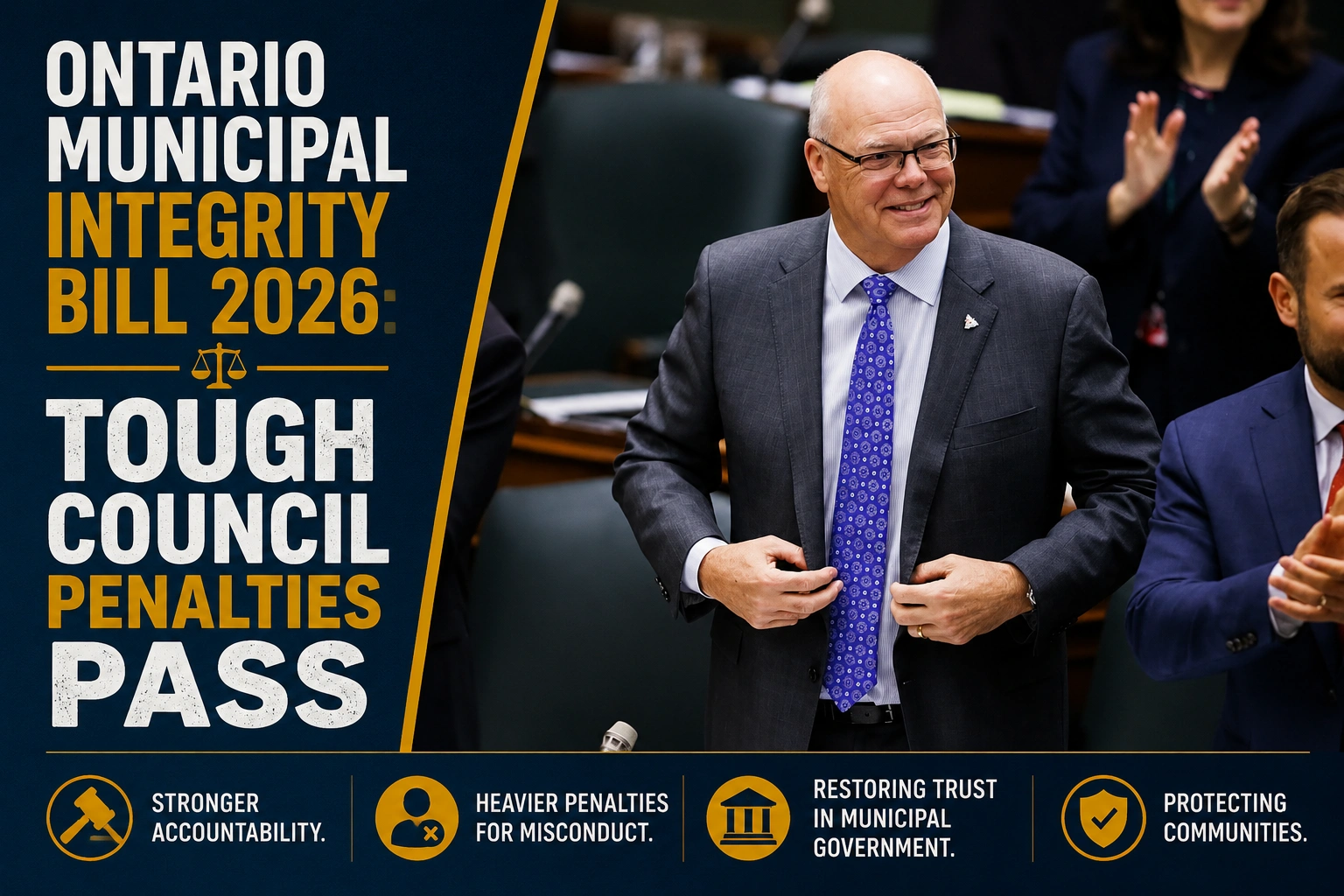
The legislative assembly at Queen’s Park has passed a sweeping municipal accountability law that fundamentally reshapes the disciplinary powers governing local politicians across Ontario’s 444 municipalities. Under the final enactment of the Ontario Municipal Integrity Bill 2026, the provincial government is dismantling the historical legal protections that shielded municipal representatives from being stripped of their seats. The new legislation directly answers years of aggressive lobbying from local councils, legal experts, and gender-equity advocates demanding ironclad mechanisms to purge politicians who engage in workplace harassment, abuse of authority, or egregious ethical violations.
Municipal Affairs and Housing Minister Rob Flack confirmed that the ministry is fast-tracking the operational framework of the statute, aiming to have the uniform regulatory parameters fully active across the province prior to the high-volume municipal elections scheduled for this October.


The Three-Tiered Removal Mechanism
Historically, Ontario’s Municipal Act strictly prevented local councils from removing a democratically elected representative from office, leaving integrity commissioners with virtually toothless enforcement tools—such as a maximum 90-day salary suspension. The Ontario Municipal Integrity Bill 2026 completely rewrites this landscape by establishing a single, uniform provincial code of conduct backed by an absolute disqualification penalty.


To protect local democratic institutions from being weaponized for partisan warfare, the process for removing a sitting councillor features a rigorous, three-tiered bureaucratic check:
-
The Local Threshold: The independent municipal integrity commissioner must lead a formal investigation and explicitly recommend that the member’s seat be vacated due to severe code breaches.
-
The Provincial Check: The Ontario Integrity Commissioner must conduct an independent review of the local investigation files and formally agree with the recommended ouster.
-
The Council Vote: The local municipal council must hold a formal vote on the floor of chambers. Excluding the accused politician, the sitting councillors must achieve absolute unanimous agreement to legally vacate the seat and disqualify the member from running in subsequent election cycles.
Advocacy Feedback and Legislative Revisions
The passage of the bill has drawn widespread reactions from across the municipal landscape. Emily McIntosh, founder of the prominent advocacy coalition Women of Ontario Say No, hailed the passage of the law as an essential first step to building safe environments for women operating in local politics, noting it establishes a concrete shield against persistent workplace harassment.
Simultaneously, opposition lawmakers—including provincial Liberal MPP Stephen Blais, who spent years championing a private member’s bill seeking identical accountability targets—warned that the current framework’s reliance on 100 percent council unanimity might prove structurally impossible to achieve in deeply fractured local chambers. Blais argues that while the law represents a monumental shift, subsequent revisions should broaden the scope of intermediate disciplinary options available to local councils to manage problematic behavior before reaching the nuclear option of a total removal vote.
Lower-tier city clerks across the Durham Region—including administration teams in Oshawa, Whitby, and Pickering—are already adjusting their post-election orientation modules to absorb the incoming provincial codes, ensuring incoming 2026-2030 council terms operate in strict alignment with the newly elevated ethical guidelines.