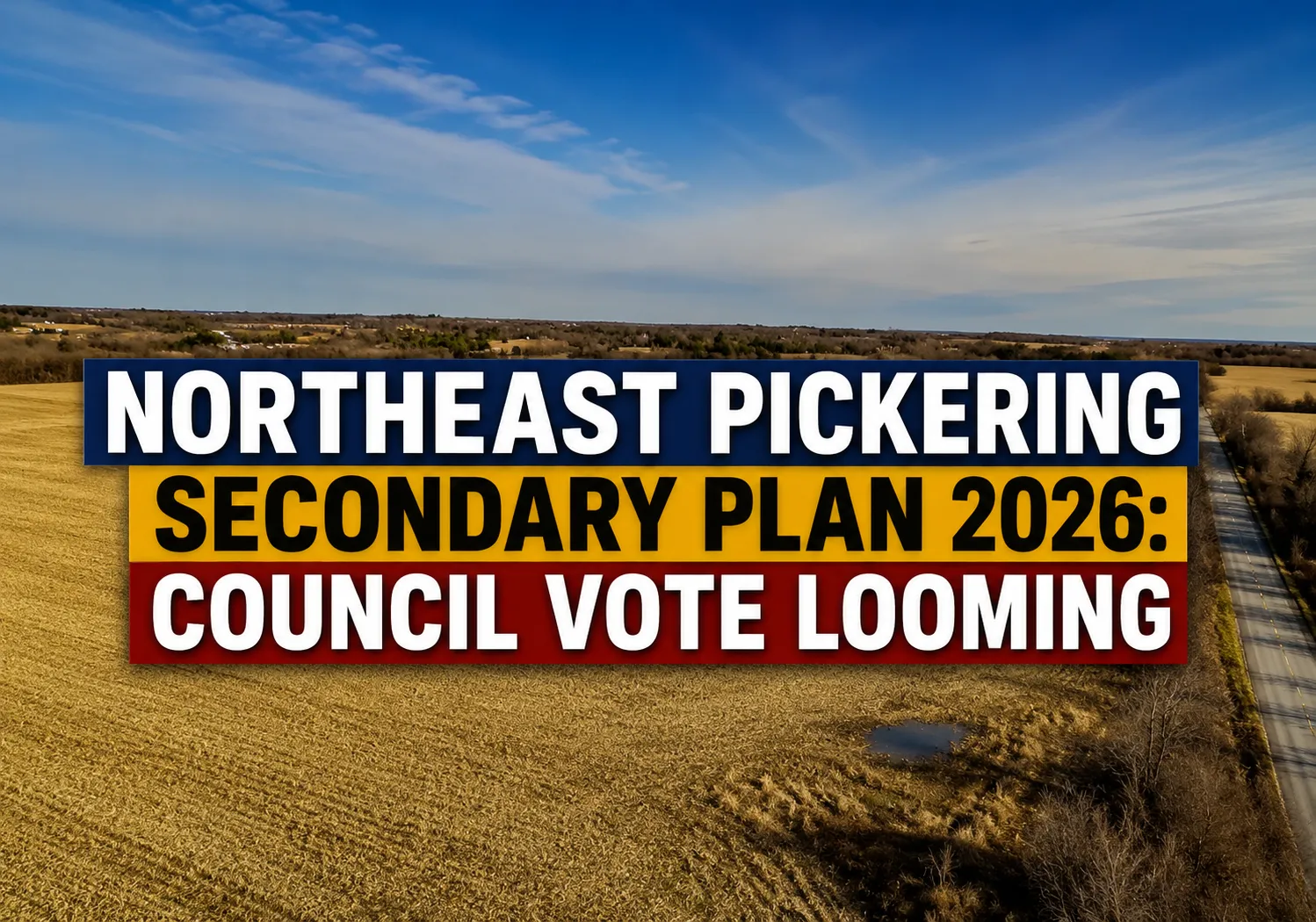
The architectural and environmental future of western Durham faces a historic turning point as Pickering City Council prepares for an explosive special meeting. At the heart of the debate is the controversial Northeast Pickering Secondary Plan 2026, a developer-backed proposal to open up 1,763 hectares of agricultural land to urbanization. While municipal staff and corporate property networks frame the expansion as a mandatory step to satisfy provincially mandated housing targets, a powerful coalition of environmental advocates, indigenous leaders, and rural residents are demanding an immediate halt to what they label catastrophic suburban sprawl.
The boundaries of the contested territory slice through prime, contiguous agricultural land, bounded roughly by the Sixth Concession to the south, the Eighth Concession to the north, Westney Road to the west, and Lakeridge Road to the east. If approved, the master development would fundamentally alter this landscape, carving out space to integrate 72,000 new residents and 9,700 jobs over the next quarter-century.


The “Buy Now, Pay Later” Infrastructure Liability
Environmental activists and fiscal watchdogs are spearheading the resistance against the Northeast Pickering Secondary Plan 2026 framework. Helen Brenner, co-chair of Stop Sprawl Durham, is slated to address council directly as a public delegate, armed with an online petition demanding an immediate pause on the initiative due to severe environmental and fiscal irresponsibility.


Echoing these concerns, community advocate Mike Borie has heavily criticized the financial architecture of the expansion, branding it a developer-led “buy now, pay later” scheme. Borie argues that low-density, car-dependent sprawl historically fails to generate enough property tax revenue to cover the long-term operational and capital costs of the roads, watermain extensions, pumping stations, and emergency services required to maintain it. Activists note that the city should prioritize filling the nearby Seaton community—where expensive municipal infrastructure networks already exist—rather than forcing existing Pickering taxpayers to subsidize far-flung “pipes and pavement” outlays to benefit corporate landowners.
Critics and city staff reports alike acknowledge that expanding hard surfaces so close to local waterways introduces severe flooding risks down-gradient, prompting demands that the entire 1,763-hectare parcel be permanently protected or annexed directly into the adjacent Rouge Urban National Park.
First Nations Consultation Deficits
Beyond fiscal and environmental concerns, the Northeast Pickering Secondary Plan 2026 has drawn sharp criticism regarding Indigenous treaty rights. Mississaugas of Scugog Island First Nation (MSIFN) Chief Kelly LaRocca has expressed ongoing dissatisfaction regarding a lack of meaningful, early-stage dialogue between municipal officials and First Nations stakeholders.
Following a direct deferral of the report two months prior, a closed-door meeting between Chief LaRocca and Mayor Kevin Ashe occurred on April 20 to address these consultation deficits. Both the MSIFN and the North East Pickering Landowners Group Inc. are awaiting further integration of a comprehensive Master Environmental Servicing Plan (MESP) and a Phase 3 Scoped Subwatershed Study to determine exact ecological parameters before any construction equipment can be authorized.
The Provincial “Speeding Train”
Despite the local outcry, Pickering Regional Councillor Maurice Brenner indicated that local politicians find their hands largely tied by Queen’s Park’s overarching legislative mandates to aggressively accelerate housing starts across Ontario. Brenner compared the provincial push for suburban land assembly to a “speeding train” that municipal councils lack the legal jurisdictional power to derail.
While municipal staff confirm that actual build-out and final shovel implementation will take decades—stretching up to a 2051 completion target—opponents are refusing to yield. Borie has vowed that the community coalition will exhaust all legal, political, and regulatory pathways to protect the farmland, promising to turn the upcoming municipal election into a referendum on the infrastructure liabilities associated with the vote.