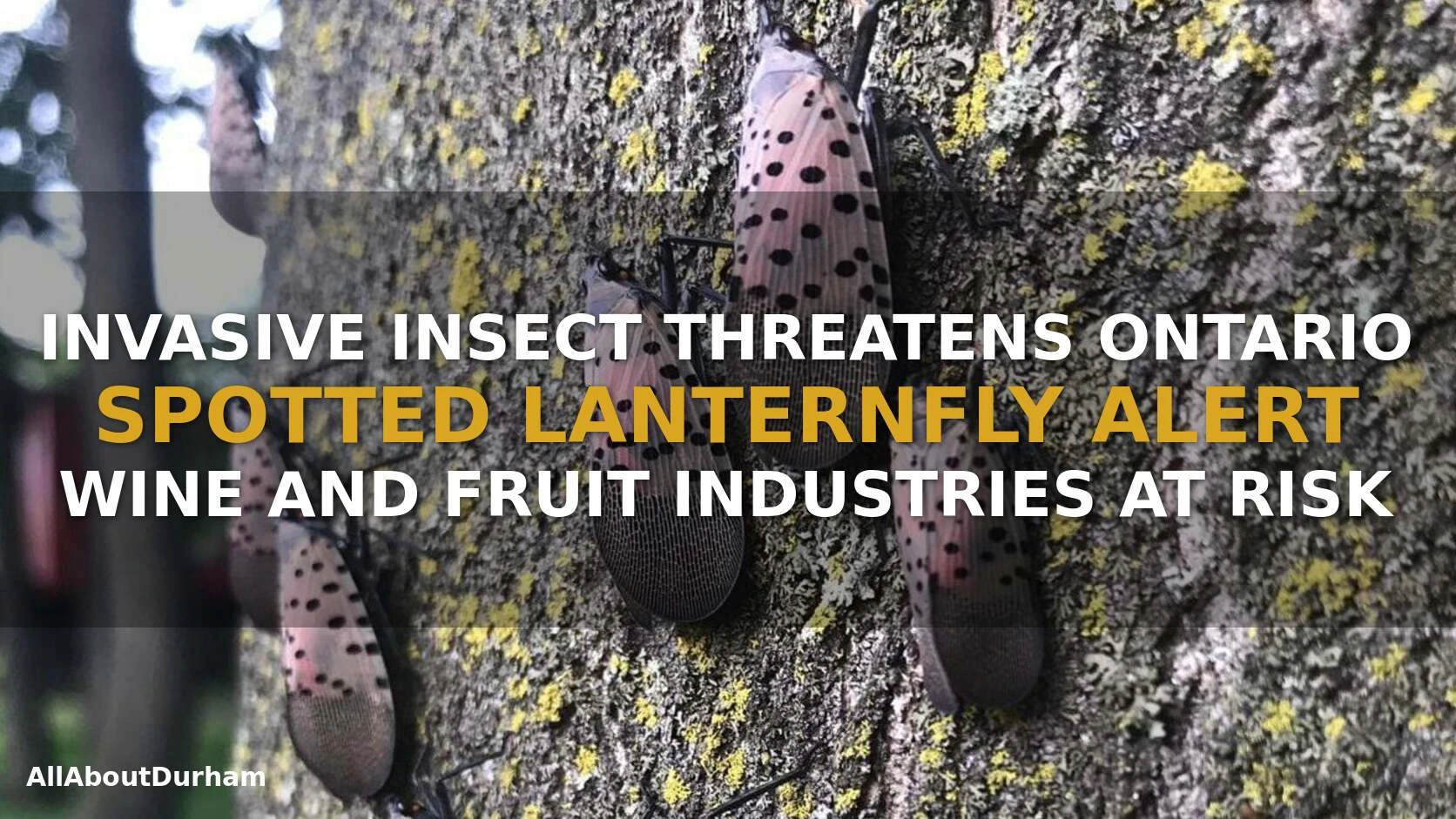
An invasive insect that poses a serious threat to Ontario’s agricultural industry has been repeatedly spotted across southern Ontario over the past six months, raising significant alarm among farmers, vintners, and environmental officials throughout the province, including right here in Durham Region where agricultural lands and local food producers could be directly and significantly impacted by this rapidly spreading environmental and agricultural threat.
The invasive spotted lanternfly Ontario sightings have been officially confirmed by the Canadian Food Inspection Agency, which warns that the pest can attack more than one hundred different species of trees and plants, including cultivated grapevines that are absolutely vital to the province’s growing and economically important wine industry. The spotted lanternfly is a planthopper insect native to Southeastern Asia that develops into a winged adult insect by July each year, making early detection and rapid reporting critically important for effective containment and management efforts across the entire southern Ontario region.


The insect has already established significant and damaging populations in the Northeastern United States, where it has caused extensive and well-documented damage to vineyards, fruit orchards, and ornamental trees in multiple American states. Its confirmed arrival in southern Ontario represents a major and growing concern for the provincial agricultural sector, which contributes billions of dollars annually to the Canadian economy and supports thousands of essential jobs across communities in Durham Region and the broader Greater Toronto Area.


According to agricultural experts currently studying the threat in detail, the invasive spotted lanternfly Ontario problem is particularly concerning because the insect feeds by piercing plant tissues and sucking out nutrient-rich sap, which progressively weakens the host plant over time and can lead to severely reduced crop yields, overall plant health decline, and even complete plant death in cases of severe and prolonged infestations that go undetected and untreated for extended periods.
Durham Region’s diverse and thriving agricultural community, which includes numerous fruit orchards, commercial vineyards, plant nurseries, and local market gardens spread across the rural communities of Clarington, Scugog, Uxbridge, and Brock, could be directly vulnerable to the pest if it continues to spread northward from current confirmed sighting locations throughout southern Ontario.
The Canadian Food Inspection Agency is asking all Ontario residents who spot the distinctive insect to report sightings immediately through their official online reporting channels and hotline. Early identification and rapid coordinated response are widely considered the most effective strategies currently available for preventing the establishment of permanent breeding populations in new areas across the province before they become impossible to eradicate.
Residents should carefully look for grey-brown winged insects with distinctive black spots and bright red underwings, as well as egg masses that appear as greyish putty-like patches on tree bark, outdoor furniture, recreational vehicles, stone surfaces, and other flat outdoor surfaces where the insects tend to lay their eggs.
The provincial government is actively working with federal agricultural agencies and municipal partners including Durham Region to develop a comprehensive coordinated response plan to address the invasive spotted lanternfly Ontario threat before it can cause widespread lasting economic damage to the agricultural sector across southern Ontario.