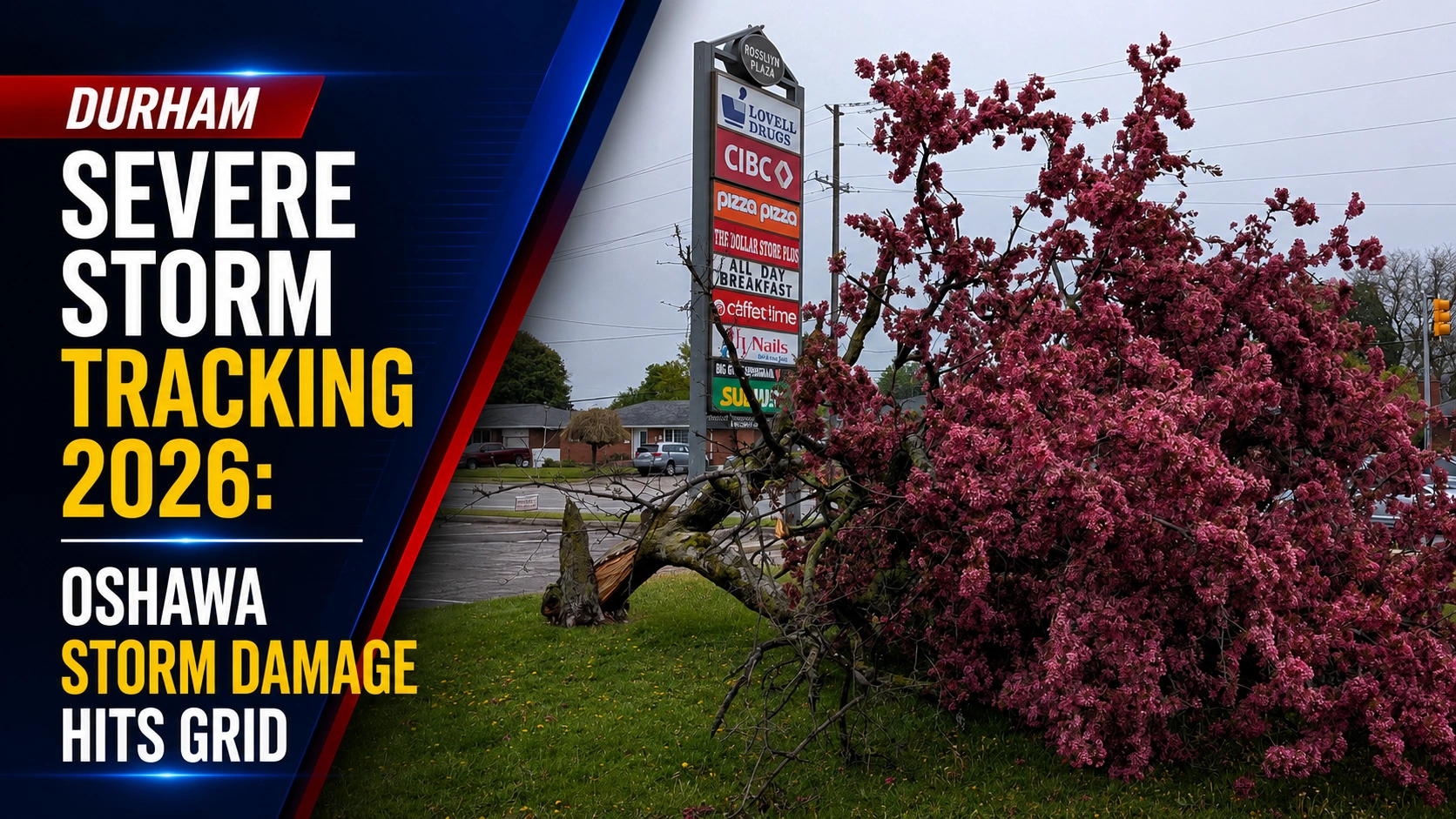
A destructive cell of fast-moving thunderstorms carrying extreme straight-line wind gusts has carved a path of property damage and localized utility disruptions across western Durham. Under the current provincial meteorological review titled Durham Severe Storm Tracking 2026, environmental emergency services confirm that while the absolute worst of the season’s volatile atmospheric front was localized further west, Durham municipal crews faced an intense overnight scramble to clear blocked transportation arteries and restore severed lifelines.
The extreme weather system has rapidly accelerated Canada’s total seasonal tornado count to 11 for the current calendar year, serving as a stark reminder of the volatile atmospheric instability pushing through the Great Lakes basin this spring.


Localized Infrastructure Damage and Blackouts
While southwestern Ontario bore the brunt of true tornadic rotations, the straight-line winds racing ahead of the squall line generated substantial wreckage closer to home. In Oshawa, emergency dispatchers fielded dozens of priority calls as mature tree canopies buckled under the atmospheric pressure.


A primary impact zone was documented at the busy intersection of Stevenson Road and Rossland Road in Oshawa, where a massive tree snapped at the base, crashing directly across the driving lanes. The falling timber compromised adjacent overhead utility lines, instantly blacking out traffic signals and stripping electricity from tens of thousands of homes and commercial plazas across the city’s western boundaries at the height of the storm. Specialized hydro crews worked through the night alongside clearing teams to isolate the damaged transformers, safely remove the heavy debris from the right-of-way, and gradually step power back up to the affected grid sectors.
The Southwestern Tornado Context
The severe weather that caused localized chaos in Durham was part of the same frontal system that produced confirmed tornado touch-downs near London, Ontario. Structural surveys executed by the Northern Tornadoes Project isolated two distinct twister profiles:
-
The Christina Rotation: An EF-0 tornado made a brief touchdown near the small rural community of Christina, situated southwest of London, generating minimal structural damage.
-
The Lambeth-to-Mossley Track: A much more aggressive EF-1 tornado spun up an intense damage path slicing directly through the southern portions of London. The path of destruction brought down substantial woodlots, shredded residential roof lines, and caused heavy structural tearing across agricultural outbuildings before lifting.
Statistically, an average weather year in Canada yields approximately 65 confirmed tornadoes, with a little over 25 percent traditionally touching down within Ontario’s borders. With 11 twisters already cataloged early in the season, emergency management groups across the Durham Region are urging property owners to secure loose outdoor materials and review household severe-weather safety plans as the province enters its peak convective storm cycle.