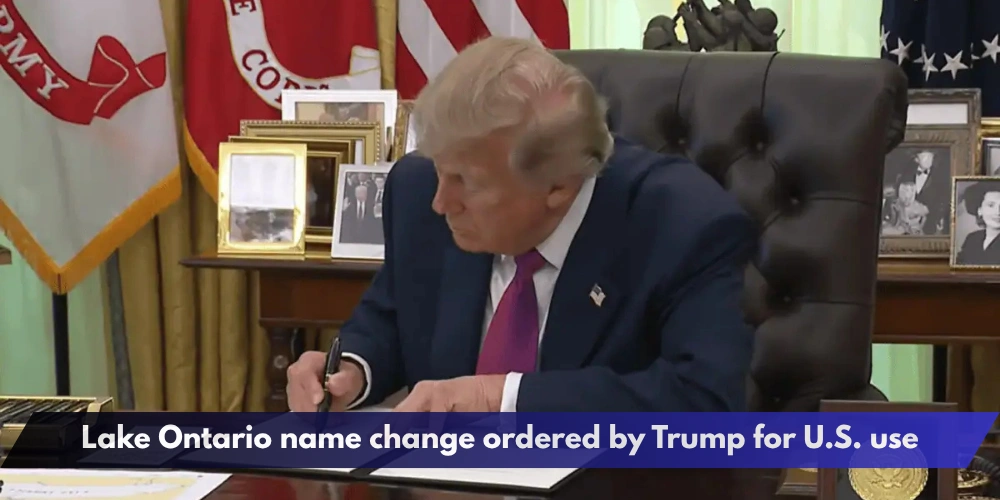
U.S. President Donald Trump has signed an executive order directing the American federal government to refer to Lake Ontario as “Lake America,” turning an earlier threat made during escalating Canada-U.S. trade tensions into formal U.S. policy.
The Lake Ontario name change, however, applies to U.S. federal use and does not change Canada’s official name for the Great Lake, which continues to be recognized as Lake Ontario.


Trump signed Executive Order 14420 on Aug. 27, just days after publicly suggesting the name change amid deteriorating relations with Canada.


What Trump’s executive order does
The executive order directs U.S. Interior Secretary Doug Burgum, working with the U.S. Board on Geographic Names, to take the steps required to change Lake Ontario to “Lake America” in American federal geographic records.
Those changes are to be completed within 30 days.
The order also calls for the Geographic Names Information System to remove references to Lake Ontario and directs U.S. federal departments and agencies to use Lake America on maps, contracts, documents and other official communications.
Trump said during the signing that the change was effective immediately, although the order provides the Interior Department with 30 days to carry out the required geographic-record updates.
Canada still recognizes Lake Ontario
The Lake Ontario name change does not require Canada to adopt the American government’s new terminology.
Canada’s official Canadian Geographical Names Database continues to list Lake Ontario, and its French equivalent Lac Ontario, as the official names of the shared Great Lake.
Trump also cannot require international organizations, Canadian governments, private businesses or mapping companies to adopt the U.S. federal designation.
That distinction is particularly important for Durham Region, where Lake Ontario forms the shoreline of Pickering, Ajax, Whitby, Oshawa and Clarington.
Residents should therefore expect Canadian governments and agencies to continue referring to the body of water as Lake Ontario unless Canadian naming authorities make a separate decision.
Name dispute comes amid tariff tensions
Trump first raised the idea of “Lake America” as relations between Washington and Ottawa deteriorated following the collapse of trade negotiations.
His administration has imposed new tariffs on Canadian products, while Canada has announced retaliatory tariffs scheduled to take effect in September.
The lake-name dispute has become another symbolic element of the wider political and economic confrontation.
Trump said at Thursday’s signing that Canada had treated the United States unfairly on trade. Canadian political leaders had already dismissed his earlier proposed name change, with Ontario Premier Doug Ford saying Canadians would continue calling it Lake Ontario.
Similar to Gulf of America order
Trump’s action follows his 2025 decision directing the U.S. federal government to use “Gulf of America” instead of Gulf of Mexico.
That change also applied primarily to U.S. federal naming systems, although some private mapping companies adopted the terminology for American users.
The new Lake Ontario order similarly directs American federal geographic authorities to implement the change without giving the U.S. power to determine how Canada identifies the shared body of water.
For Durham residents, the practical result is therefore limited: Canadian maps, governments and official geographic databases still recognize the lake bordering the region as Lake Ontario.
The Lake Ontario name change nevertheless marks a significant escalation from Trump’s earlier suggestion, transforming it from political rhetoric into an official naming requirement across the U.S. federal government.