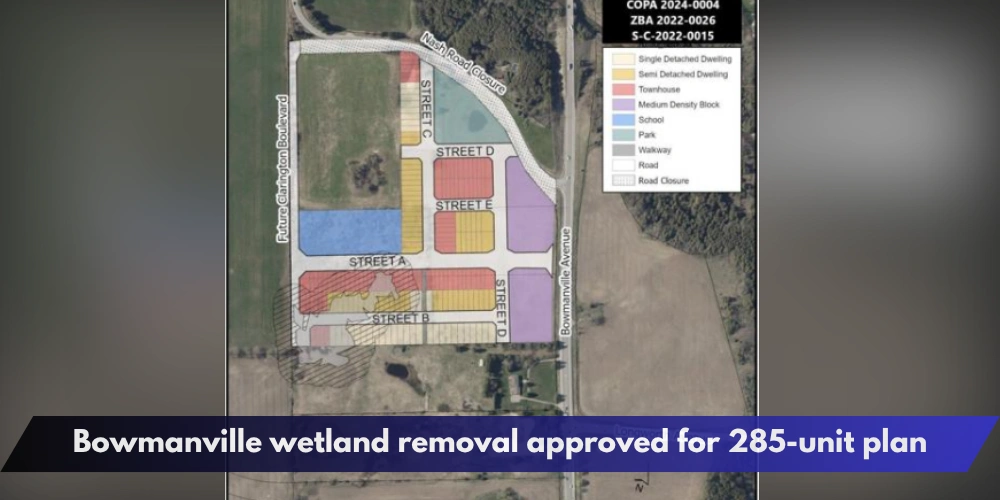
Clarington council has approved a site-specific planning change that will allow a wetland to be removed as part of a proposed 285-unit residential development near Bowmanville Avenue and Nash Road.
The Bowmanville wetland removal applies to lands at 2499 Nash Road and 2538 and 2494 Bowmanville Avenue. The project is being advanced by Tribute Tercot Brookhill 2 Inc. and includes a mix of single-detached homes, semi-detached homes and townhouses.

Municipal planning documents identify the wetland as approximately 0.67 hectares. The Official Plan amendment creates a site-specific exception allowing the feature to be removed, subject to environmental studies and an ecological compensation plan.


Developer says wetland is isolated
At the Aug. 19 special council meeting, a representative for the developer argued that the wetland is isolated from creeks, rivers and other waterbodies and has limited ecological function.
Municipal documents show that Clarington retained Aquafor Beech Ltd. to peer-review the environmental work because the development proposes removing identified environmental features. The review confirmed that the southwest feature meets the municipality’s definition of a wetland.
According to the council report summarized at the meeting, the retained technical expert found the wetland has limited ecological features and functions compared with provincially significant wetlands and no demonstrated hydrologic connection.
That assessment was central to the recommendation that compensation could be considered in this site-specific case rather than requiring the feature to remain in place.
Restoration proposed elsewhere in Bowmanville Creek watershed
The Bowmanville wetland removal will be paired with ecological compensation elsewhere in the Bowmanville Creek watershed.
The developer proposed restoring wetland habitat at a three-to-one ratio compared with the area being removed. The intent is to create a net ecological benefit in another part of the watershed rather than retaining the isolated feature within the future neighbourhood.
Clarington’s proposed policy requires any compensation plan to be reviewed to ensure it is at least proportional to lost ecosystem function, strengthens the wider Bowmanville Creek subwatershed and is satisfactory to both the municipality and the conservation authority.
The Central Lake Ontario Conservation Authority supported the compensation approach, according to the council report, as did Clarington’s retained technical consultant.
Resident raises concerns about wetland loss
Not everyone supported the decision.
Resident Libby Racansky opposed the proposal in correspondence to council, arguing that wetlands remain important ecological features, particularly as communities deal with climate change and more extreme weather.
Her comments questioned whether restoring habitat somewhere else can fully replace the environmental role of a wetland at the development site.
The debate highlights a broader planning challenge in fast-growing communities: balancing new housing with protection of natural features.
Development would add 285 homes
The proposed neighbourhood covers about 11.15 hectares, or 27.5 acres.
Clarington’s project information lists 37 single-detached homes, 60 semi-detached homes, 88 street townhouses and 100 townhouse units in two medium-density blocks. A park and part of a school block are also included in the plan.
The site is within the Bowmanville urban area and the Brookhill Neighbourhood Secondary Plan.
Council’s decision on the Bowmanville wetland removal clears an important planning hurdle, but the broader development continues through the municipal planning and subdivision approval process.
The compensation and restoration work will also require further technical review and implementation as the project advances.