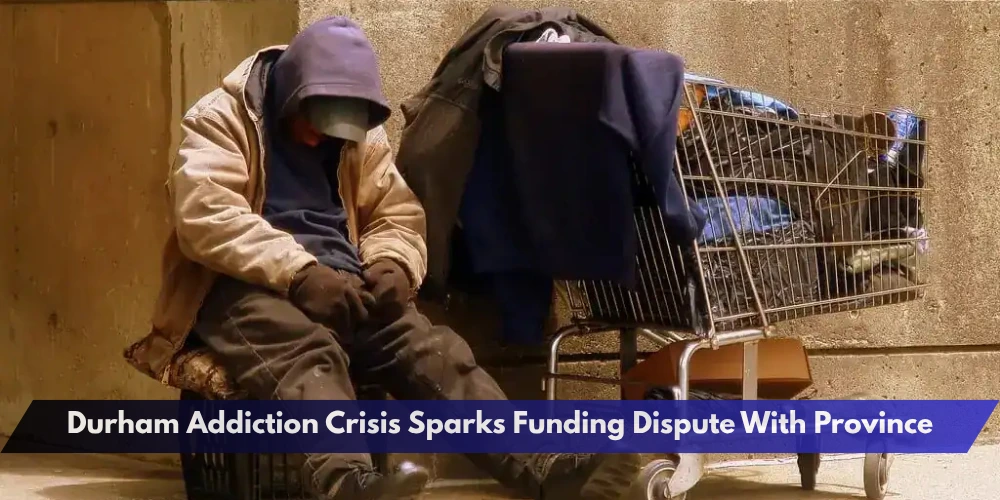
The Durham Addiction Crisis is at the centre of a growing dispute between local municipal leaders and the Ontario government over who should shoulder more responsibility for homelessness, mental health and addiction services.
Whitby Mayor Elizabeth Roy has joined Ontario’s Big City Mayors in calling for stronger provincial action, including additional funding and an emergency declaration recognizing the severity of the homelessness, mental health and addictions crisis.


The province, however, says municipalities already have access to billions of dollars in housing and homelessness funding and should use those resources to expand services and supportive housing.


The debate has particular significance in Durham Region, where the article cites at least 1,871 people experiencing homelessness, including 338 people in Whitby.
Whitby Mayor Calls for More Provincial Support
Roy said municipalities cannot continue absorbing the financial pressure created by homelessness and addiction services.
She argued that local governments have already invested heavily in shelters, outreach programs, supportive housing, community safety initiatives and partnerships with frontline organizations.
However, she said housing and health care are not traditionally municipal responsibilities.
Roy warned that municipal property taxpayers cannot continue carrying increasing costs associated with a crisis that affects communities across Ontario.
She said the current approach is not sustainable and called for long-term provincial investment and stronger leadership.
Ontario Says Record Funding Is Already Available
The provincial government responded by saying it has made significant investments in mental health, addictions, housing and homelessness programs.
Lily Barnes, press secretary and senior communications adviser for Ontario Health Minister Sylvia Jones, said municipalities also have an important role to play in responding to homelessness.
According to Barnes, Ontario has provided municipalities with approximately $14 billion over three years to support housing construction, supportive housing and homelessness programs.
The province argues that municipalities should use those resources to expand mental health and addiction services and improve community safety.
Oshawa and Whitby HART Hubs Highlighted
A major part of Ontario’s response involves its Homelessness and Addictions Recovery Treatment program.
The province says it has invested $560 million to establish 29 HART Hubs across Ontario.
The article specifically notes that one is located in Oshawa, while another is planned for Whitby.
These hubs are intended to connect people experiencing addiction and mental health challenges with treatment, recovery services, primary care, housing support and other services.
Ontario also cited funding for 500 new addiction recovery beds and more than 1,200 supportive housing units across the province.
Durham Homelessness Numbers Raise Concern
The Durham Addiction Crisis is closely tied to the region’s growing homelessness problem.
Roy said current data shows at least 1,871 people experiencing homelessness across Durham Region.
Whitby alone accounts for 338 of those individuals.
Those figures have become part of the argument for stronger provincial intervention.
Local leaders say shelters and other community services are under growing pressure as more people require emergency housing, treatment and mental health support.
Big City Mayors Push Five Major Demands
Ontario’s Big City Mayors have launched the next phase of their Solve the Crisis: Reaction to Recovery campaign.
Their demands include expanded access to recovery and treatment, a dedicated Ministry of Mental Health and Addictions, reviews of provincial health legislation and more addiction treatment inside correctional institutions.
The group is also asking Ontario to declare an emergency recognizing the homelessness, mental health and addictions crisis.
The mayors represent more than 70 per cent of Ontario’s population.
Oshawa Mayor Has Raised Similar Concerns
Whitby is not the only Durham municipality calling for more help.
Oshawa Mayor Dan Carter has previously described homelessness and addiction as one of the most serious health crises facing the community.
Carter has argued that the number of people experiencing homelessness and toxic drug use is placing significant pressure on municipal services.
He has also called on the province to develop a different approach focused on treatment and saving lives.
The issue is particularly important in Oshawa because the city has experienced visible encampments and growing demand for shelter and outreach programs.
Province Says Municipalities Must Use Existing Tools
Ontario maintains that its current investments provide municipalities with the tools needed to respond.
Barnes said the government expects municipalities to use available funding to build supportive housing, expand treatment services and improve homelessness supports.
The province also says it will continue investing in treatment and recovery programs.
The disagreement is therefore less about whether more services are needed and more about who should provide them and how they should be funded.
Durham Debate Likely to Continue
The Durham Addiction Crisis is unlikely to be resolved quickly.
Municipal leaders argue they need additional provincial financial support because housing, health care and addiction treatment extend beyond traditional municipal responsibilities.
Ontario, meanwhile, says it has already committed substantial funding and expects local governments to make full use of those programs.
With homelessness numbers continuing to concern local leaders and new HART Hubs being developed in Oshawa and Whitby, the debate over funding, responsibility and treatment models is likely to remain a major issue across Durham Region.