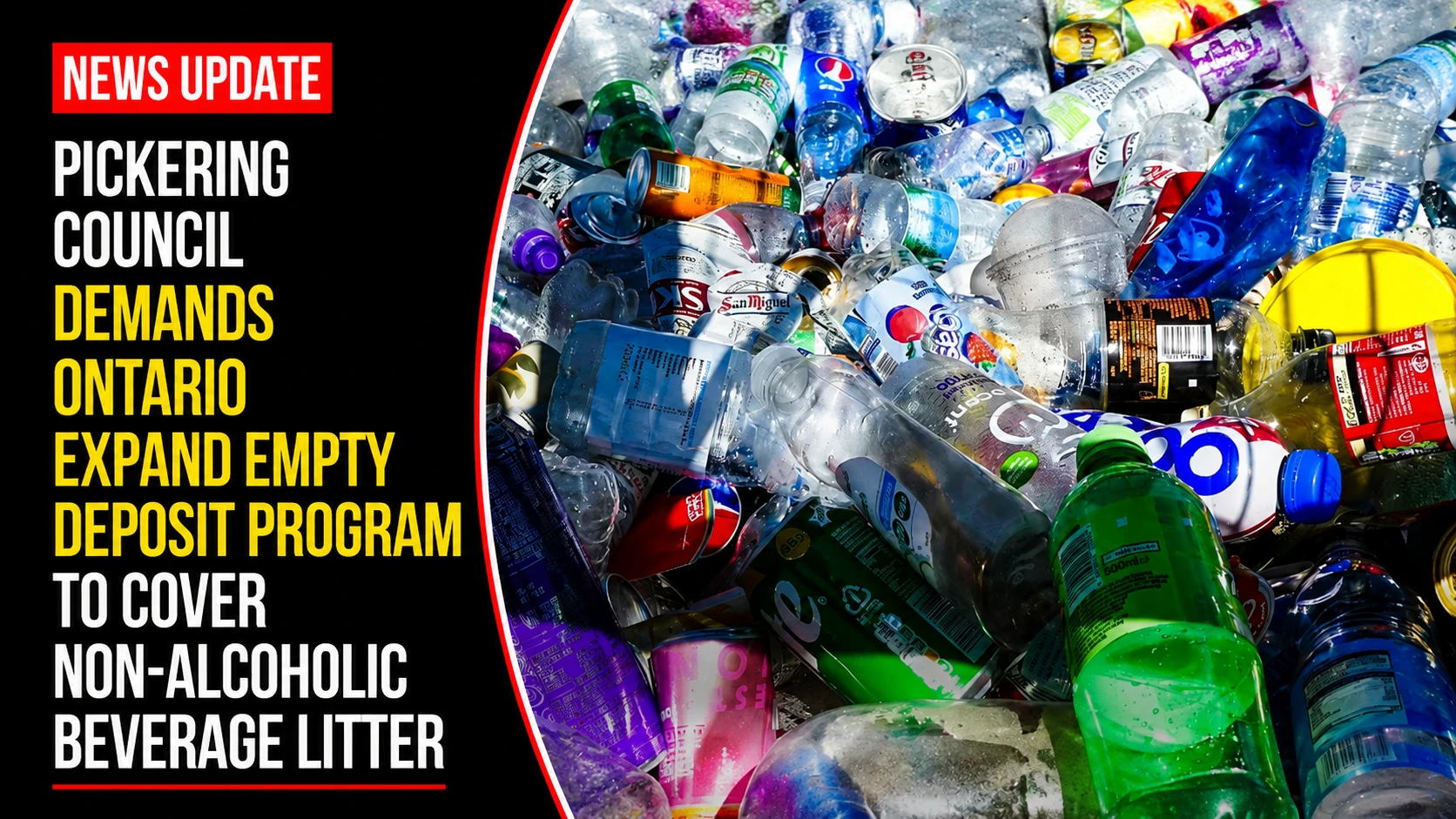
The waste management directorates, environmental advisory committees, and municipal finance desks within the Durham Region are pushing for a major overhaul of provincial recycling frameworks. Tracked under regional environmental and local government portfolios on Wednesday, July 8, 2026, municipal legislative clerks finalized the policy resolution Call to implement deposit-return on all beverage containers. Voting definitively during their late-June operational sitting, Pickering City Council carried a formal motion demanding that the province immediately scale up Ontario’s legacy Deposit Return Program to encompass juice, pop, and bottled water containers.
The municipal push is designed to shift millions of dollars in sorting, processing, and public park litter cleanup costs directly off local property taxpayers and back onto global beverage manufacturers.

The Legislative Trigger and Financial Arguments
The policy push stems from direct consultations with industry stakeholders tracking severe efficiency shortfalls in Ontario’s current recycling infrastructure.


-
The Advocacy Catalyst: The council motion was formally triggered by policy briefs submitted by Richard Linley, Vice-President of the Canadian Beverage Association. Linley urged local governments to back an expansion of the Ontario Deposit Return Program (ODRP) to capture non-alcoholic containers.
-
The Blue Box Limitation: While Ontario has recently transitioned to a new producer-responsibility Blue Box model, the structural framework is failing to capture mobile waste. The current system successfully collects only about 50 percent of beverage containers, meaning billions of plastic bottles are systematically diverted into regional landfills, neighborhood parks, or local Lake Ontario waterways.
-
The Target recipient: City clerks have formally routed the certified copy of the motion to Durham MPP Todd McCarthy, attempting to leverage his provincial cabinet influence to force a legislative amendment at Queen’s Park.
Analyzing the Deposit Return System (DRS) Efficiency Projections
Municipal policy analysts have mapped out how a comprehensive deposit system outpaces standard curbside sorting across parallel provincial jurisdictions.
| Environmental System Metric | Legacy Blue Box Curbside Setup | Projected Expanded DRS Model | Proven Inter-Provincial Baselines |
| Material Recovery Benchmark | Stagnates at a low ~50% extraction rate | Targets a 75%+ recovery ceiling | Consistently achieved in British Columbia, Alberta, and Nova Scotia. |
| Municipal Cost Footprint | High processing overhead; absorption of public park litter costs | Drastically reduces sorting strain and city litter management expenditures | Shifts structural collection costs directly onto the producers. |
| Civic Public Space Status | High presence of single-use plastics in green spaces and waterways | Visually cleaner public parks, shorelines, and urban walkways | Creates a secondary financial incentive for community bottle drives. |
The Consumer Recycling Incentive Deficit
Local infrastructure supervisors emphasize that Ontario remains one of the final Canadian provinces operating without a comprehensive, universal Deposit Return System for all beverage classes. While the province’s alcohol sector boasts a highly disciplined 75 percent annual return rate through the legacy Beer Store deposit network, the absolute lack of a financial bounty on standard plastic water bottles and aluminum pop cans removes the immediate consumer incentive to recycle responsibly while traveling along public streets and transit corridors.
The City of Pickering Clerk’s Office and the Ministry of the Environment, Conservation and Parks handle ongoing municipal resolutions and provincial waste management policy filings.
Pickering residents, local conservation groups, and municipal property taxpayers looking to review active council voting sheets, read the full Canadian Beverage Association brief, or track local zero-waste initiatives can access the data networks online via the official Pickering civic tracking portal or monitor regional waste management updates through the Durham Region public dashboard.