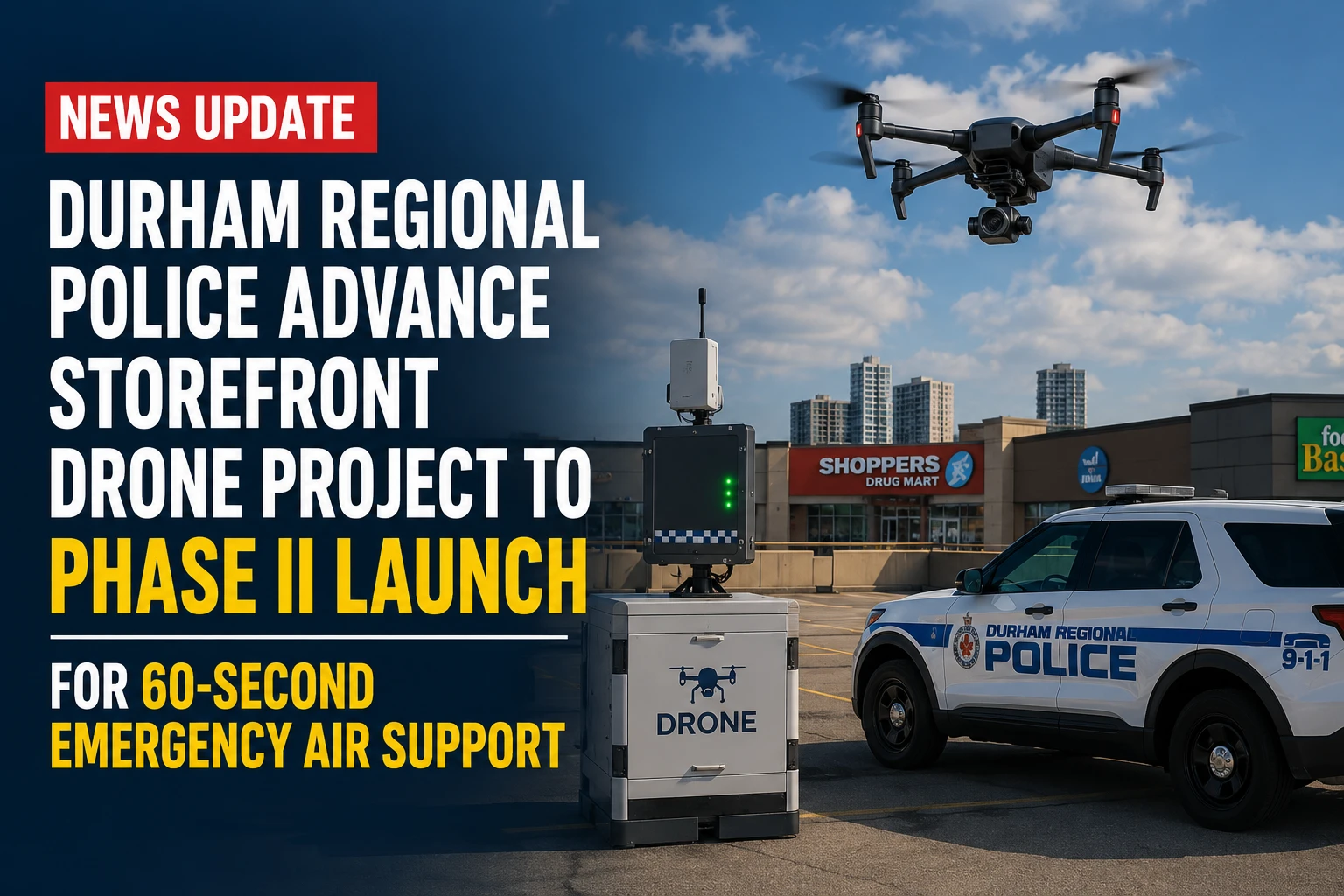
The tactical dispatch operations, public safety tech arrays, and municipal policing networks inside the Durham Region are rolling out an advanced aerial response program. Tracked under provincial law enforcement registries on Friday, June 26, 2026, command staff from the Durham Regional Police Service (DRPS) finalized the deployment blueprints for the Crime fighting drone pilot project in Durham Region moves into Phase II. Following months of quiet systemic field trials, the “Drone as First Responder” (DFR) tactical model officially goes live across the county this weekend. The update puts automated, remote-piloted aircraft over active emergency scenes to feed live tactical intel to ground units long before initial cruisers arrive.
The multi-station network positions Durham as one of the first major police forces in Canada to integrate automated drone docks directly into standard high-threat emergency responses.
The Real-Time Operations Integration and Privacy Buffers
The expanded emergency grid shifts drone operations from localized, manual field setups to automated, centralized digital tracking networks.
-
The 60-Second Target Window: The remote-piloted aircraft are engineered to automatically clear their docking housings and fly straight to active crisis points within 60 seconds of a 9-1-1 call intake, establishing immediate overhead visual grids.
-
The Command Hub Operations: Missions are managed by certified DFR Remote Pilots-in-Charge sitting inside the centralized Real Time Operations Centre (RTOC), passing live video streams directly to incoming patrol cruisers.
-
The Strict Privacy Firewalls: Chief of Police Peter Moreira explicitly confirmed that the technology will not be used for general public surveillance and completely lacks facial recognition software. The automated cameras operate under strict federal Transport Canada rules and provincial privacy audits, functioning without audio capture capabilities.
-
The Targeted Criteria Matrix: Drones will strictly deploy to serious emergency calls. The mandatory criteria restrict launches to Priority 1 calls (imminent physical harm), Priority 2 calls (urgent safety risks), active crimes in progress where suspects are escaping, or situations cleared by a Regional Duty Inspector.
Analyzing the 2026 DRPS Drone First Responder Deployment Grid
The summer testing phase relies on automated docking pads placed throughout regional hot spots to evaluate response times and hardware limits in hot weather.
| Deployed Drone Fleet Class | Tactical Response Activation Rules | Integrated Command Node | Core Technical Data Constraints |
| IP-Rated Tactical DFR | Priority 1 & 2 Call Dispatch Tiers | Real Time Operations Centre (RTOC) | Zero audio recording / No facial scans |
| Dock Station Networks | Data-driven crime map positioning | Roving Ground Patrol Cruisers | Multi-direction video telemetry feeds |
| Airspace Safety Array | Transport Canada Flight Waivers | Regional Duty Inspector Oversight | Targeted 60-second scene arrival |
The network locations for the Phase II automated drone docks were chosen using historical call data, ensuring the aircraft sit close to areas with higher crime rates while staying clear of restricted airport flight paths. DRPS will audit the entire program at the end of the summer, using response statistics and safety data to help the police board decide whether to turn the program into a permanent, region-wide tactical unit.
Durham families, technology analysts, and community members looking to read the complete Privacy Impact Assessment, ask questions about flight paths, or view the official program framework can explore the public portal online at drps.ca/DFR.