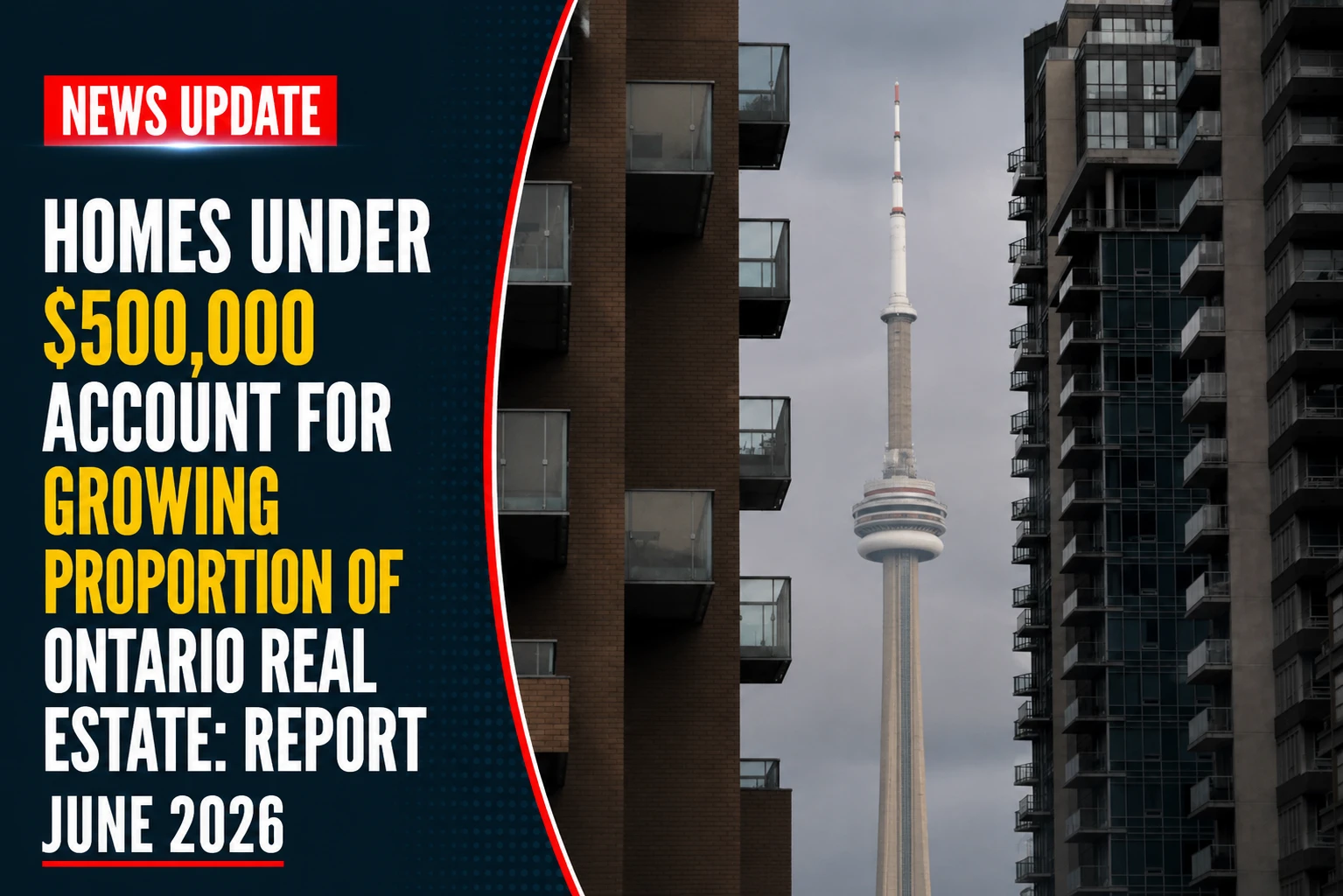
The baseline structural tracking models and residential valuation matrices across the Greater Toronto Area have revealed a notable market shift. Tracked under provincial property registries on Wednesday, June 24, 2026, analysts finalized the municipal data logs for Homes under $500,000 account for growing proportion of Ontario real estate: report. Released publicly by the Municipal Property Assessment Corporation (MPAC), the province-wide real estate inventory audit confirms that entry-level home values are taking up an expanding share of the aggregate market footprint, providing critical pricing corrections from the high-inflation peaks recorded four years ago.
The unexpected inventory pivot is primarily driven by an aggressive structural realignment within high-density urban residential sectors.
The Urban Condo Corrections and Property Class Segmentations
The expansion of lower-tier property pools relies heavily on regional multi-residential condominium developments adjusting from historically over-leveraged baselines.
-
The Aggregated Surge: MPAC’s chief assessor Greg Martino confirmed that properties valued under $500,000 now account for nearly 24 per cent of the entire provincial housing inventory landscape, climbing significantly from the low threshold of 17 per cent logged during the 2022 market peak.
-
The Condo Entry-Point Double: Condominiums are the clear leaders of this pricing adjustment. Province-wide, 46 per cent of all active condo units are now valued under the $500,000 threshold in 2026, nearly doubling the tight 24 per cent share documented in 2022.
-
The Low-Rise Access Deficit: In sharp contrast to the condo sector, ground-level multi-unit properties remain exceptionally rare in the lower price brackets. Only 5 per cent of provincial townhouses fall below the half-million-dollar mark today—a steep decline from the 69 per cent recorded a decade ago. Similarly, semi-detached properties sit at 15 per cent, down from 52 per cent in 2016.
Analyzing the Decadal Real Estate Valuation Transition Matrix
While current corrections offer renewed entry opportunities for first-time buyers, historical baselines show the overall market remains significantly altered compared to the previous decade.
| Evaluated Property Asset Tier | 2016 Structural Market Share | 2022 Peak Market Share | 2026 Active Rebalancing Share |
| Homes Under $500,000 | 67% Dominant Baseline | 17% Historical Low | 24% Expanding Real Estate Share |
| Intermediate ($500K – $750K) | 19% Mid-Tier Pool | 27% Standard Track | 31% Stabilized Segment |
| Premium Assets (Over $1M) | Less than 5% Segment | 35% Peak Footprint | 25% Corrected Footprint |
The regional breakdown reveals that the shift into lower price tiers is expanding outward from the core GTHA. While Toronto and its immediate sub-markets maintain elevated averages, peripheral commuter communities like Brock within north Durham, alongside outer-ring regions like Hamilton and Kawartha Lakes, have seen their median property indices slide back below the $750,000 line, expanding options for prospective buyers previously priced out of the market.
However, MPAC analysts emphasize that the trend is far from uniform across the province. In several northern and eastern Ontario communities, structural supply shortages continue to drive entry-level options down, with cities like Greater Sudbury seeing their proportion of homes under $250,000 drop from 50 per cent to just 2 per cent over the same ten-year period.
Ontario property owners, real estate analytics teams, and local home buyers looking to navigate active property insights maps, review localized roll return highlights, or track regional median home values can explore the centralized real estate data dashboards online at mpac.ca.