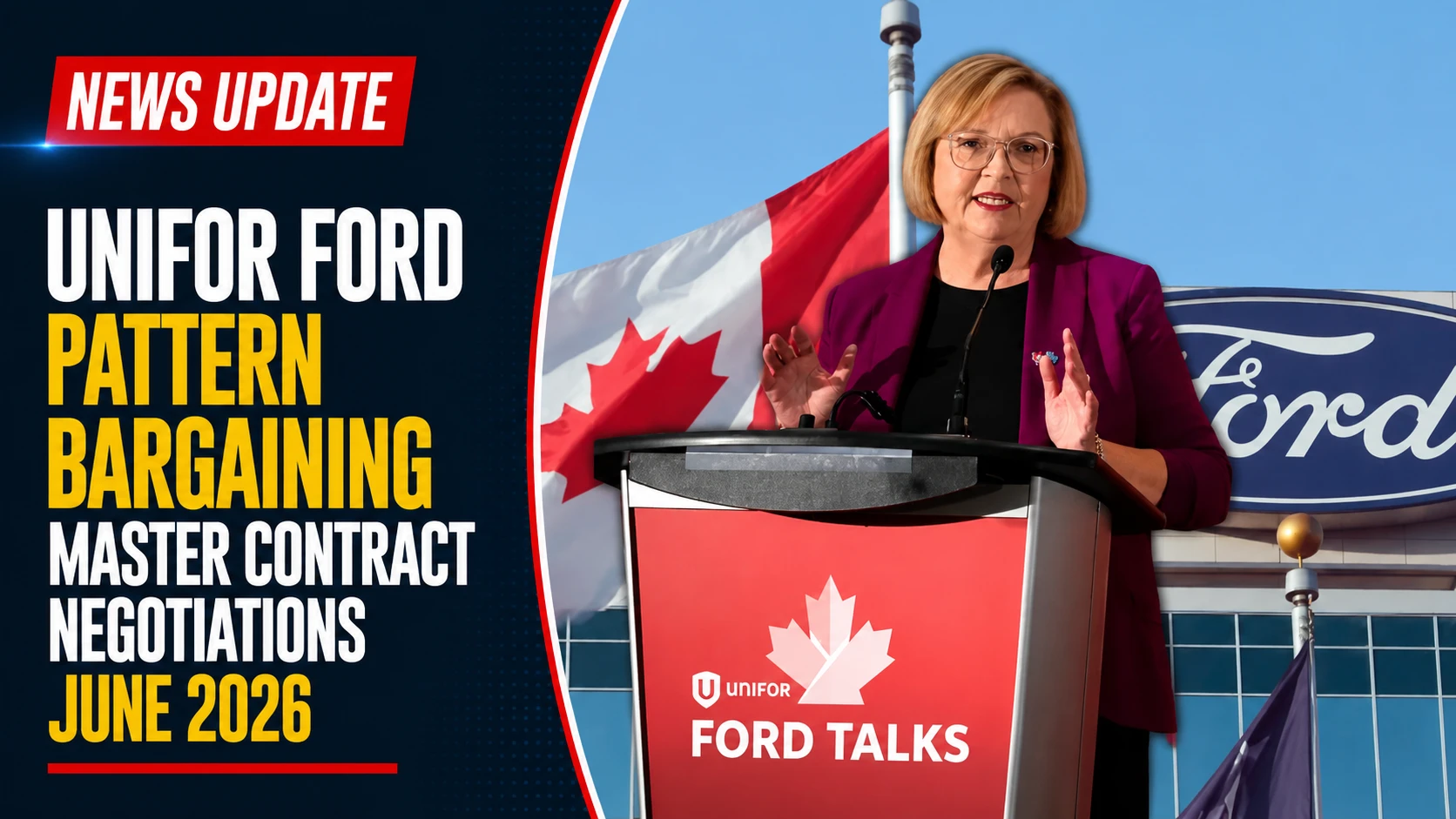
The long-term economic stability and labor frameworks governing the Canadian automotive manufacturing industry have entered a critical phase of high-stakes master arbitration. Tracked under regional industrial economic portfolios on Monday, June 22, 2026, administrative executives and labor organizers formally opened The Unifor Ford Pattern Bargaining Master Contract Negotiations June 2026. Convening at the Sheraton Centre in downtown Toronto, representatives from Unifor—Canada’s largest private-sector labor union—commenced direct collective bargaining parameters with Ford Motor Company of Canada, establishing a definitive strike-risk deadline for July 10, 2026, to solidify a foundational economic pattern before initiating parallel contract renewals with General Motors and Stellantis.
The high-priority contract negotiations occur at a volatile moment for domestic vehicle assembly networks, as workers face severe ongoing trade wars, aggressive cross-border investment restrictions, and deep protectionist tariff regimes.

The Pattern-Setting Strategy and Master Labor Timelines
The traditional collective bargaining strategy relies heavily on choosing a single target manufacturer to negotiate a master template contract, establishing standardized baseline compensation metrics that the remaining domestic auto giants must subsequently mirror.


-
The Selected Target Partner: Unifor National President Lana Payne confirmed that Ford of Canada was explicitly chosen to anchor the 2026 Detroit Three cycle due to the corporation’s sustained capital commitments to its domestic facilities and a history of constructive working relationships.
-
The Core Financial Focus: The master bargaining committee, led by corporate chairperson John D’Agnolo, has structured its primary demands around substantial hourly wage increases, robust income security buffers to hedge against market downturns, the enhancement of legacy pension structures, and enhanced medical benefits.
-
The Expiry Backstop: While the current, legally binding three-year collective agreements covering approximately 19,000 autoworkers nationwide are officially scheduled to expire on September 20, 2026, at 11:59 p.m., the union has accelerated timelines by mandating a tentative deal with Ford by early next month.
Analyzing Auto Sector Manufacturing Assets and Regional Operational Risk Matrices
The ongoing master labor negotiations carry massive economic weight across the Greater Toronto and Hamilton Area, where changing consumer demand patterns and global supply chain pressures create persistent corporate investment friction.
| Target Automaker Node | Active Union Workforce Scale | Primary Local Assembly Target | Immediate Regional Economic Risk Factors |
| Ford Motor Company | 5,150 Canadian Members | Oakville Staging Complex | Pattern-setting baseline vector for national grid |
| General Motors (GM) | Pending Subsequent Dates | Oshawa Assembly Plant | Rumored light-duty truck product line loss |
| Stellantis Automotive | Pending Subsequent Dates | Brampton / Windsor Infrastructure | EV platform integration funding adjustments |
The underlying industrial anxiety hits exceptionally close to home for families across the Durham Region. Frontline manufacturing teams are managing a wave of corporate uncertainty fueled by harsh U.S. tariffs on Canadian-built vehicles and components, alongside shifting global supply chains that have stripped nearly 6,500 total jobs from Canada’s broader manufacturing sector since early last year. Local assembly specialists are tracking intense rumors that General Motors’ high-output Oshawa Assembly Plant could lose its lucrative light-duty truck allocations later this calendar year, a production shift that would completely destabilize local supply chains and independent parts depots operating throughout Whitby, Ajax, and Pickering.
By establishing an early, aggressive bargaining posture at the Toronto table, union leaders aim to lock down long-term job security guarantees before external cross-border trade disputes further impact corporate capital allocations.
Durham Region autoworkers, local supply chain technicians, and automotive retail professionals looking to track live bargaining updates, download specialized committee toolkits, or review historical master agreements can explore the centralized union information index online at autotalks.ca.