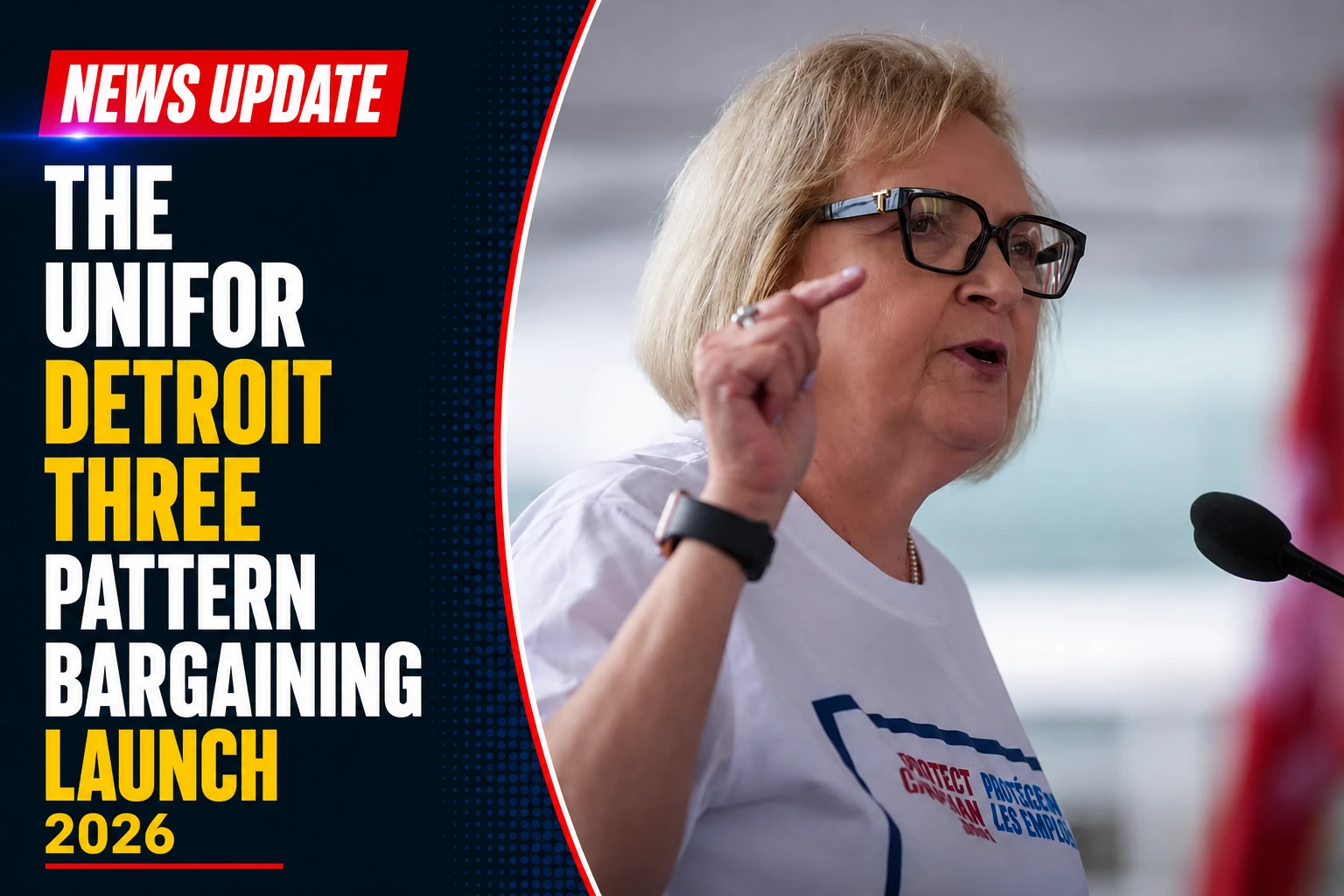


The macroeconomic framework and industrial labor relations network across the Canadian automotive sector are entering their most volatile chapter in decades. Tracked under the central public registry The Unifor Detroit Three Pattern Bargaining Launch 2026, Unifor national executives and corporate labor relations panels finalized the master negotiation parameters on Thursday, June 18, 2026. Set to officially kick off face-to-face bargaining lines on Monday, June 22, 2026, in Toronto, the union—representing roughly 19,000 autoworkers—is bracing for a historic standoff before current collective agreements expire on September 20.
The contract talks open at a highly defensive moment for the domestic industry, which is grappling with aggressive U.S. vehicle tariffs, a critical upcoming cross-border trade agreement review, and a sudden contraction in local manufacturing jobs.
The Pattern Bargaining Flow and Plant Investment Matrices
Unifor is deploying its traditional pattern bargaining strategy, focusing all its early leverage on a single automotive manufacturer to establish a baseline economic contract before forcing the remaining companies to match the terms.
The underlying corporate labor registries itemize the baseline operational realities shaping the table:
-
The Initial Target Line: Unifor has selected Ford Motor Company as the lead strike target to set the 2026 pattern. Unifor National President Lana Payne highlighted Ford as the “most stable employer” since punitive 25 per cent U.S. tariffs hit non-compliant vehicles and components last year, pointing to Ford’s $5 billion ongoing Canadian investment—including the retooling of its Oakville complex to assemble gas and diesel F-Series Super Duty pickups.
-
The Sector Contraction: Unlike previous bargaining cycles where unions held maximum leverage, workers enter negotiations from a position of relative weakness. Nearly 6,500 Canadian auto assembly jobs have been lost since February 2025, driven by prolonged retooling shutdowns, line idling at GM’s Ingersoll plant and Stellantis’ Brampton site, and global supply constraints.
-
The EV Market Disruption: The table faces sudden competition parameters after the federal government altered its import defensive lines, slinging a deal that slashes tariffs on Chinese-manufactured electric vehicles from 100 per cent down to just 6.1 per cent, subject to an annual cap of 49,000 units.
Analyzing Union Priorities vs. Global Trade Vulnerabilities
Independent automotive analysts expect an incredibly tense round of bargaining. Automakers are highly hesitant to commit to long-term Canadian product allocations until they see the final terms of the upcoming Canada-United States-Mexico Agreement (CUSMA) review.
| Institutional Stakeholder Group | Core Bargaining Room Mandate | Primary Strategic Priority Field | Macro Environmental Threat |
| Unifor National Executive | Rejecting all worker concessions | Firm plant product allocations | Low-cost Chinese EV imports |
| General Motors Management | Maintaining floor output agility | Retaining dual-line truck flexibilities | 25% U.S. auto component tariffs |
| Ford of Canada Leadership | Offsetting soaring materials costs | Scaling Oakville Super Duty rollouts | Shifting consumer EV demand curves |
| Stellantis Corporate Panel | Streamlining plant asset costs | Calibrating idle facility frameworks | Stricter CUSMA origin rule proposals |
Labor studies experts warn that with Chinese vehicles applying downward pricing pressure on the domestic market, the union’s ability to use a strike as a high-leverage weapon is weakened, raising the risk of companies threatening to shift production south if labor costs climb too fast.
President Payne remains resolute, stating that while macro issues like tariffs are out of the union’s hands, the bargaining table gives workers direct control over their immediate living standards. The union is refusing to accept concessions, arguing that systemic tariff crises cannot be solved by cutting pay or benefits on the factory floor.
Oshawa assembly workers and parts suppliers across Ajax, Whitby, and Pickering are watching the Ford talks closely, as whatever terms are signed in the coming weeks will directly dictate the future of their own contracts before the autumn deadline.
Durham Region autoworkers, industrial suppliers, and economic watchers looking to track daily negotiation updates, review contract extension parameters, or access member bulletin logs can explore the master bargaining database online at unifor.org.