







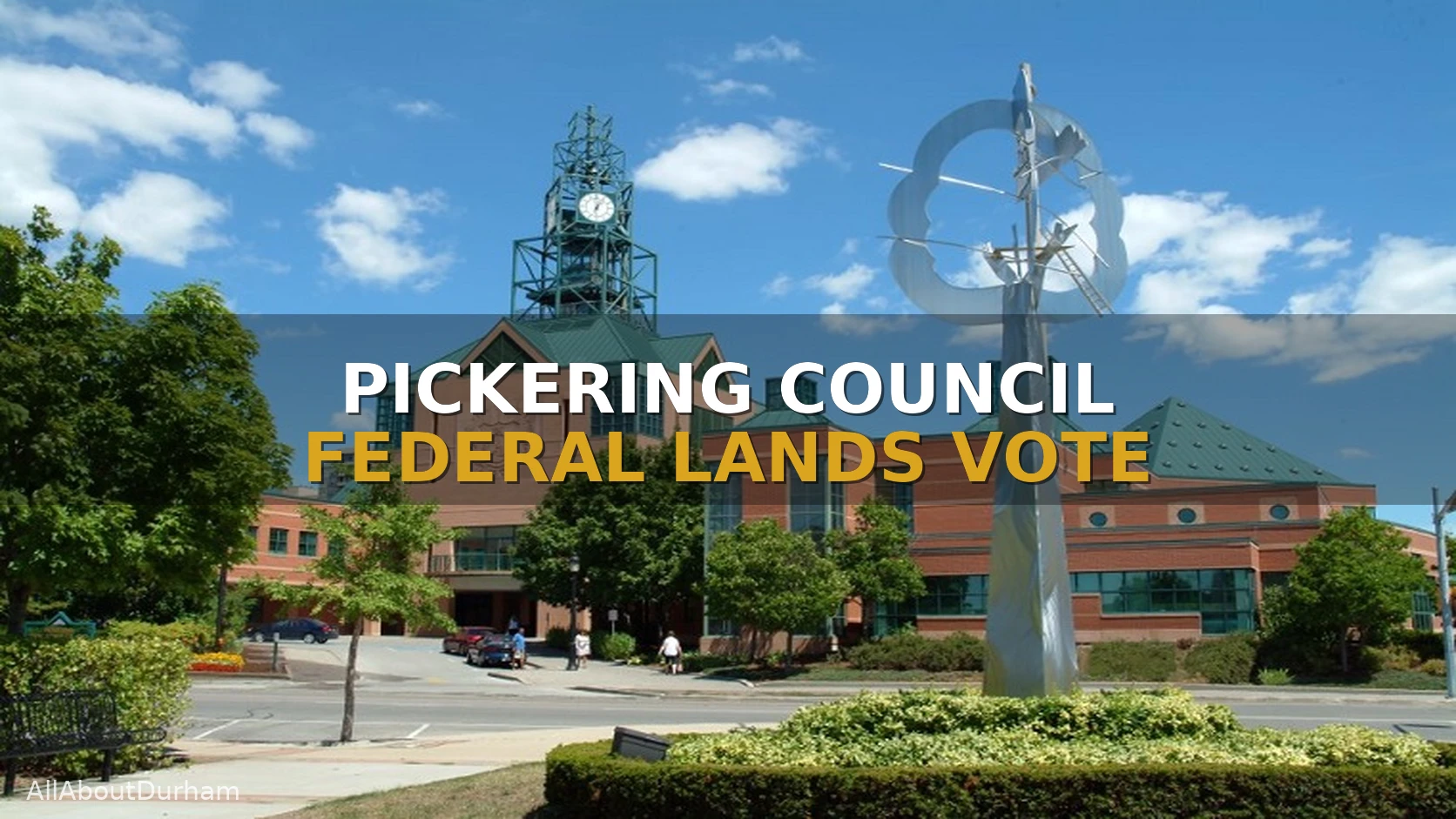
Pickering City Council has endorsed a landmark framework for the future of more than 7,500 acres of federally owned lands in north Pickering, voting to protect the vast majority while unlocking roughly 1,900 acres for employment and economic development.
The dual votes at Monday’s council meeting advanced both the Northeast Pickering Secondary Plan and the Pickering Federal Lands Recommendation Framework — decisions that could reshape the community for generations.

Under the endorsed plan, over 6,500 acres would be designated for agricultural use within an expanded Rouge National Urban Park, with 30-year farming leases offered to encourage long-term agricultural investment. The remaining 1,900 acres would be set aside for prestige employment uses.


The city projects the employment lands could generate approximately $3.7 billion in investment, $244 million in upfront revenues, and roughly $18 million in annual tax revenues. If applied to the 2026 residential tax levy, the commercial and industrial tax income could reduce residential property taxes by about 17 per cent. The area is expected to create some 16,000 local jobs.
“Economic development and job creation are powerful antidotes to sprawl,” the city said in a statement. “By creating commercial investment and employment opportunities close to home, the city can reduce the need for residents to commute to Toronto, Markham, Vaughan, or Mississauga for work.”
Mayor Kevin Ashe called it a once-in-a-generation opportunity. “By protecting the vast majority of the Pickering federal lands through the expansion of Rouge National Urban Park while strategically planning for high-quality employment uses, we are advancing a vision that supports environmental stewardship, strengthens agriculture, and creates thousands of good-paying jobs close to home,” he said.
Not everyone is celebrating. Councillor Lisa Robinson publicly condemned the votes, arguing they represent a shift toward long-term urban sprawl despite significant public concern. She said residents were never offered the option many actually wanted — a fourth option to preserve the Pickering federal lands entirely, expand Greenbelt and Rouge National Urban Park protections, and leave the acreage largely untouched.
“Once these lands are paved, fragmented, and opened to long-term urbanization pressure, we do not get them back,” Robinson stated.
The backdrop dates to 2025, when the federal government launched a consultation process to determine the future of what was formerly known as the Pickering airport lands. The city commissioned SGL Planning and Design Inc. to prepare its own review reflecting public engagement and aligning with federal priorities including environmental protection, agricultural preservation, and economic development.
The report will be submitted to the Government of Canada as Pickering’s formal contribution to the federal consultation process. Ultimately, Ottawa will decide the future use, management, protection, and long-term direction of these federally owned Pickering federal lands.
The decision comes as Durham Region continues to experience rapid growth, with municipalities across the area grappling with how to balance development pressure against environmental conservation and agricultural preservation. For Pickering residents, the stakes could not be higher — the outcome will determine whether the Pickering federal lands become a model for balanced growth or a cautionary tale of sprawl.