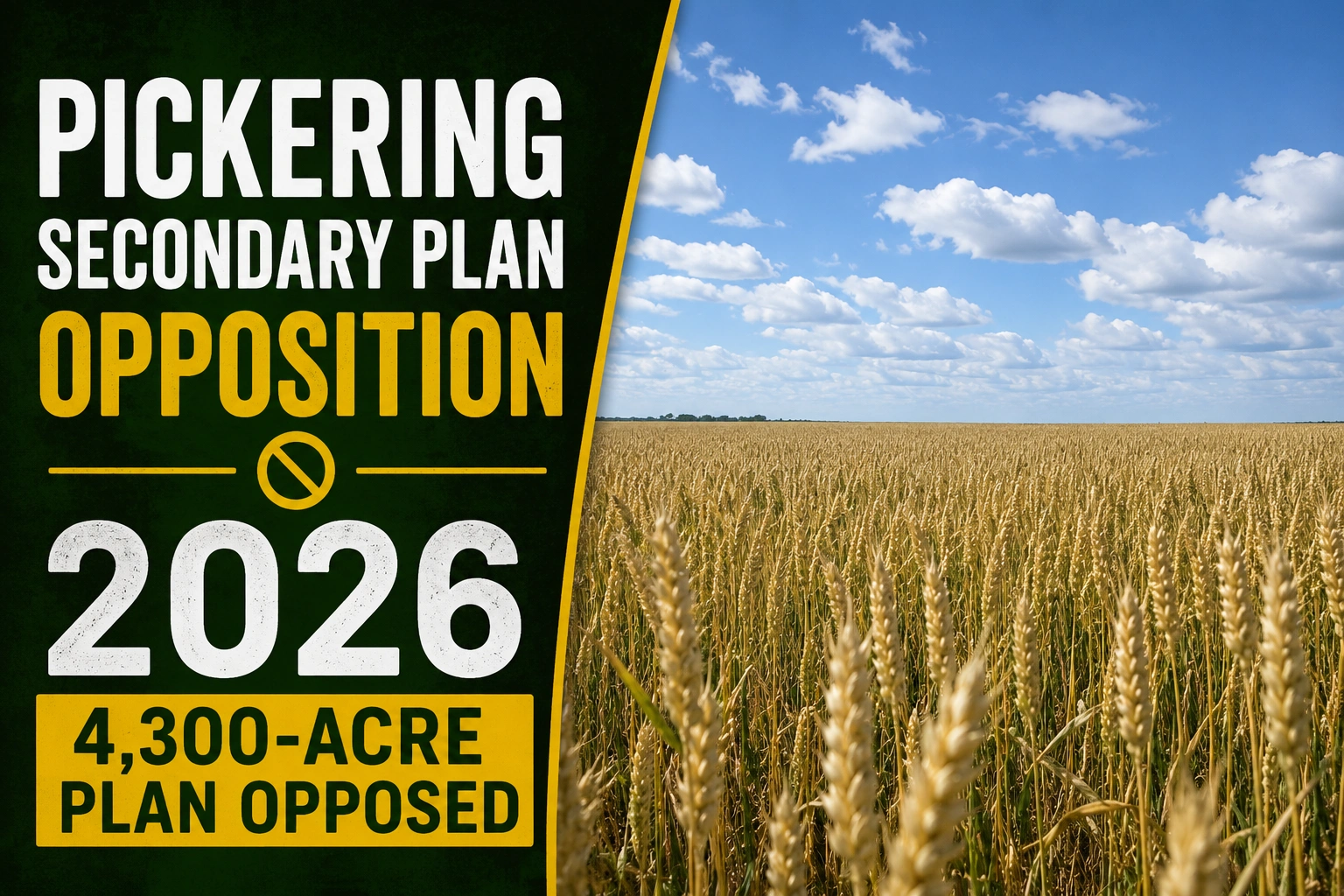
A high-stakes municipal land-use battle has erupted in the City of Pickering after local lawmakers voted to greenlight a massive long-term urbanization framework over intense community resistance. Under the public tracking profile titled the Pickering Secondary Plan Opposition 2026, the environmental advocacy coalition Stop Sprawl Durham has joined forces with local agricultural boards and regional First Nations to condemn a 5–2 vote passed during a marathon five-hour Special Council meeting. The decision formally adopts the Northeast Pickering Secondary Plan, locking in a comprehensive growth model for thousands of acres of rural territory before critical population and ecological audits are finalized.
While council members defended the strategy as a preliminary policy document to guide remote infrastructure design, environmentalists warn the decision effectively shifts the municipal conversation from whether the land should be developed to how it will be paved.


The Loss of Class 1 Agricultural Soil
The primary environmental asset at risk under the new secondary plan is a massive expanse of Class 1 agricultural soil—historically recognized as the most fertile, high-yield, and scarce arable land mass in the Province of Ontario.


According to land registries compiled by Stop Sprawl Durham Co-Leads Helen Brenner and Abdullah Mir, the targeted development zone encompasses approximately 4,356 acres, meaning prime agricultural soil comprises 93 percent of the entire planning footprint.
Under active provincial planning statements, expansion into designated prime agricultural sectors is strictly prohibited unless the municipality can present undeniable, data-backed evidence that the land is explicitly required to meet provincially mandated 2051 population targets. Advocacy groups point out that because Pickering’s comprehensive Official Plan review—known as Pickering Forward—is still actively underway, the city has technically violated the legal sequence of the planning process by approving urban expansion before demonstrating actual necessity.
Indigenous Consultation Failures and Servicing Risks
The political friction surrounding the plan is further compounded by a formal breakdown in regional treaty negotiations. The Mississaugas of Scugog Island First Nation (MSIFN) issued an official statement confirming their continued, unaltered opposition to the secondary plan.
The First Nation verified that while administrative discussions with the city are ongoing, no formal consultation protocol has been finalized. Tribal leadership expressed deep concern that Pickering Council pushed through a binding planning decision of this scale while active concerns regarding cumulative environmental impacts and Aboriginal and Treaty Rights remained completely unresolved on the floor of chambers.
Beyond the legal and cultural challenges, the Pickering Secondary Plan Opposition 2026 campaign highlights severe downstream financial and watershed risks that could penalize existing taxpayers:
-
Property Tax Impacts: Servicing 4,300 acres of remote rural land with municipal water mains, sewage infrastructure, and electrical grids carries uncalculated capital costs that critics warn will spark sharp hikes in residential tax rates.
-
Downstream Flooding Hazards: Paving over thousands of acres of natural absorbent topsoil creates massive stormwater runoff vectors, significantly increasing the statistical risk of flash flooding across urban watersheds located downstream.
The coalition is formally calling on the City of Pickering to halt any subsequent zoning approvals until staff can present clear evidence that additional land is required based on current post-pandemic population trends, finalize an ironclad consultation protocol with MSIFN, and verify the city’s actual financial infrastructure capacity.