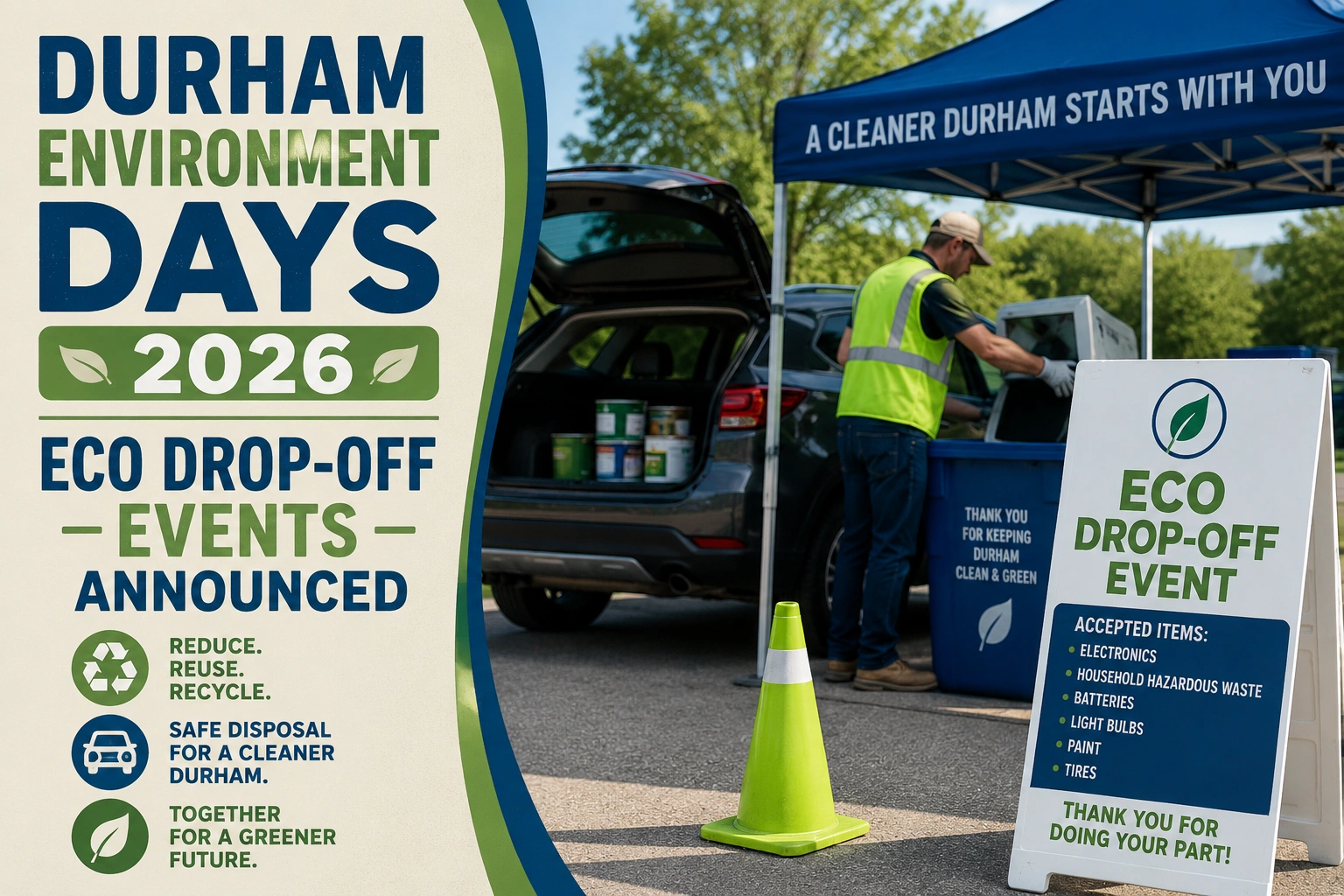
The Regional Municipality of Durham, in direct coordination with lower-tier public works departments, has launched its seasonal environmental recovery framework to divert thousands of tonnes of hazardous materials and consumer assets from regional landfills. According to the formal Durham Environment Days 2026 operational directive released on Tuesday, May 26, 2026, waste management teams are standing up three centralized collection hubs strategically distributed across the summer and autumn months.
The multi-municipal campaign is engineered around a strict circular economy model—a structural resource recovery design focused on retaining, repairing, and repurposing consumer materials before they can permanently enter the municipal solid waste stream or contaminate vulnerable local ecosystems.
Operational Schedule and Venue Layout
The collection events are scheduled to operate rain or shine, offering local households free access to specialized drop-off lanes. Residents can map their seasonal sorting plans around three distinct regional coordinates:


| Calendar Date | Operational Hours | Municipal Venue Coordinates | Targeted Community Core |
| Saturday, June 13 | 8:00 a.m. – 12:00 p.m. | Whitby Operations Centre (333 McKinney Drive) | Whitby / Central Durham |
| Saturday, August 22 | 8:00 a.m. – 12:00 p.m. | Rick MacLeish Memorial Community Centre (91 Elliot Street) | Cannington / Brock Township |
| Saturday, October 3 | 8:00 a.m. – 12:00 p.m. | Municipal Boat Launch Parking Lot (2 Old Rail Lane) | Port Perry / Scugog |
Tri-Stream Material Sorting Protocols
To maximize throughput and ensure optimal processing efficiency at the sorting lines, public works officials are instructing attendees to pre-sort all incoming vehicular cargo into three separate infrastructure streams prior to arrival on-site:
-
The Reuse Stream: Intake teams will accept clean, dry, and odorless clothing, household textiles, bedding, small appliances, and sporting goods in functional working condition. All items in this stream are transferred to local charitable partners; any materials rejected by charity inspectors must be extracted by the resident and taken to a regional Waste Management Facility where standard disposal fees may apply.
-
The E-Waste Stream: End-of-life electronics—including cellular phones, computing rigs, stereo components, cameras, and televisions—will be securely processed to harvest rare-earth metals and copper elements. Technicians emphasize that residents must completely wipe all personal hard drives and SIM cards before dropping off obsolete hardware.
-
The Hazardous (HHW) Stream: This critical chemical containment stream targets residential toxins like used motor oil, brake fluid, antifreeze, automotive batteries, mercury thermostats, expired medications, and fluorescent lighting tubes. Public works lines strictly prohibit any commercial, institutional, agricultural, or industrial-grade chemicals at these gates.
In addition to the core waste management operations, regional planners are transforming the Durham Environment Days 2026 nodes into high-volume collection points for local emergency food networks. All attending residents are heavily encouraged to pack a donation of undamaged, unexpired non-perishable food items, which will be loaded directly into transport vehicles to restock regional food banks ahead of seasonal summer demand spikes. Detailed staging guidelines and vehicle packing checklists are currently available via the central regional waste portal and the downloadable Durham Region Waste App.