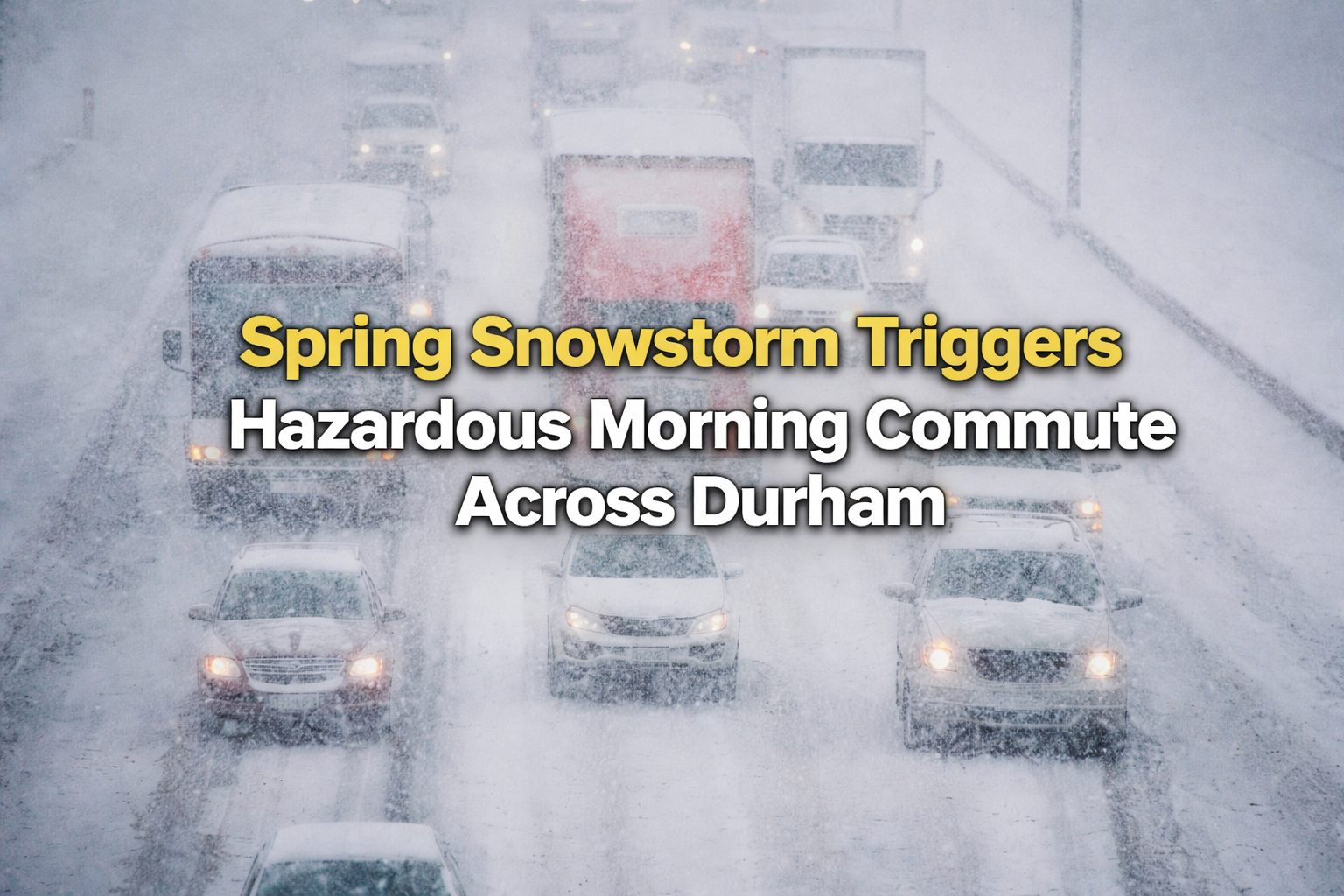
Residents in the Durham Region woke up to a sharp reminder that winter isn’t finished with Southern Ontario just yet. Environment and Climate Change Canada issued a weather advisory on Tuesday morning as a fast-moving but intense system swept through the area. While the total accumulation is expected to remain relatively low, the snow expected to fall has already begun to create dangerous conditions on major arteries like Highway 401 and Highway 407.
Sudden Visibility Drops and Road Conditions
The primary concern for today’s weather event isn’t the volume of accumulation, but the rate of snowfall. Forecasters are predicting local amounts of 4 to 8 centimetres, but the “burst” nature of the storm means that visibility can drop to near-zero in a matter of seconds. This phenomenon, combined with localized blowing snow, makes highway driving particularly treacherous for commuters in Oshawa and Pickering.
Road surfaces across Whitby and Ajax have quickly become slippery as the snow interacts with the cooling pavement. Maintenance crews were seen deployed early this morning, but the speed of the system means that plows are struggling to keep up with the initial surge. The snowfall is expected to be at its heaviest through the mid-morning hours before tapering off by the early afternoon.
Regional Impact Zones
The system is moving in a west-to-east trajectory, heavily impacting the following areas:
-
Southern Durham: Including the lakeshore communities of Pickering, Ajax, and Oshawa.
-
Northern York & Simcoe: Impacting Newmarket, Georgina, Barrie, and Collingwood.
-
Northumberland County: Extending toward Cobourg and Colborne, where the effects may linger slightly longer due to proximity to the St. Lawrence River system.
Environment Canada warns that even though this is a short-duration event, the timing coincides perfectly with the peak morning rush, leading to a “flash” of hazardous conditions that catch many drivers off guard.
Safety Tips for Durham Drivers
With the snow expected to continue until at least 1:00 p.m., local police services are urging motorists to adjust their driving habits immediately. “We are seeing a high volume of minor collisions and vehicles sliding off the road,” noted a regional traffic update.
Drivers are advised to:
-
Reduce Speed: Even if the road looks clear, black ice can form under fresh powder.
-
Increase Following Distance: Leave at least twice the usual space between you and the vehicle in front.
-
Clear Your Vehicle: Ensure all windows and lights are completely clear of snow to maintain maximum visibility.
-
Check Lighting: Manually turn on your full lighting system to ensure you are visible to others in whiteout conditions.
As the system moves out this afternoon, temperatures are expected to stabilize, but residents in Clarington and northern Durham should remain vigilant for black ice as the sun sets and moisture on the roads begins to refreeze.