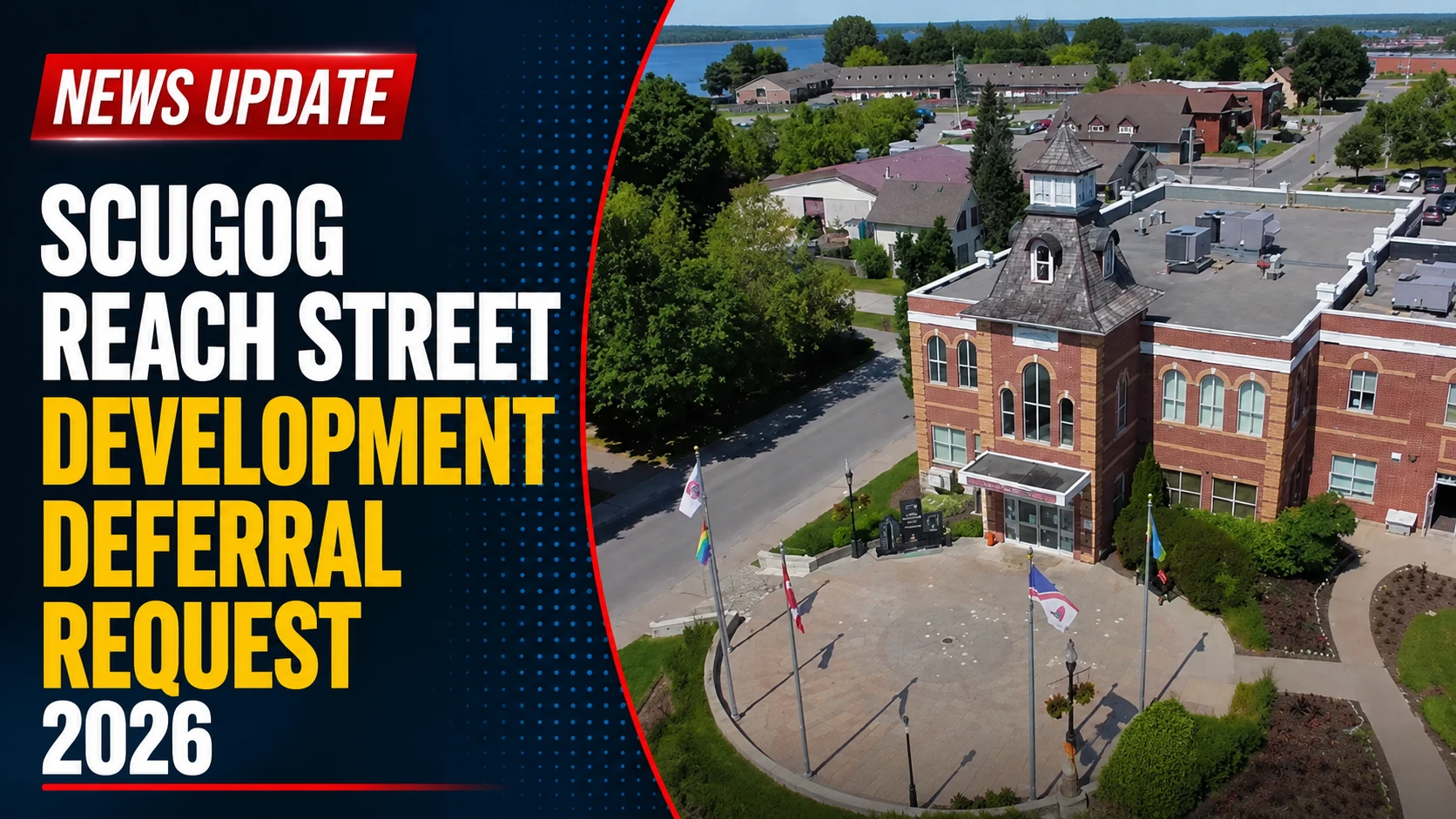
The municipal planning framework in the Township of Scugog has entered an active political dispute following a formal demand to stall a massive residential build in Port Perry. Tracked under the local administration file The Scugog Reach Street Development Deferral Request 2026, township planners and election officials logged the comprehensive open policy challenge on Monday, June 15, 2026. The intervention, led by mayoral candidate Mike Coll ahead of the October municipal elections, calls on Mayor Wilma Wotten and council members to immediately halt the evaluation of the multi-building complex, arguing it bypasses ongoing community consultation loops.
The high-density proposal represents an unprecedented shift for the rural northern Durham municipality, threatening to alter local infrastructure, school capacities, and protected employment lands.

The Proposed Scope and Planning Inconsistencies
The dispute centers on a massive development footprint along the Reach Street corridor in Port Perry, which sits in direct contrast to the township’s established slow-growth guidelines.


The localized planning data outlines severe contradictions in how the town handles major development applications:
-
The Development Scale: The Reach Street application seeks clearance to build up to 1,355 residential units, featuring multi-family apartment structures climbing up to eight storeys in height.
-
The Strategic Growth Gap: In 2024, Scugog Council approved a formal growth strategy that targeted a slow, sustainable increase of approximately 100 housing units per year. This single proposal drops more than thirteen years worth of development into a single project.
-
Approval Inconsistencies: Local advocacy groups point out that while smaller projects—like the Heritage Advisory Committee’s fairground designation and Myrtle Market’s land diversification—were told to wait for the official plan review, this massive high-rise project is being rushed through.
Infrastructure Deficits and Protected Employment Lands
Beyond the sheer height and density of the buildings, the location of the project sits entirely within highly protected geographic zones.
| Monitored Town Infrastructure Pillar | Present Local Operating Capacity | Projected Development Impact Profile | Strategic Municipal Risk |
| Regional Roadway Integrity | 63% Reported in Poor Condition | Extreme heavy vehicle tracking load | Accelerated asphalt breakdown |
| Healthcare / Doctor Roster | Active severe local shortages | Explodes clinic wait times across town | Zero funding for hospital additions |
| Public School Enrolment | Near maximum capacity thresholds | Student overcrowding in local classrooms | Portable classroom expansions forced |
| On Demand Transit Grid | Highly limited regional service lines | Substantial strain on dispatch software | Total gridlock for non-driving riders |
The subject property is currently designated as employment land. Because Scugog sits securely within the provincial Greenbelt, these employment lands are legally protected by the township, Durham Region, and the province. Once these zones are paved over and turned into residential complexes, they are almost impossible to replace, permanently robbing the community of future local job creation.
Mayor Wilma Wotten responded briefly to the public policy letters, confirming that the project would be discussed during the mid-June council sessions and inviting residents to attend in person to voice their opinions.
With the Official Plan Review currently underway to decide what Scugog should look like over the next few decades, critics argue that approving an eight-story complex now completely undermines the public consultation process.
Scugog residents can review the complete engineering blueprints, check upcoming council meeting agendas, and sign up for public feedback sessions by visiting the township’s web platform at scugog.ca, or call the corporate administrative clerk’s desk at 905-985-7346.