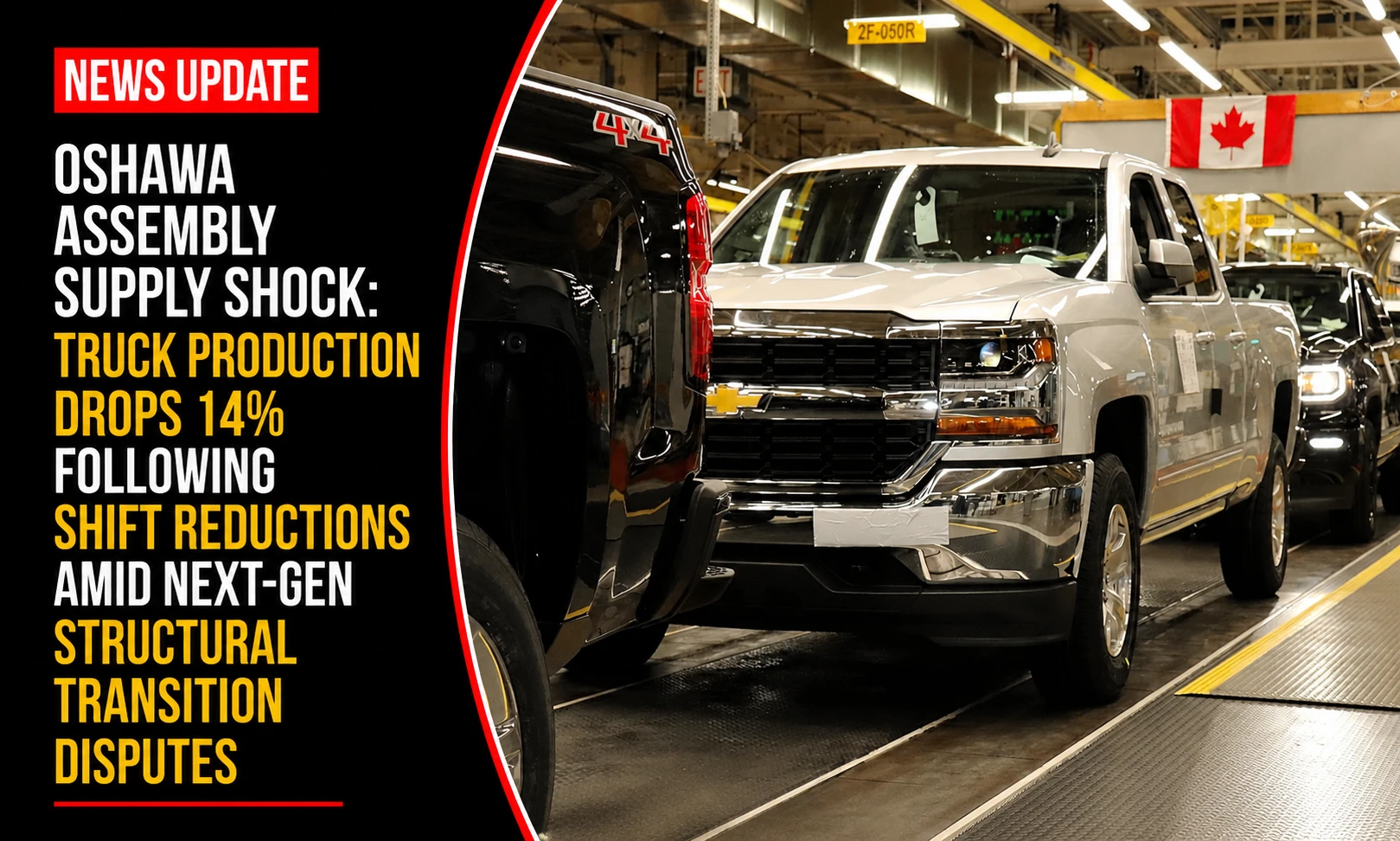
The municipal economic development committees, heavy industrial grids, and regional labor councils within the Durham Region are closely monitoring local manufacturing stability metrics. Tracked under provincial industrial economics, corporate manufacturing, and labor relations portfolios on Monday, July 13, 2026, commerce tracking clerks finalized the high-impact operational report Truck production in Oshawa falls 14 per cent: automaker still leads Canada in sales. Despite General Motors Canada finishing the first half of 2026 as the country’s top-volume automaker, its primary regional production footprint faces localized contraction following a multi-hundred worker workforce reduction implemented early this year.
Industrial intelligence firms have sparked deep anxiety across the regional supply chain by publishing forecasting models suggesting a imminent phase-out of light-duty truck lines, a claim corporate communication executives are actively denying.


The Workforce De-escalation and Production Milestones
The manufacturing data reveals a stark division between record historical volume achievements and current operational headwinds.


-
The Sales and Shift Matrix: GM successfully delivered 148,540 total vehicles nationwide during the first six months of 2026. However, its core regional product—the Chevrolet Silverado pickup truck line—sustained a sharp 14 percent production plunge. This drop is linked directly to the physical loss of an entire factory production shift and the elimination of over 500 active positions in February.
-
The Half-Million Milestone: Despite the current slowdown, the facility successfully logged the completion of its 500,000th Chevrolet Silverado unit assembled since the corporation resurrected the vehicle assembly lines in late 2021.
-
The Component Output: The campus simultaneously celebrated the completion of one million stamped aftermarket components manufactured over the past 54 months, a milestone highlighted by GM Canada President Jack Uppal as proof of the plant’s sustained operational consistency.
Analyzing the Next-Gen Allocation Risk and Labor Matrix
Industry intelligence models indicate potential structural realignments ahead of upcoming fall product conversions, creating friction with ongoing union master agreement strategies.
| Industrial Parameter / Risk Vector | Current Documented Status | Projected Fall 2026 Transition Impact | Corporate Counter-Positioning |
| Light-Duty Silverado Line | Primary high-volume assembly asset. | Auto Forecast Solutions Forecast: Predicts total loss of the light-duty line during fall retooling, threatening a reduction down to a single shift. | Jennifer Wright (GM Executive): Denies any scale-back plans; notes local output locations for next-gen models are officially undisclosed. |
| Heavy-Duty Silverado Line | Specialized dual-assembly asset. | Retained as the foundational core of the plant’s heavy commercial manufacturing footprint. | Cites a recent $343,000,000 capital investment injection as firm proof of long-term local priorities. |
| Unifor Labor Pattern | Active contract renewal preparation phase. | Union negotiators finalized a baseline pattern agreement with Ford this weekend. | The newly minted framework will serve as a rigid guide during upcoming high-stakes talks with GM and Stellantis. |
General Motors Canada Corporate Relations, Unifor Local 222 Executive Board, and regional automotive parts manufacturing associations handle ongoing plant transition logistics, collective agreement bargaining, and shift allocation audits.
Oshawa autoworkers, regional business analysts, and industrial supplier networks looking to track live updates regarding the upcoming Unifor collective bargaining schedule, review historical plant investment prospectuses, or examine vehicle sales data sheets can find the networks online through the central General Motors Canada corporate portal, review member updates via the Unifor Local 222 dashboard, or track regional economic charts via the Durham Region industrial index.