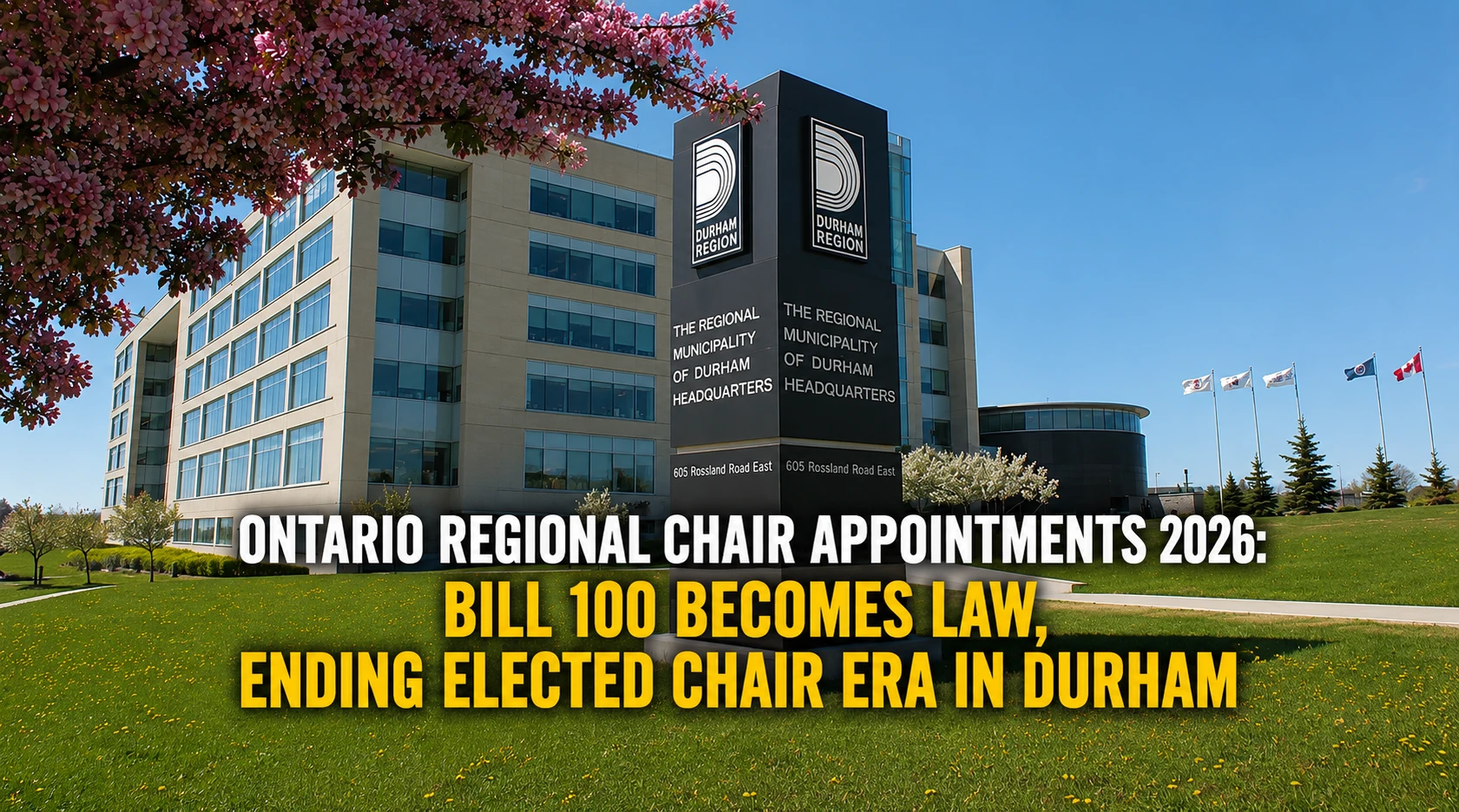
A transformative shift in local governance has officially taken hold as the provincial legislature passed Bill 100, marking the end of the democratically elected Regional Chair in Durham. The Ontario Regional Chair Appointments 2026 legislation, which became law following a final vote on May 12, grants the Minister of Municipal Affairs the power to directly appoint leaders in Durham, Halton, Niagara, Peel, Waterloo, York, Muskoka, and Simcoe County. The move effectively dismantles a system Durham residents established via a 2010 referendum, sparking fierce criticism from local leaders who call it “taxation without representation.”
The Ontario Regional Chair Appointments 2026 will see current Durham Chair John Henry leave his post this fall. Henry, who has served since 2018, described the decision as “deeply disappointing,” arguing that it severs the critical accountability link between residents and regional leadership. Under the new law, the province will not only select the chair but also grant them “strong chair” powers. These powers allow provincial appointees to veto certain bylaws, hire or fire the Chief Administrative Officer (CAO), and exert significant control over the annual municipal budget—authority previously balanced by a vote of the people.


The political fallout from the Ontario Regional Chair Appointments 2026 has been swift across the Durham Region:


-
Whitby Mayor Elizabeth Roy characterized the move as a “disservice,” stating it moves decision-making further away from the people.
-
Oshawa MPP Jennifer French was even more vocal, labeling the future appointees “puppet chairs” who will answer only to the Premier rather than local taxpayers.
-
Minister Rob Flack, however, defended the bill, promising an “open process” for applications and claiming that provincial oversight will bring “more focus” to regional governance.
The Ontario Regional Chair Appointments 2026 effectively overrides the 2014 transition that saw Roger Anderson become Durham’s first voter-elected chair. For over a decade, Durham residents have enjoyed the right to choose their regional leader at the ballot box. Critics of Bill 100 point out that the appointed chairs will now have access to taxpayer pockets without the risk of being voted out by those same taxpayers. Minister Flack has stated that John Henry is “welcome to apply” for his own job, though Henry has indicated he plans to continue serving the community in a “different capacity” once his term ends.
Beyond the leadership change, the Ontario Regional Chair Appointments 2026 is viewed by many analysts as a precursor to broader municipal restructuring. Premier Doug Ford has previously expressed support for amalgamations in regions like Niagara, and the centralization of chair appointments provides the province with a direct line of command to implement such large-scale changes. For the residents of Ajax, Pickering, and Clarington, this means the regional budget and infrastructure priorities for 2027 and beyond will be guided by a provincial appointee rather than an elected official.
As the fall transition approaches, the Ontario Regional Chair Appointments 2026 remains one of the most contentious political developments in Durham’s recent history. While the province insists the move will streamline development and housing goals, local mayors and MPPs warn of a “democratic deficit” that may take years to reconcile.