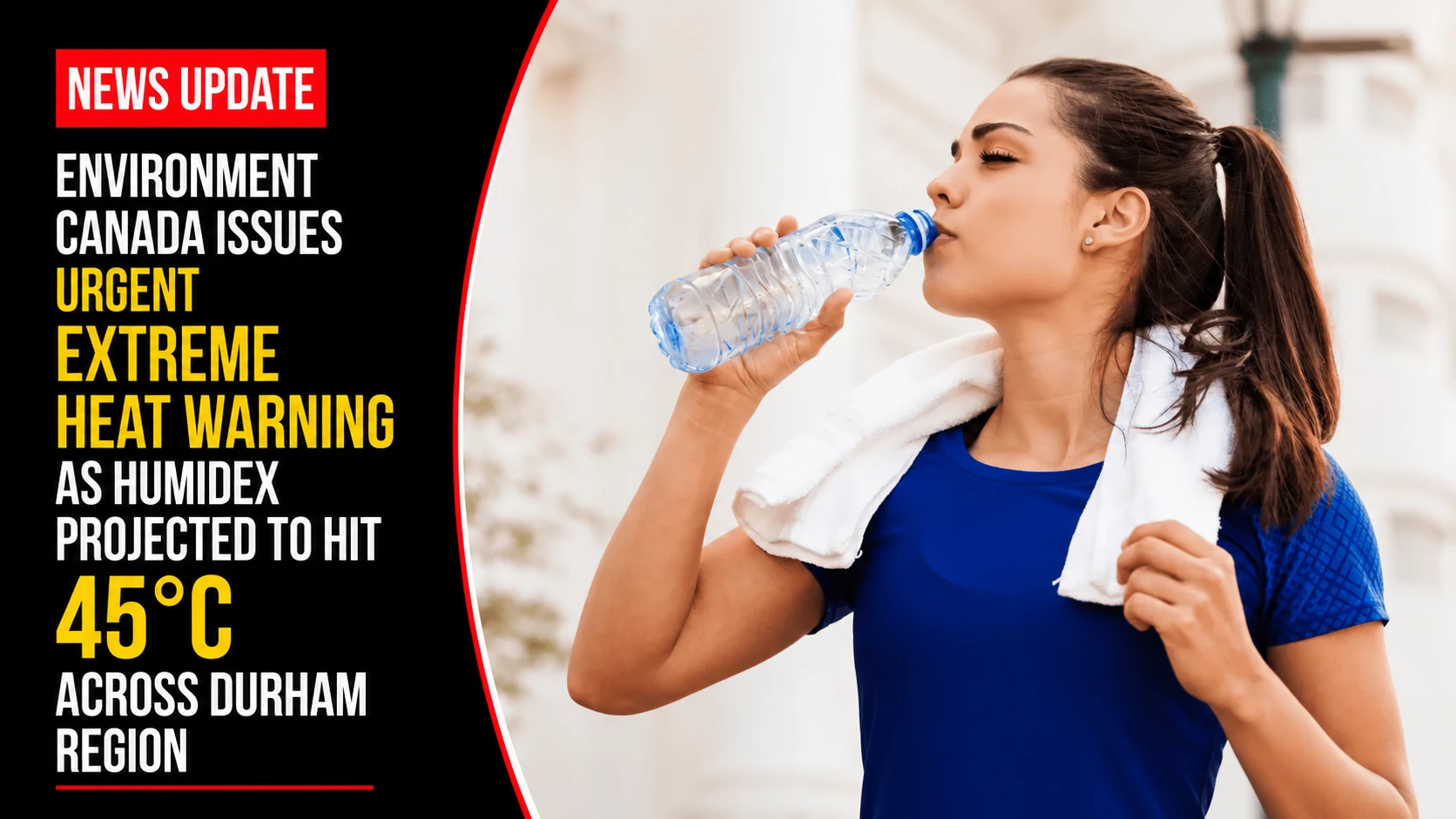
The emergency service lines, municipal cooling networks, and regional health enforcement desks within the Durham Region are transitioning to an emergency operating stance. Tracked under provincial meteorology and public health portfolios on Monday, July 13, 2026, disaster management teams finalized the critical alert log Weather warning: Heatwave will make it feel like 45 C in southern Ontario. Triggered by a dense sub-tropical air mass locking over the southern corridor, the formal warning highlights dangerously high thermal metrics capable of causing rapid metabolic strain and severe heat-related medical emergencies if proper mitigation behaviors are not immediately enacted.
Municipal leaders are coordinating the immediate activation of public cooling hubs and warning residents that the intense humidity will simultaneously degrade local air quality down to high-risk thresholds.


The Critical Heat Warning Criteria and Medical Escalations
The atmospheric event is marked by dangerous mid-day temperature peaks paired with elevated overnight baselines that prevent normal structural and biological cooling.


-
The Humidex Apex: While ambient base values will hover between 30°C and 36°C, intense atmospheric moisture levels will drive the perceived humidex factor to a dangerous peak of 45°C on Tuesday afternoon.
-
The Air Quality Degradation: The combination of extreme stagnant heat, high humidity, and solar radiation is projected to push the regional Air Quality Health Index (AQHI) near the high-risk category, posing immediate breathing hazards for individuals with pre-existing respiratory issues.
-
The Overnight Floor: Ambient nighttime values will remain trapped between 20°C and 23°C. This lack of nocturnal cooling removes standard physical recovery windows for individuals living in homes without air conditioning.
Analyzing the Heat-Illness Symptom and Emergency Response Matrix
Public health officials have divided the physical impacts of this system into two distinct clinical categories, noting that the latter represents a life-threatening crisis requiring an immediate 911 dispatch.
| Clinical Condition Tier | Primary Biological Symptom Profile | Immediate First-Aid Field Protocol | Regional Infrastructure Support Systems |
|
Heat Exhaustion (Early Phase Traction) |
• Persistent headache / dizziness • Acute nausea / intense thirst • Dark urine and muscle fatigue |
Halt all physical labor immediately. Move the individual to a shaded or air-conditioned space and administer cool water continuously. | Municipal Cooling Hubs: Libraries, community centers, and pools opened with extended operational hours. |
|
Heat Stroke (Severe Medical Emergency) |
• Red, hot, completely dry skin • Mental confusion / delirium • Altered states of consciousness |
Call 911 instantly. Move the victim to shade, strip away heavy outer clothing layers, and actively pack the body with ice or cold water. | EMS Primary Response: Paramedic crews placed on priority deployment to manage rapid thermal shock cases. |
The Environment Canada Public Advisory Mandate
“Extreme heat can affect everyone’s health, particularly older adults, infants, young children, pregnant individuals, and those with chronic illnesses,” Environment Canada forecasters warned in the multi-regional emergency statement. To mitigate the severe risk of thermal shock, health authorities are advising residents to systematically check in on isolated neighbors multiple times a day, ensure pets are never left inside parked vehicles for any duration, and shift all mandatory outdoor athletic or commercial activities exclusively to early morning or late evening cooling windows.
Environment and Climate Change Canada and the Durham Region Medical Advisory Desk handle ongoing regional weather alert updates and emergency health monitoring.
Durham Region families, commercial property managers, and construction safety inspectors looking to locate the nearest active municipal cooling center, view live local air quality indexes, or download the formal corporate heat safety guideline sheets can find the networks online through the central Environment Canada warning index, review emergency directories via the Durham Region Health Department portal, or track real-time public health updates via the municipal safety hub.