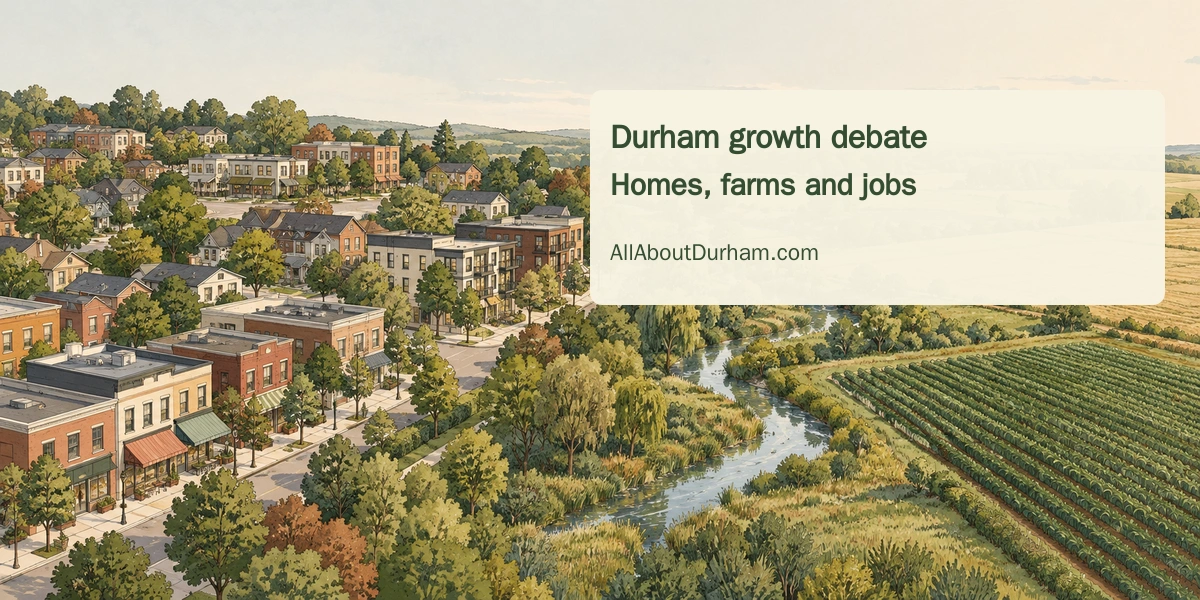
The Durham growth debate is bringing infrastructure costs, farmland protection and opportunities for small businesses into focus as residents prepare to choose municipal councils on October 26.
An October 22 DurhamRegion.com report features interviews with planning and environmental advocates and a local business representative about how municipalities should respond to growth. Their proposals are viewpoints offered in the election discussion, not newly approved planning rules or an announced regional capital programme.
Building within existing communities
Franz Hartmann of the Alliance for a Liveable Ontario argues that accommodating more housing within established neighbourhoods can make better use of infrastructure already in place.
His explanation links outward expansion with the cost of adding roads, sewers and water systems. He favours a broader range of housing forms between detached houses and tall apartment buildings, including smaller multi-unit options.
Hartmann also emphasizes that additional density can be adjusted to a neighbourhood’s circumstances rather than imposed at the same scale everywhere. The Alliance’s official material identifies affordable, mixed housing and protection of farmland and natural areas among its goals.
The interview refers to earlier housing-capacity research, but the October 22 story is not a new study release. No new housing-capacity calculation has been independently produced for this report.
Farmland and watershed concerns
Stop Sprawl Durham activist Helen Brenner raises concerns about development beyond established urban areas and the value of agricultural land in Pickering.
Her position connects land-use choices with food production and the financial cost of extending infrastructure. Those concerns form part of the broader discussion about growth; they do not mean a new decision has been made on the Duffins Rouge Agricultural Preserve.
All About Durham has previously covered specific Pickering development proposals and decisions. The new interview report is distinct because it considers wider municipal growth approaches and procurement opportunities, rather than presenting another update on the same planning vote.
More opportunity for local firms
Benjamin Shelley, identified in the report as board president of the Greater Oshawa Chamber of Commerce and a local contractor, welcomes industrial investment for the business activity it can generate locally.
He also argues that municipalities could make smaller local businesses better able to compete for public work, such as renovations and park improvements. His comments concern the design of procurement opportunities, not the award of a new contract.
The Chamber’s official site describes its role in connecting, representing and advocating for local businesses. The interview illustrates how investment and local purchasing can be connected in the Durham growth debate without assuming that every incoming employer or municipal contract automatically benefits every firm.
Residents comparing candidates’ positions can consider where proposed housing would go, who would pay for supporting services and how local businesses would participate. The interviews provide questions for that discussion rather than a single adopted municipal growth plan.