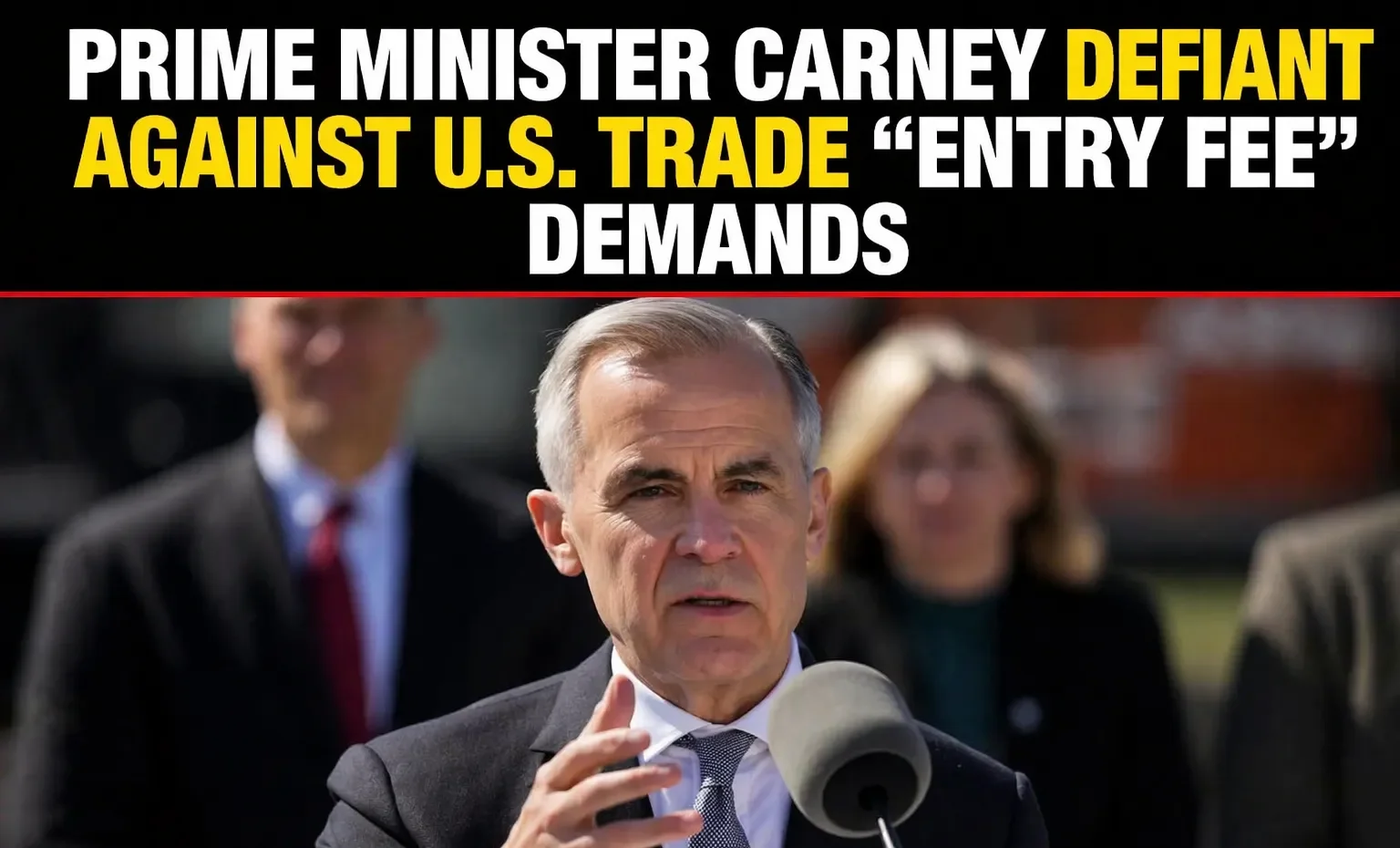
In a direct challenge to the Trump administration’s trade tactics, Prime Minister Mark Carney asserted on Thursday that Canada will not be pressured into making preliminary concessions to secure a seat at the negotiating table. Speaking at a news conference in Ottawa on April 23, 2026, Carney responded to reports that the United States is demanding an “entry fee” in the form of significant policy changes before formal talks on the CUSMA trade talks renewal can begin. “There are two parties in a negotiation,” Carney told reporters. “We’re not sitting here taking notes or taking instructions from the Americans.”


The Prime Minister’s comments come amid escalating tensions over U.S. tariffs on Canadian steel, aluminum, and forest products—sectors that are vital to the industrial heartland of Ontario. Carney labeled these tariffs as “more than irritants,” describing them as fundamental violations of the current trade agreement that must be resolved as part of the broader CUSMA trade talks process. The pushback follows a Radio-Canada report suggesting that White House officials are seeking a series of “preconditions” from Ottawa. Carney was firm in his stance, stating he had “never heard” of an entry fee requirement and emphasizing that Canada enters these discussions as an equal partner rather than a subordinate.


Adding to the friction, United States Trade Representative Jamieson Greer recently warned a congressional committee of potential “enforcement action” if Canada does not address specific American grievances. One of the primary points of contention is the availability of American alcohol on Canadian liquor store shelves, which Greer claims is being unfairly restricted by provincial procurement rules. Despite these warnings, the CUSMA trade talks remain a high-stakes priority for the Carney government, which has already established a new advisory council—including representatives from across the political spectrum and various industrial sectors—to prepare for the summer negotiations.
For residents and businesses in the Durham Region, the outcome of these talks is of critical importance. The regional economy, particularly in Oshawa and Whitby, is deeply tied to the automotive and manufacturing sectors, both of which face uncertainty as the U.S. pushes for a “Buy American” agenda. Carney’s refusal to yield to “pre-negotiation” demands signals a strategy of “forward guidance,” aiming to protect Canadian sovereignty while seeking a mutually beneficial economic outcome. However, with U.S. officials accusing Canada of “doubling down on globalization” instead of aligning with American priorities, the path to a renewed agreement appears increasingly complex.
As the formal review of the Canada-United States-Mexico Agreement approaches the July 1 deadline, the rhetorical battle between Ottawa and Washington is expected to intensify. Prime Minister Carney has promised to defend Canada’s supply management system for dairy and poultry, a key pillar of the agricultural economy in northern Durham, while pushing back against any attempt to dictate the terms of the CUSMA trade talks. With the first meeting of Canada’s new trade advisory council set for April 27, the government is signaling that it is rolling up its sleeves for a long and difficult summer of diplomacy, rooted in the belief that “hope is not a plan, and nostalgia is not a strategy” when dealing with a shifting American trade landscape.