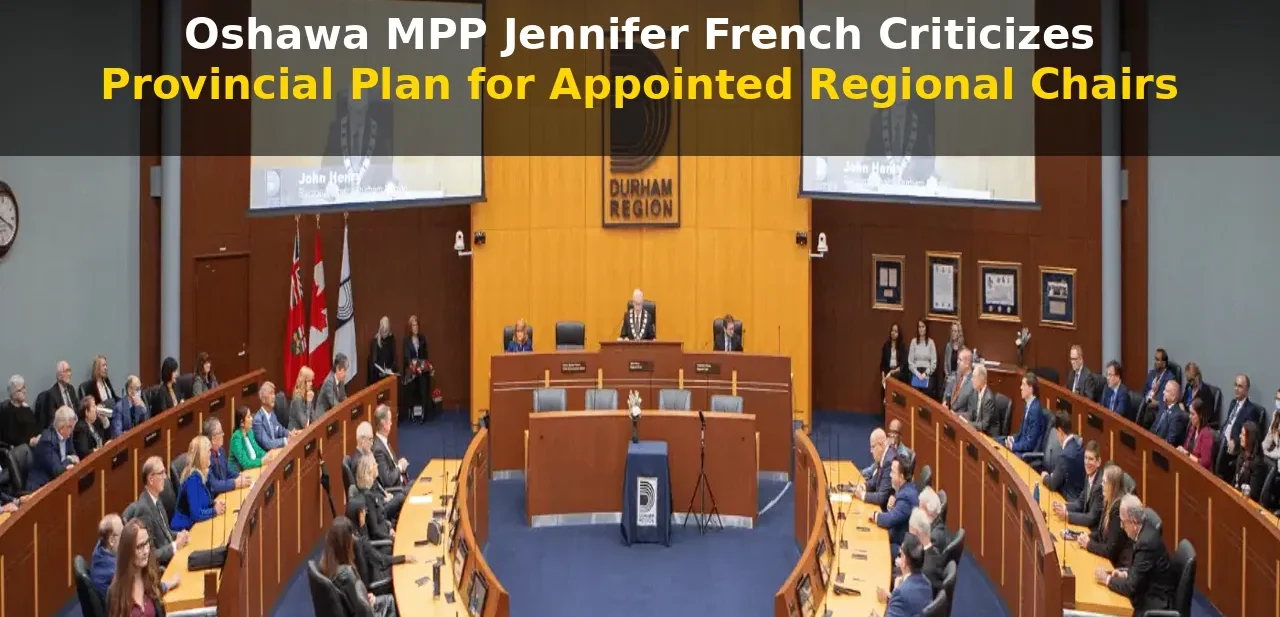
The political landscape in Durham Region is facing a significant shift as Oshawa MPP Jennifer French publicly condemns the provincial government’s new legislation to appoint regional chairs. Under the proposed bill tabled by Municipal Affairs Minister Rob Flack, the province would gain the power to directly appoint and dismiss the heads of upper-tier municipalities, including Durham, Halton, Niagara, and York. French has characterized these future appointees as “puppet chairs,” arguing that the move strips local voters of their democratic right to elect their own regional leadership. This appointed regional chairs controversy stems from a 2010 referendum in which Durham residents voted to have the people, rather than council, elect their chair—a process that has been in place since 2014.
The new legislation not only changes how chairs are selected but also grants them “strong chair” powers. Similar to the “strong mayor” powers currently active in many Ontario municipalities, these appointed officials would have the authority to veto bylaws, hire or fire the Chief Administrative Officer (CAO), and hold significant control over the annual municipal budget. French has voiced deep concerns over this centralized power, calling it “taxation without representation” because these individuals will be accountable to the Premier rather than the electorate. She specifically questioned Minister Flack on whether the current Durham Regional Chair, John Henry, was being dismissed for failing to “kiss the ring” of the provincial leadership.
In response to the criticism, Minister Flack maintained that “nobody was fired” and stated that an “open process” would be used to find the “brightest and the best” candidates. He noted that current Chair John Henry is welcome to apply for the appointed position, asserting that provincial appointments will bring more accountability and focus to the role. However, French remains skeptical, questioning why the province believes it knows better than the local voters and suggesting the changes are designed primarily to benefit the Premier’s office rather than the public.
The current Durham Regional Chair, John Henry, expressed his disappointment with the provincial decision, labeling it a “disservice” to taxpayers. Henry, who has held the seat since 2018, was the second chair in the region’s history to be elected by a popular vote. While his term as the elected chair is set to end this October, he affirmed that his commitment to the Durham community remains unchanged and that he intends to continue serving the region in a different capacity in the future. The appointed regional chairs controversy has left many questioning the future of local autonomy as the provincial government moves to consolidate oversight of regional budgets and administration.
As the legislation moves forward, the impact on Durham Region’s governance and its relationship with the province will be closely monitored. The shift from an elected official to a provincial appointee represents a fundamental change in municipal structure that Jennifer French argues only serves to silence the voices of Durham residents. For now, the region waits to see how the “open process” for these new appointments will unfold and what it will mean for the 2026 fiscal budget and beyond.