










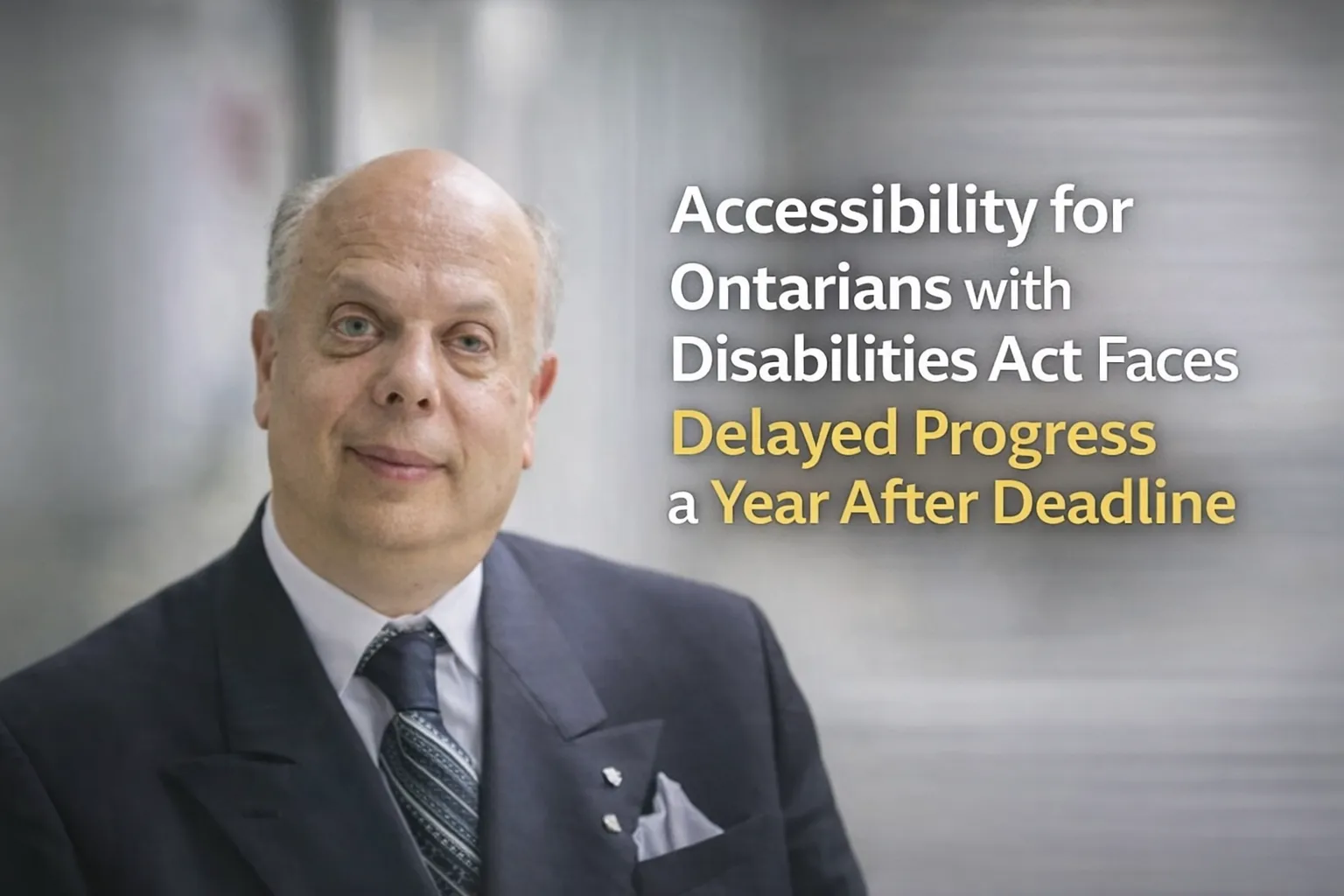
More than a year after the January 1, 2025 deadline for making Ontario fully accessible under the Accessibility for Ontarians with Disabilities Act (AODA), advocates and community members continue to voice frustration over the lack of meaningful progress. Despite the law’s clear mandate and its legal obligations, advocates like David Lepofsky, a disability rights lawyer, and Jim McEwen, a Clarington resident living with a disability, say Ontario has failed to implement substantial changes or improvements for people with disabilities.
Lepofsky, who has been closely tracking AODA progress for decades, expressed his dissatisfaction with the government’s inaction. “The only change has been in the wrong direction,” Lepofsky said. “The government has announced absolutely no new actions on implementing and enforcing the AODA since it missed the deadline a year ago. In fact, it hasn’t even publicly acknowledged that it missed the deadline.”


Lepofsky, the leader of the AODA Alliance, a group dedicated to tracking accessibility issues, pointed out that despite multiple recommendations from government-appointed panels on accessibility standards in employment, education, healthcare, communications, transportation, and the built environment, nothing has been enacted. These panels have submitted recommendations over the years, but Lepofsky argued that the government has done nothing to address these critical issues.

One key area of frustration is accessible housing. With housing becoming an ever-growing issue in Ontario, there has been no movement on providing accessible housing solutions, despite the ongoing housing crisis. “They have enacted nothing,” Lepofsky stated, highlighting the failure to prioritize this essential issue.
Locally, Jim McEwen, a member of the Region of Durham’s Accessibility Advisory Committee and a stroke survivor from Clarington, echoed Lepofsky’s concerns. McEwen, who uses a wheelchair, shared that he has seen no improvements in accessibility in the last year since the deadline. He acknowledged the efforts at the municipal level—particularly in Clarington, where officials are looking into amending traffic bylaws to exempt those with accessible permits from parking fees—but said that large-scale, systemic change remains elusive.
McEwen’s personal pet peeve is the lack of accessible washrooms in public places. He shared that, on several occasions, he has had to ask another person to assist him in opening washroom doors so he can access facilities. This is an issue that still persists, despite being a legal requirement under the AODA. “There should be an accessible washroom in each restaurant and accessible doors to get in and out of washrooms,” McEwen said, expressing his frustration.
Raymond Cho, the Minister for Seniors and Accessibility, did not respond to requests for comment regarding the ongoing accessibility challenges.
As Ontario moves forward in 2026, both Lepofsky and McEwen agree that more work must be done to make Ontario fully accessible for all residents, particularly for those with disabilities. “We should be doing better,” McEwen said, emphasizing that progress needs to happen now.