








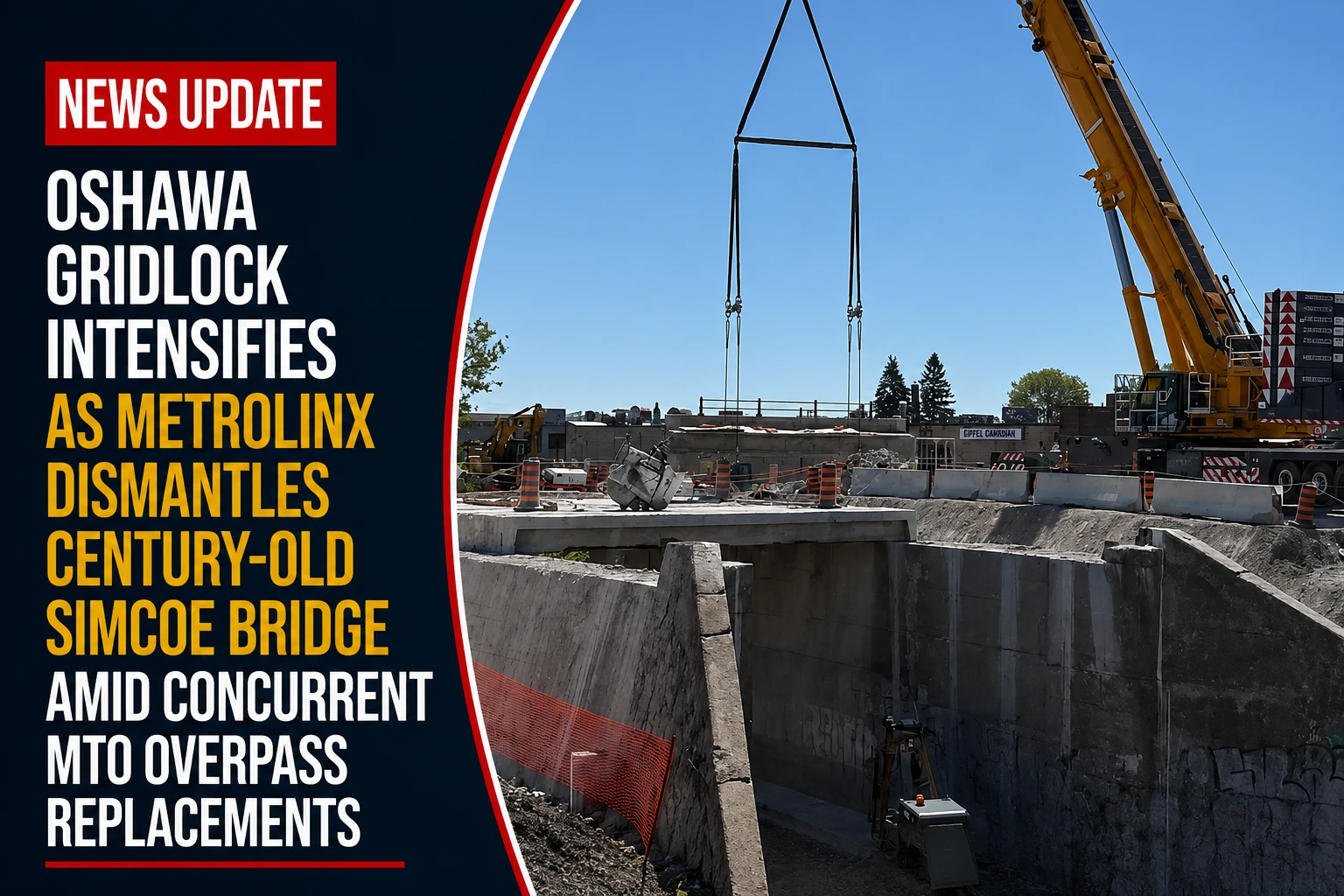
The regional engineering bureaus, provincial transit authorities, and municipal public works networks within the Durham Region are navigating an unprecedented traffic management challenge. Tracked under provincial transit infrastructure, highway expansions, and municipal road network portfolios on Wednesday, July 15, 2026, transportation planners finalized the high-tier disruption brief Traffic chaos in Oshawa continues as ancient bridge slowly comes down for GO train expansion. Crews have begun the methodical, beam-by-beam demolition of the 100-plus-year-old Simcoe Street bridge spanning the CP rail lines. The complex engineering task is part of the province’s Bowmanville GO Extension project, but its execution—paired with a sudden acceleration of Ministry of Transportation (MTO) highway widening projects—has severed the primary north-south arteries connecting downtown Oshawa to Highway 401 and the southern industrial sectors.
City council members are escalating pressure on provincial agencies, warning that the uncoordinated pooling of multiple multi-year bridge rebuilds within a single square kilometer has trapped local neighborhoods in a structural traffic bottleneck.

The Demolition Chronology and GO Expansion Mandate
The removal of the historic steel-and-concrete span is required to clear the structural footprint for the next generation of rapid mass transit.


-
The Simcoe Shutdown Profile: The critical arterial corridor has been entirely blocked to physical vehicular traffic since January 2026 and is locked down for an absolute remaining duration of 18 months.
-
The Metrolinx Transit Objective: Engineering crews must entirely replace the ancient, narrow overpass with a significantly wider, modernized bridge structure capable of carrying new passenger rail lines directly into the planned Central Oshawa GO Station situated immediately to the east.
-
The Long-Term Corridor Utility: For nearly a century, the original bridge served as the primary transit vein feeding workers from northern residential communities directly down to the historic General Motors assembly plant and the core Highway 401 ramps.
Analyzing the Concurrent MTO Overpass and Closure Matrix
Compounding the Metrolinx rail work, the Ministry of Transportation has aggressively accelerated its Highway 401 multi-lane widening program, shutting down secondary neighborhood relief routes simultaneously.
| Blocked Transit Corridor | Exact Physical Closure Boundaries | Core Provincial Agency in Charge | Underlying Project Purpose | Projected Road Reopening Target |
| Simcoe Street South | Over the primary CP Rail lines (Immediately west of the future GO hub). | Metrolinx (Bowmanville GO Extension Portfolio) | Complete demolition and replacement to fit expanded twin tracks underneath. | Early 2028 (18 months remaining in a 2-year window) |
| Park Road | From Bloor Street to College Avenue (Shut down early on July 13, 2026). | Ministry of Transportation (MTO) | Complete demolition and structural replacement of the main Highway 401 overpass. | Fall 2027 (Moved up from the original 2027 construction calendar) |
| Cubert Street | Sector connecting Bloor Street directly to northern residential grids. | Ministry of Transportation (MTO) | Structural highway overpass replacement to allow wider lane counts below. | Fall 2027 (Currently locked to all non-construction vehicles) |
| Wilson Road | From Dieppe Avenue to Bloor Street | Ministry of Transportation (MTO) | Full overpass rebuilding sequence to expand regional highway clearances. | Late Spring 2027 (Sustained full corridor blockage) |
The Metrolinx Bowmanville Extension Project Office, the Ministry of Transportation Central Region Operations Branch, and the City of Oshawa Traffic Engineering Department handle ongoing construction scheduling, localized detour configuration, and signal timing adjustments.
Oshawa commuters, logistical transit managers, and local business operators looking to download official detour route maps, track real-time lane restriction modifications via provincial traffic cameras, or submit public complaints to the regional construction review board can access the systems online through the central Metrolinx project hub, review construction schedules via the Ontario Ministry of Transportation portal, or monitor regional transit delay indexes through the Durham Region public safety dashboard.