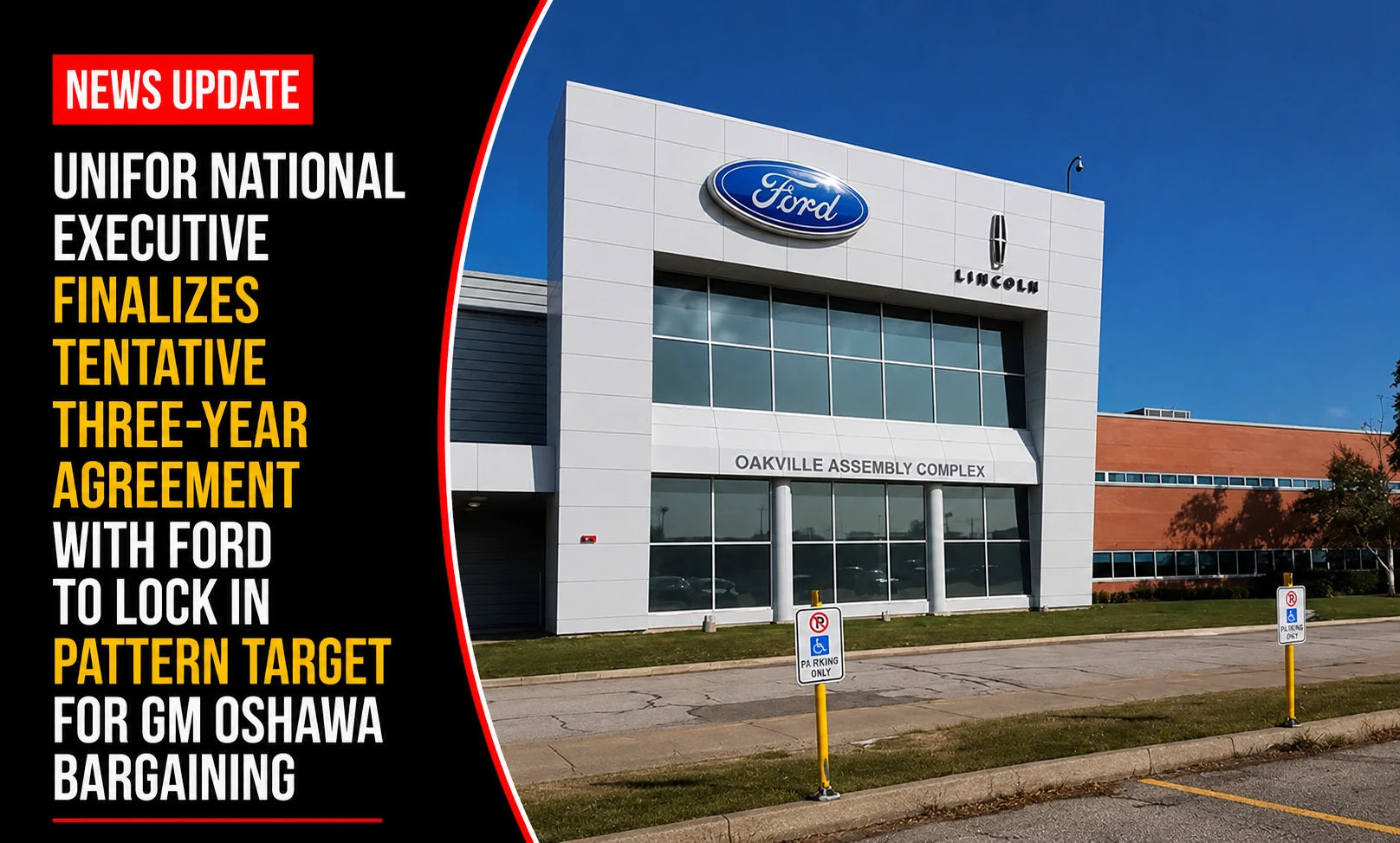
The regional labor councils, municipal economic planning units, and automotive parts manufacturing networks within the Durham Region are preparing for immediate contract alignment phases. Tracked under provincial industrial economics, corporate manufacturing, and collective bargaining portfolios on Monday, July 13, 2026, labor relations monitors finalized the high-priority industrial log Union, Ford employees in Oakville, reach tentative deal. Following a condensed two-week period of intensive contract talks that launched on June 22, the Unifor national leadership team successfully reached a comprehensive tentative settlement with the Ford Motor Company. This milestone establishes the binding operational “pattern” that will legally dictate the boundaries for upcoming high-stakes master agreement renewals with General Motors and Stellantis.
National union executives note that establishing a unanimous committee endorsement ahead of the summer plant retooling schedules provides immediate leverage to protect advanced assembly jobs against rising macroeconomic and tariff pressures.
The Multi-Facility Master Contract Footprint
The economic framework covers a diversified national industrial workforce across multiple manufacturing, power-train, and logistical distribution nodes.
-
The Labor Volume: The newly minted tentative settlement directly impacts 5,150 unionized industrial workers operating across the country.
-
The Contract Lifespan: The legal package locks in a fixed three-year duration, anchoring baseline operational structures and employment guarantees through to mid-summer 2029.
-
The Voting Window: Full technical parameters and financial breakdowns will remain strictly confidential until they are presented directly to the rank-and-file membership during mandatory regional ratification meetings scheduled for July 17–19.
-
The National Plant Grid: Beyond the core Oakville Assembly complex, the legal text covers workers at the Windsor Annex and Essex Engine plants, alongside essential parts distribution hubs in Paris and Casselman, Ontario, and Leduc, Alberta.
Analyzing the Automotive Master Bargaining and Regional Pattern Cascade
The successful execution of the Ford contract phase triggers an immediate structural transition into secondary-tier automotive negotiations across the province.
| Industrial Phase Node | Active Workforce Volume | Primary Facility Targets Involved | Core Collective Bargaining Strategy | Localized Durham Regional Impact Vector |
|
Phase 1: The Ford Pattern (Current Milestone) |
5,150 Active Members | Oakville Assembly, Windsor Engine, Paris & Casselman Logistical Hubs. | Establishes the foundational floor for wages, pension adjustments, and job security protections. | Acts as the operational template that sets expectations for the entire Canadian auto sector. |
|
Phase 2: The GM Transition (Imminent Execution) |
Thousands of Local Workers | Oshawa Assembly Complex, St. Catharines Propulsion, Woodstock Parts Hub. | Unifor negotiators will bring the Ford pattern to the table, forcing GM to match or exceed the terms. | Directs contract stability for Unifor Local 222 shop floors amid next-gen truck production concerns. |
|
Phase 3: Tier-1 Parts Grid (Downstream Flow) |
Extensive Regional Networks | Local specialized parts stamping, injection molding, and sequencing plants. | Supply houses adjust localized labor budgets based on the master assembly agreements. | Normalizes the broader industrial economic framework across the Whitby-Oshawa manufacturing zone. |
The Unifor National Executive Board, the Ford Master Bargaining Committee, and the General Motors Corporate Labor Relations Division handle ongoing ratification management, contract text dissemination, and pattern matching preparations.
Oshawa autoworkers, local industrial parts manufacturers, and regional economic analysts looking to monitor the upcoming local GM bargaining schedules, track official union voting return parameters post-July 19, or review historical Canadian automotive labor output data sheets can find the networks online through the central Unifor National portal, track local updates via the Unifor Local 222 dashboard, or monitor industrial market indicators through the Durham Region business dashboard.