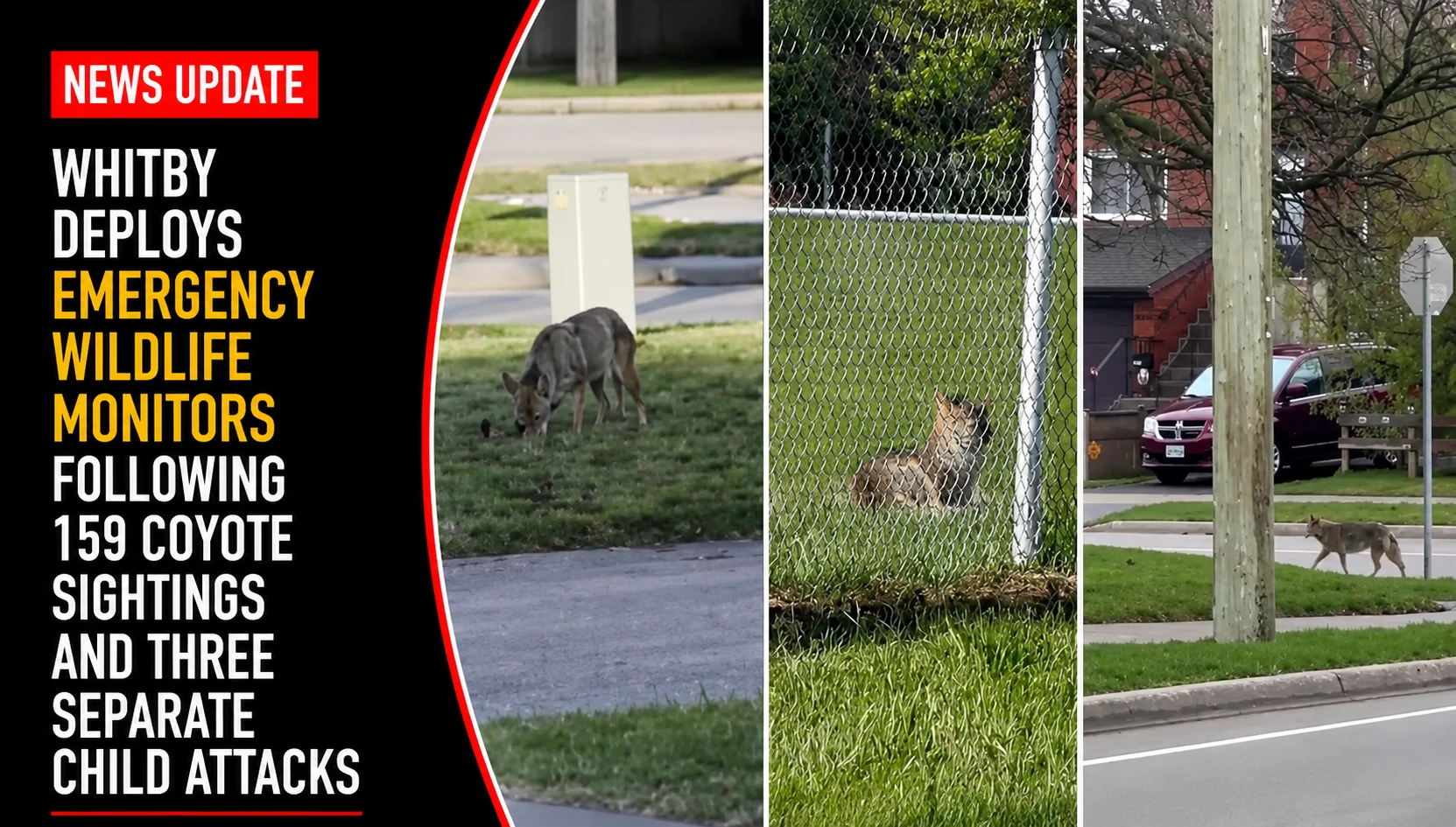
The municipal animal services divisions, public safety task forces, and emergency council desks within the Durham Region have instituted active environmental interventions. Tracked under local governance, public safety, and wildlife management portfolios on Monday, July 13, 2026, bylaw enforcement managers finalized the high-alert tracking brief Violent coyote attacks leave Whitby parents and pet owners on edge: ‘I have never seen so many’. Following a dangerous spike in bold wildlife behaviors inside high-density residential subdivisions, the Town of Whitby has executed emergency trail closures and mobilized dedicated tracking nets to manage escalating interface risks between urban populations and habituated predators.
Public safety commanders warn that the animals are demonstrating an unprecedented breakdown in standard fear responses, shifting their hunting and territorial behaviors directly into daylight neighborhood parks and school properties.


The Attack Ledger and Geolocation Trajectory
Municipal enforcement logs and police dispatches confirm that predatory contact has focused exclusively on young children over a localized 60-day window.


-
The Jack Miner Incident (May 2026): An eight-year-old student was aggressively ambushed and scratched by a coyote on the active property of Jack Miner Public School (144 Bleeker St.) during daytime hours.
-
The Lynde Creek Strike (June 2026): A young boy was bitten while playing in an open field zone inside Lynde Creek Park, prompting immediate regional police sweeps.
-
The Vanier Park Face Attack (July 5, 2026): In the most severe escalation to date, a toddler was bitten directly on the face by a habituated coyote while utilizing the playground structures at Vanier Park (101 Vanier Dr.).
-
The High-Density Sighting Volume: Whitby Animal Services verified an unprecedented 159 validated coyote sightings within a single 30-day tracking block, forcing the immediate emergency closure of Heber Down Conservation Area’s Heber Trail to protect the public.
Analyzing the Legislative Debate and Wildlife Management Matrix
The escalation has triggered a significant policy division within local government regarding public safety enforcement powers versus traditional non-lethal wildlife coexistence frameworks.
| Proposed Municipal Action Plan | Key Legislative / Operational Mechanics | Backing Political / Institutional Node | Primary Community Counter-Argument |
| Provincial Act Amendment | Demands a special urban exemption in the Fish and Wildlife Conservation Act to bypass current hunting/trapping restrictions. |
Coun. Chris Leahy
(Calling for emergency summer recess session) |
Animal rights groups warn that removing apex urban predators creates an immediate vacuum for unchecked rodent spikes. |
| Targeted Euthanization | Authorizes animal control officers to immediately track, muzzle, and humanely terminate habituated or aggressive wildlife. |
Municipal Precedent Stream
(Following Markham & Toronto protocols) |
Citizen Petition Network: Hundreds of local residents signed a registry opposing lethal measures. |
| Attractant Audit & Hazing | Employs high-visibility patrols, fines property owners for unsecure garbage, and uses noise sticks to re-introduce fear boundaries. |
Kate Novia, Bylaw Supervisor
(Whitby Animal Services Mandate) |
Local families argue that simple public awareness fails to protect children actively using public park structures. |
The Executive Governance Positioning
“I have never seen so many coyotes in my life,” stated Whitby Councilor Chris Leahy, who is pushing to accelerate legislative tools to allow municipal officers to humanely euthanize habituated predators showing zero fear of humans. Mayor Elizabeth Roy has formally integrated the predatory wildlife crisis into a recurring municipal safety roundtable scheduled for late summer. However, with school cycles approaching in September, ward representatives are demanding immediate school-board education sessions alongside clear operational maps so parents can visualize neighborhood wildlife hotspots in real time.
The Town of Whitby Animal Services Division, the Durham Regional Police Service (DRPS), and the Ontario Ministry of Natural Resources handle ongoing tracking mapping, attractant compliance enforcement, and public safety patrols.
Whitby parents, pet owners, and community safety advocates looking to view the live interactive coyote sighting hotspot grid, submit a localized wildlife encounter report, or read through safe wildlife hazing guidelines can access the public systems online through the central Town of Ajax-Whitby animal services portal, report urgent wildlife threats via the DRPS non-emergency link, or review safety mandates through the Durham Region public health matrix.