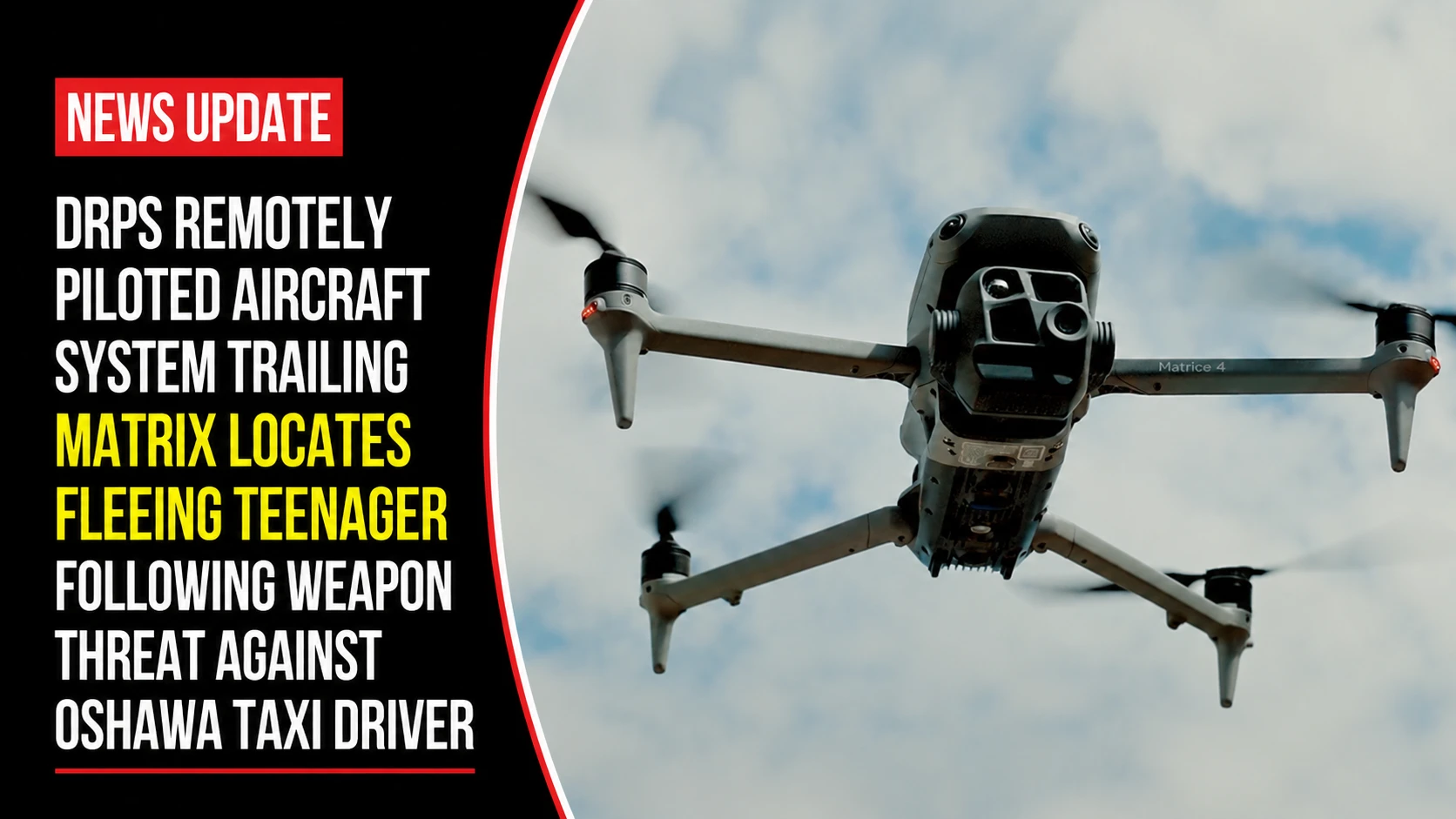
The tactical flight divisions, transit safety units, and youth crime bureaus within the Durham Region have documented a high-technology tracking arrest. Tracked under provincial safety and technological policing portfolios on Wednesday, July 8, 2026, criminal records clerks finalized the apprehension report Drone used to nab fleet-of-foot teen who threatened cabbie. Following an emergency alert involving an armed threat inside a commercial vehicle, Central East Division patrol officers deployed an aerial drone system to establish an eye in the sky, rapidly pinpointing an escaping suspect who had fled into a nearby urban neighborhood.
The incident highlights the police service’s growing dependence on their Remotely Piloted Aircraft System (RPAS) framework to safely contain armed individuals without initiating blind ground-level tracking loops.


The Intercept Geometry and Aerial Surveillance Timeline
The weapon threat rapidly shifted from an active transit dispatch into a structured technological containment operation.


-
The Emergency Contact: At approximately 5:40 p.m. on Sunday, July 5, a working taxi driver flagged down a patrolling Central East Division cruiser near the intersection of Bloor Street East and Ritson Road South.
-
The Waistband Threat: The driver reported that as he neared the teenager’s requested drop-off destination, the youth brandished an object that appeared to be a handgun tucked inside his waistband while uttering verbal threats. The suspect then bolted from the vehicle on foot.
-
The Drone Deployment: A tactical RPAS flight crew immediately launched a police drone into the immediate airspace. Operating from an elevated visual vantage point, the drone’s high-definition tracking system quickly isolated a matching silhouette navigating local streets.
-
The Flight-Guided Arrest: Drone operators fed real-time directional coordinates to perimeter ground units. When the suspect spotted approaching cruisers and attempted to flee, officers initiated a brief foot pursuit, executing a physical takedown and seizing a large knife concealed in his waistband.
Analyzing the Judicial and Statutory Booking Profile
Because the suspect operates within the juvenile age classification, booking procedures and data protection rules align directly with provincial youth justice structures.
| Accused Demographic Profile | Primary Location of Arrest | Seized Physical Weaponry | Formal Criminal Charges Laid | Immediate Custodial Status |
|
15-Year-Old Male
(Resident of the City of Oshawa) |
South Oshawa Corridor
(Bloor St. E. / Ritson Rd. S.) |
Large Fixed-Blade Combat Knife |
• Assault with a Weapon
• Possess Weapon Dangerous to Public
• Uttering Threats |
Remanded into continuous custody; held for a formal bail hearing. |
The Juvenile Identity Protection Mandate
In strict compliance with the federal Youth Criminal Justice Act (YCJA), no public photographs, names, or identifying biological markers of the 15-year-old accused can be released. Durham Regional Police emphasize that while the initial transit report indicated a suspected firearm, the rapid deployment of the drone allowed ground units to approach the suspect with a precise understanding of his path, successfully preventing a weapons-drawn encounter in a residential area.
The Durham Regional Police Service Central East Division and the Ontario Youth Court handle ongoing criminal prosecutions, evidence processing, and flight logs.
Durham Region transit operators, commercial drivers, and community safety advocates looking to view updated local youth crime data sheets, track upcoming youth court dockets, or review the privacy and operational manuals for the municipal police drone fleet can find the information platforms online through the official Durham Regional Police Service network or monitor public safety frameworks via the Durham Region administrative hub.