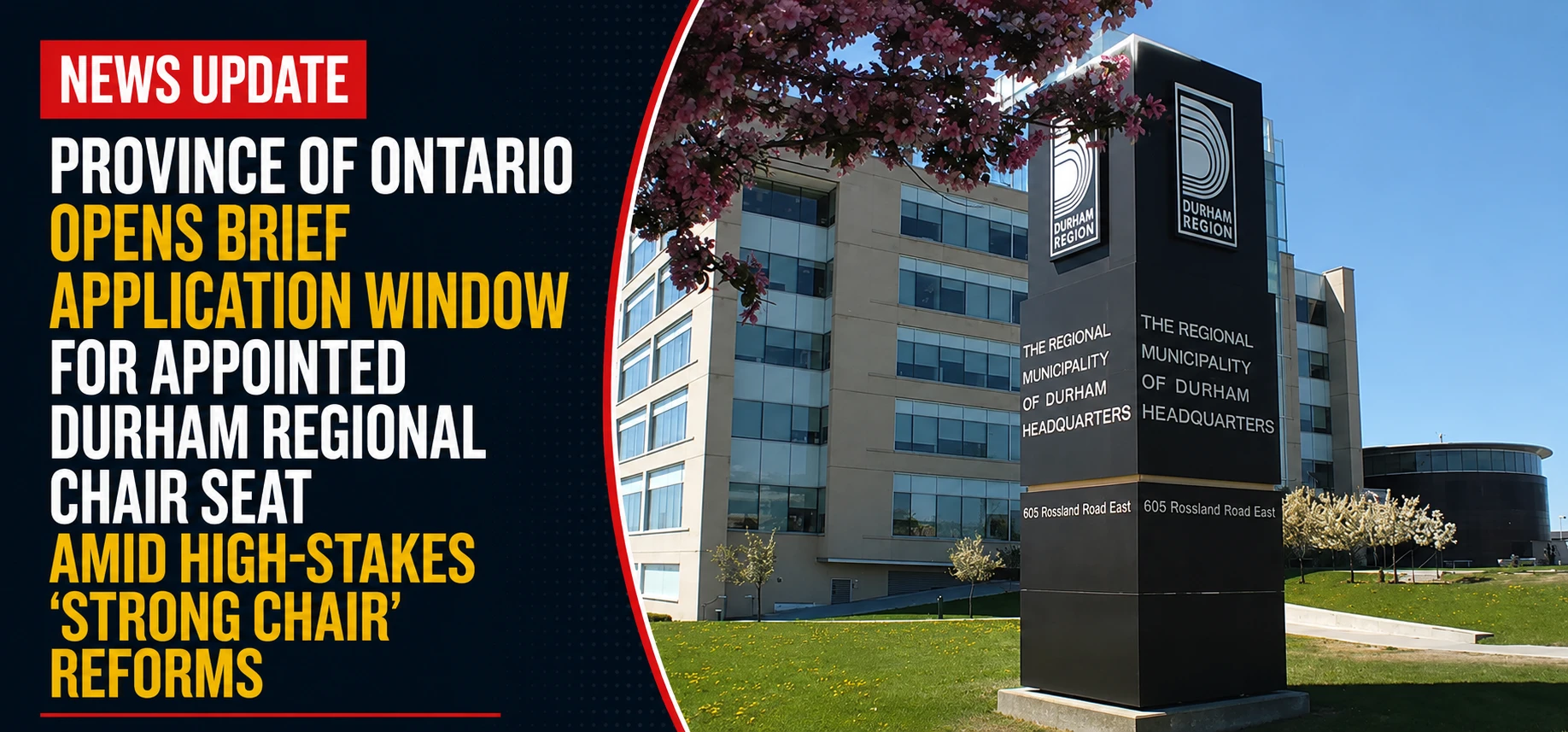
The municipal governance tables, regional legislative offices, and public administration branches across the Durham Region are navigating a massive structural disruption. Tracked under provincial and municipal political portfolios on Monday, July 6, 2026, administrative desks finalized the operational details for the recruitment file Applications for Durham Region Chair position now open. Marking the end of an era of direct public elections for the region’s highest political office, the Ministry of Municipal Affairs and Housing has officially opened a remarkably brief application window to select Durham’s next regional leader under a controversial provincial appointment model.
The incoming chair will wield newly minted, executive “strong chair” veto powers designed by the Queen’s Park administration to aggressively accelerate local housing developments.


The Legislative Shift and the Elimination of Public Elections
The transition represents a total reversal of Durham’s established municipal democratic process, sparking sharp pushback from local and provincial representatives.


-
The Legislative Foundation: Championed by Premier Doug Ford’s administration to gain direct control over regional planning, the provincial bill became law in May. It empowers Municipal Affairs and Housing Minister Rob Flack to directly appoint regional chairs in Durham, Halton, Niagara, Peel, Waterloo, York, Muskoka, and Simcoe County.
-
The Democratic Rollback: In 2010, Durham residents voted overwhelmingly in a public referendum to establish a direct election model for the Regional Chair. Voters successfully chose their leaders at the ballot box in 2014, 2018, and 2022.
-
The Political Backlash: Incumbent Durham Chair John Henry—who has held the seat since 2018—called the decision “deeply disappointing,” stating that replacing public elections with a provincial appointment breaks a critical link of accountability between residents and regional leadership. In the legislature, Oshawa MPP Jennifer French fiercely criticized the law, labeling the upcoming appointed figures “puppet chairs” and calling the system “taxation without representation.”
The Compensation and ‘Strong Chair’ Power Matrix
The selected applicant will step into a highly lucrative position backed by unprecedented executive authorities that bypass traditional regional council voting majorities.
| Executive Governance Metric | Assigned Structural Framework / Value | Primary Operational Authority |
| Base Financial Salary | $224,823 Baseline Cash Compensation | Standard municipal executive ledger line |
| Total Compensation Package | Exceeding $250,000 annually | Includes board stipends, per-diems, and operational expenses |
| Administrative Control | “Strong Chair” Statutory Powers | Unilateral authority to hire or fire the CAO and department heads |
| Legislative & Budget Authority | Veto Capabilities | Power to veto specific bylaws and directly write the annual budget |
The Brief Application Timeline and Prerequisite Baseline
While Minister Flack maintained at Queen’s Park that “nobody was fired” and that John Henry is fully welcome to apply through what he promised would be an “open process,” the timeline to submit documentation is unusually tight.
The application window officially opened on June 29 and will slam shut on Monday, July 13, 2026. Successful candidates are highly recommended to possess prior elected political experience, a deep understanding of upper-tier provincial priorities, and a proven track record of leading major structural changes in large organizations. The designated term of office will run from November 15, 2026, to November 14, 2030—aligning directly with the incoming regional council representatives who will take office following the upcoming municipal elections on October 26. John Henry has confirmed his time in the chair’s seat is ending but stated his commitment to serving Durham in new capacities remains unchanged.
The Ministry of Municipal Affairs and Housing manages the central selection and vetting registry for the appointed seat.
Durham Region taxpayers, political analysts, and potential applicants looking to look over the official job description, download the provincial appointment application forms, or track the legislative history of the regional restructuring bill can access the public information portals online at ontario.ca/government, durham.ca, or track Queen’s Park debates via ola.org.