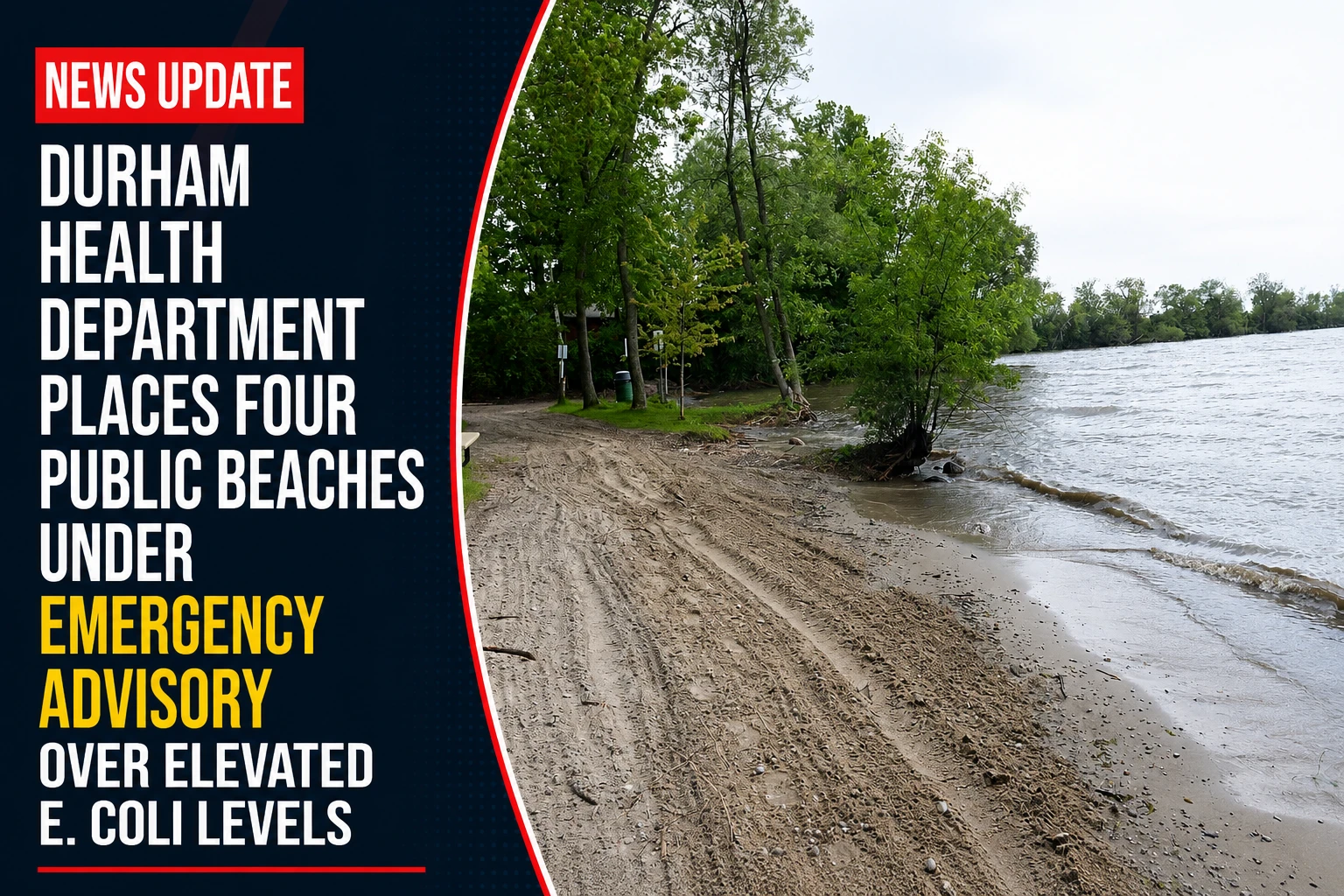
The public health inspectorates, regional environmental monitoring divisions, and municipal parks departments across the Durham Region have issued urgent shoreline safety closures. Tracked under local public health registries on Friday, July 3, 2026, medical officers finalized the testing logs for the brief Stay out of the water at four Durham public beaches. Driven by high-volume agricultural runoff and warm water temperatures accelerating bacterial reproduction following recent Canada Day storms, laboratory tests confirmed that four distinct regional swimming zones have breached provincial safety limits.
Beachgoers are being warned to avoid any swimming, wading, or direct water contact at the flagged locations to prevent severe gastrointestinal illness and secondary bacterial infections.


The Statutory Provincial Safety Guidelines
The Ontario Ministry of Health and Long-Term Care enforces strict regulatory boundaries to determine whether open public waters are safe for human contact. A beach is legally declared unsafe for swimming if:


-
A single individual water sample contains 400 or more E. coli bacteria per 100 millilitres of liquid.
-
The geometric mean of five separate water samples collected over a trailing testing block reaches 200 or more E. coli bacteria per 100 millilitres.
Because laboratory incubation and transportation protocols require a day or more to process fully, public health officials stress that the data reflects conditions at the time of collection. As a general rule, residents should never swim if the water appears unusually cloudy, if large flocks of waterfowl are present on the sand, or for at least 48 hours following a major convective rainstorm.
Analyzing the Durham Region Public Beach Water Status Grid
While the four northern and inland sites have been posted with warning signs, all major southern shores along Lake Ontario currently remain clear and safe for weekend swimming.
| Monitored Public Beach Facility | Geographic Boundary Intersection | Regional Municipality | Verified Water Safety Status |
| Beaverton North Beach | Wellington Street & Victoria Street | Township of Brock | UNSAFE — Swimming Prohibited |
| Beaverton South Beach | Simcoe Street & Harbour Park Crescent | Township of Brock | UNSAFE — Swimming Prohibited |
| Kinsmen Beach | Water Street & Mary Street | Township of Scugog | UNSAFE — Swimming Prohibited |
| Rowan Beach | Rowan Avenue (Caesarea) | Township of Scugog | UNSAFE — Swimming Prohibited |
| Frenchman’s Bay East Beach | Wharf Street & Liverpool Road | City of Pickering | Safe — Open for Recreation |
| Frenchman’s Bay West Beach | West Shore Blvd & Beachpoint Prom | City of Pickering | Safe — Open for Recreation |
| Paradise Beach | Lakeview Boulevard & Paradise Lane | Town of Ajax | Safe — Open for Recreation |
| Iroquois Beach | Gordon Street & Waterfront Trail | Town of Whitby | Safe — Open for Recreation |
| Whitby Beach | South Blair Street & Water Street | Town of Whitby | Safe — Open for Recreation |
| Lakeview East Beach | Simcoe Street South & Lakeview Park Ave | City of Oshawa | Safe — Open for Recreation |
| Lakeview West Beach | Kluane Avenue & Lakeview Park Ave | City of Oshawa | Safe — Open for Recreation |
| Bowmanville East Beach | Port Darlington Road & East Beach Road | Municipality of Clarington | Safe — Open for Recreation |
| Bowmanville West Beach | West Beach Road & Cove Road | Municipality of Clarington | Safe — Open for Recreation |
| Newcastle Central Beach | Mill Street South & Boulton Street | Municipality of Clarington | Safe — Open for Recreation |
| Thorah Centennial Park Beach | Shoreline Road & Thorah Concession Rd 9 | Township of Brock | Safe — Open for Recreation |
Pathogen Exposure Warning: Accidental ingestion of contaminated beach water can lead to severe food-poisoning symptoms, including debilitating stomach cramps, bloody diarrhea, and acute vomiting. High E. coli counts also indicate a strong presence of other invisible pathogens that can trigger severe ear, eye, nose, and throat infections, as well as painful skin rashes.
Public health teams are also monitoring the shores for toxic blue-green algae blooms, which can be lethal to dogs and local wildlife. Field inspectors will collect the next round of water samples early next week to determine if the advisories can be lifted.
The Durham Region Health Department Health Protection Division manages all central water quality registries.
Durham swimmers, cottage owners, and families looking to review updated ppm bacteria counts, check for toxic blue-green algae alerts, or track upcoming municipal park closures can access the official environmental health portal online at durham.ca/beaches or monitor provincial alerts via ontario.ca/health.