








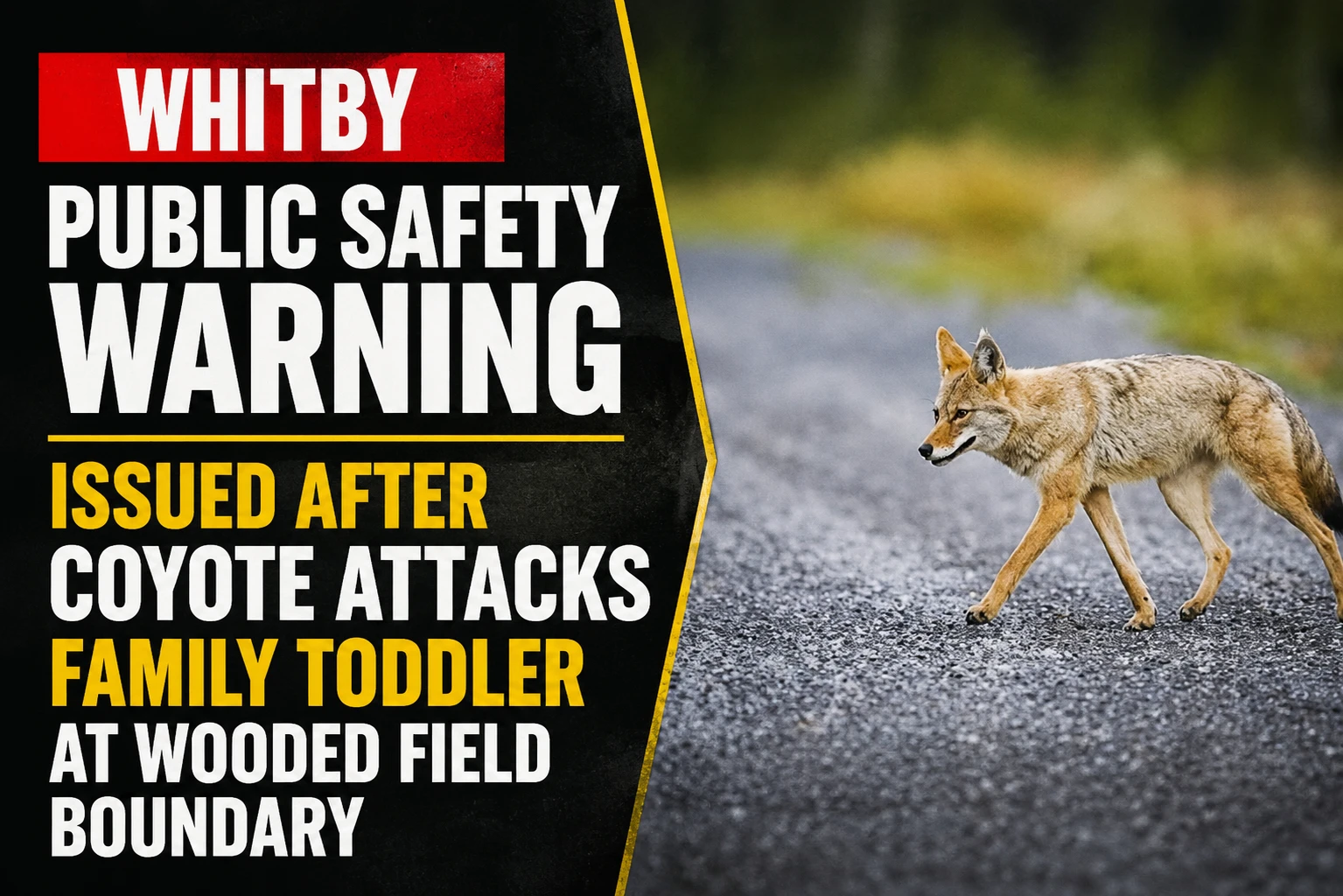
The municipal protection networks, wildlife control agencies, and public safety divisions within the Town of Whitby are operating under an emergency awareness directive. Tracked under regional protective service profiles on Thursday, June 25, 2026, commanders from the Durham Regional Police Service (DRPS) unsealed a high-priority advisory detailing Police, mayor cautioning residents after toddler bitten by coyote in Whitby. The critical alert stems from a rare predatory encounter where a young child was attacked and bitten by an aggressive wild canine, mobilizing county health assets and prompting city administrators to adjust wildlife response policies.
While municipal animal services track localized wildlife movements across the urban-rural boundary, community health teams are emphasizing a region-wide spike in bold, food-conditioned animal behaviors.

The Coronation Road Encounter and Emergency Medical Transfer
The dynamic investigation focuses on a specific public green space where residential developments meet dense brush lines, a natural corridor for regional wildlife.


-
The Incident Scene: The encounter occurred on Monday, June 22, 2026, within a public field running alongside a heavily forested tree line near Coronation Road and Rossland Road West in Whitby.
-
The Attack Dynamic: The victim, a young male toddler, was walking alongside his parents when a coyote emerged from the brush and bit the child. Frontline emergency personnel stabilized the toddler at a local hospital before trauma teams coordinated a transfer to a specialized medical facility in Toronto, where he remains in stable condition.
-
The Regulatory Response: Following the attack, DRPS officially notified Durham Region Public Health and Whitby Animal Services to initiate active tracking, disease screening protocols, and physical monitoring across the zone.
Analyzing Municipal Wildlife Trends and Town Response Strategies
The town’s internal data shows that interactions along the green spaces in southern Durham have steadily climbed, causing concern for local families.
| Monitored Wildlife Vector | 30-Day Documented Sightings | Active Safety Protocol | Core Municipal Policy Initiative |
| Urban Coyote Network | 46 Active Resident Reports | Stand tall, wave arms, yell “Go Away” | Enforced ban on wildlife feeding |
| Local Trail Boundaries | High Activity Clusters | Pick up small pets and toddlers immediately | Specialized school education sessions |
| Residential Fence Lines | Scattered Den Enclosures | Never turn your back or run from animal | Public interactive tracking dashboard |
Whitby Mayor Elizabeth Roy expressed deep concern for the injured child and his family, announcing that she is putting coyote management at the top of the agenda for the upcoming community roundtable session later this summer. The collaborative safety group—which connects police, school board trustees, and municipal staff—will look at expanding school education campaigns, following a successful wildlife safety session held at a Whitby elementary school last month after a coyote wandered onto school grounds.
Wildlife experts note that there have been roughly 50 coyote-related police files across the region since early last year. They emphasize that feeding wildlife—either directly or accidentally through unsecured green waste totes, fallen orchard fruit, and outdoor pet dishes—remains the number one driver behind animals losing their natural fear of humans.
Whitby residents, outdoor park users, and local property owners looking to report aggressive wildlife encounters, check active sighting hot-spots on the community map, or review aversion techniques can find the town’s interactive dashboard online at whitby.ca/coyotes.