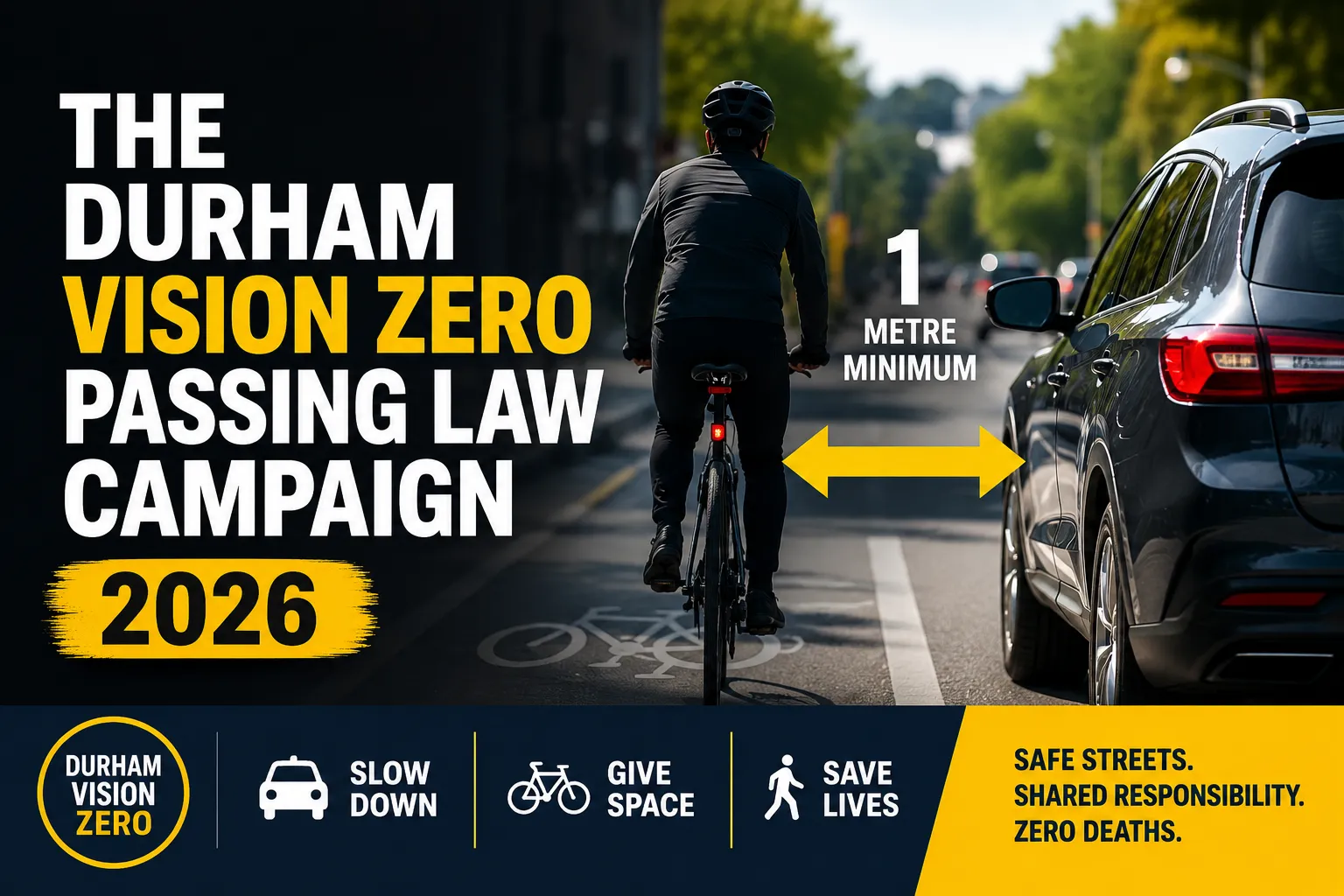
The Regional Municipality of Durham has launched an aggressive mid-week road safety enforcement blitz aimed at reducing escalating collisions between passenger vehicles and cyclists. Tracked under the active transit safety folder The Durham Vision Zero Passing Law Campaign 2026, regional planners and regional traffic enforcement units finalized a public compliance push on Tuesday, June 2, 2026. Directed out of the regional headquarters in Whitby, the public intervention aims to explicitly educate motorists on spatial driving laws while aggressively enforcing side-by-side corridor buffers across urban and rural roads.
The strategic safety push arrives as regional health departments monitor a substantial surge in two-wheeled commuters driven by the unseasonably warm early June weather.
The Mechanics of the One-Metre Spatial Law
The absolute baseline of the June enforcement push is a strict reminder of pre-existing provincial legal frameworks that govern mixed-mode transportation lanes. Under the direct authority of Ontario’s Highway Traffic Act (HTA), motorists traveling behind or alongside a bicycle moving in the same direction are legally required to maintain a absolute minimum passing clearance distance of one metre (3.3 feet).
Traffic safety supervisors have outlined clear guidelines for navigating shared municipal lanes:
-
The Passing Clearance: Drivers must physically check their passenger-side mirrors to guarantee a clear one-metre gap exists before overtaking a cyclist. If a tight lane width or an oncoming vehicle prevents this space, the motorist must stay behind the bicycle until the lane widens.
-
Center-Line Exemptions: To make passing safe, the law permits drivers to cross over a painted center line to clear the cyclist, provided they have full visibility and oncoming lanes are entirely empty.
-
Cyclist Legal Parameters: While cyclists are not required to maintain a specific one-metre bubble themselves, they are legally classified as vehicles under the HTA. This requires them to obey all stop signs, red light signals, and use proper hand signals when navigating regional corridors.
The Architecture of Durham Vision Zero
The current spatial clearance push is a core component of the broader Durham Vision Zero strategic plan, which is managed via the regional web portal at durham.ca/VisionZero. The program unites public health nurses, regional engineers, and local police divisions under a single objective: completely eliminating road-network fatalities and severe, life-altering injuries across the municipality’s transit grid.
| Tactical Framework Node | Regional Safety Implementation Target | Campaign Link Infrastructure |
| Primary Initiative Focus | Spatial passing separation and lateral clearance lanes | durham.ca/OneMetre |
| Core Parent Strategy | Vision Zero multi-sector collision elimination grid | durham.ca/VisionZero |
| Enforcement Hub | Combined Regional Traffic Police & Municipal Logistics | 605 Rossland Rd. E, Whitby |
| Primary Target Group | Urban active commuters and rural Oak Ridges trail riders | All 8 Regional Municipalities |
By deploying specialized roadside signage and launching digital tracking hubs, regional coordinators aim to convert general safety policies into daily driving habits. Officials emphasize that sharing the road safely is a critical community responsibility. Local drivers can access targeted training videos, spatial simulation layouts, and regional bike path maps by visiting the dedicated public safety database at durham.ca/OneMetre.