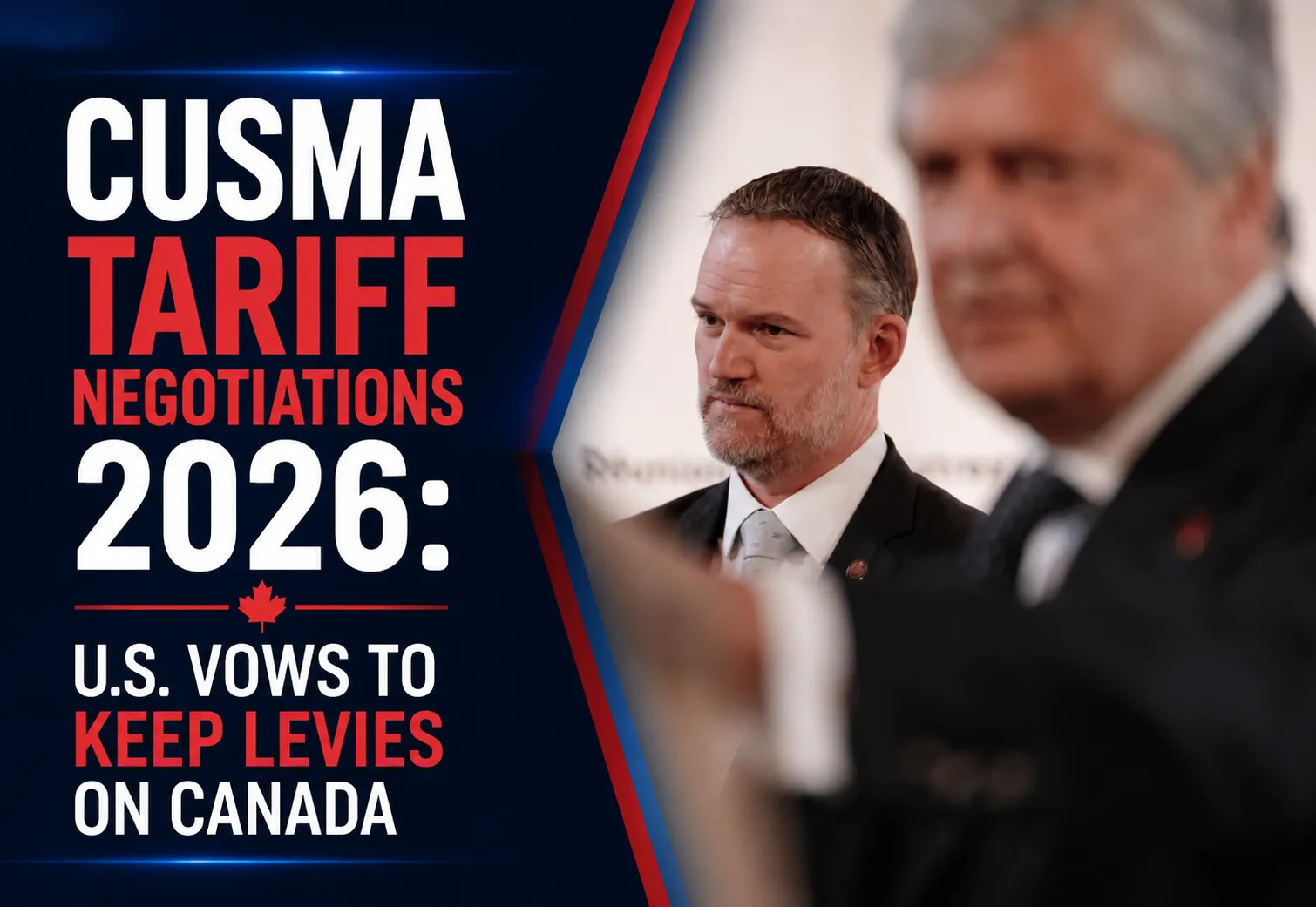
A severe international economic headwind is intensifying against the industrial heartland of Southern Ontario after the White House issued an aggressive policy declaration regarding the future of continental trade. Under the geopolitical files tracking the CUSMA Tariff Negotiations 2026, United States Trade Representative and designated “trade czar” Jamieson Greer confirmed that punitive American tariffs will remain permanently fixed onto Canadian exports, even if a trilateral agreement is successfully preserved.
The protectionist stance marks a volatile diplomatic standoff between Washington and Ottawa, threatening to disrupt hundreds of billions of dollars in highly integrated supply chains that anchor the manufacturing economy of the Durham Region.
The Looming CUSMA July Deadline
The trade dispute is unfolding alongside an approaching statutory deadline governing the Canada-United States-Mexico Agreement (CUSMA). In July 2026, all three sovereign signatories face a critical three-way choice under the pact’s built-in review clause:
-
Renew: Formally recommit to the continental trade deal for an additional 16-year term.
-
Withdraw: Issue an official notice of intent to exit the trade alliance completely.
-
The Standoff Option: Signal non-renewal while avoiding immediate withdrawal, a move that triggers a grueling annual review cycle capable of dragging negotiations out for up to a decade.
While Washington has already entered into formal, structured treaty negotiations with Mexico, the Trump administration has explicitly refused to open identical tables with Canada. U.S. officials are keeping the negotiation pipeline frozen, a diplomatic deep-freeze sparked by a dispute over an Ontario-sponsored ad campaign that used quotes from former U.S. President Ronald Reagan to criticize protectionist tariffs.
Despite a brief diplomatic thaw in March—when Canada-U.S. Trade Minister Dominic LeBlanc, chief negotiator Janice Charette, and Ambassador Mark Wiseman held an emergency meeting with Greer—the U.S. trade representative signaled no room for compromise. Greer noted that while most international trading partners have “begrudgingly” accepted Trump’s tariffs as a baseline reality, Canada continues to aggressively push back against the financial penalties.
Direct Structural Vulnerabilities for Durham Industry
While basic commodity lines like energy grids, critical minerals, and fertilizers have been shielded under compliance rules, the White House is actively utilizing aggressive separate sectoral tariffs to penalize Canadian manufacturing.
This targeted strategy threatens the economic vitality of the Durham Region, most notably within Oshawa’s automotive assembly ecosystem. Highlighting an uncompromising protectionist stance on cross-border supply chains, Greer repeated President Trump’s controversial rhetoric regarding the domestic auto sector, asking an audience at the Council on Foreign Relations, “Why do we make cars in Canada?”
The immediate continuation of these 10 percent sectoral tariffs threatens the financial margins of automotive parts suppliers, logistics networks, and secondary manufacturing plants scattered across Ajax, Whitby, and Clarington. To coordinate a unified domestic defense, Minister LeBlanc hosted an emergency summit with provincial and territorial trade ministers on Monday to draft retaliatory contingencies and economic safety nets. Local industrial boards are urging regional manufacturers to brace for a highly combative summer negotiation cycle, as the U.S. administration aims to aggressively force supply chain infrastructure back inside American borders under the guise of national security.