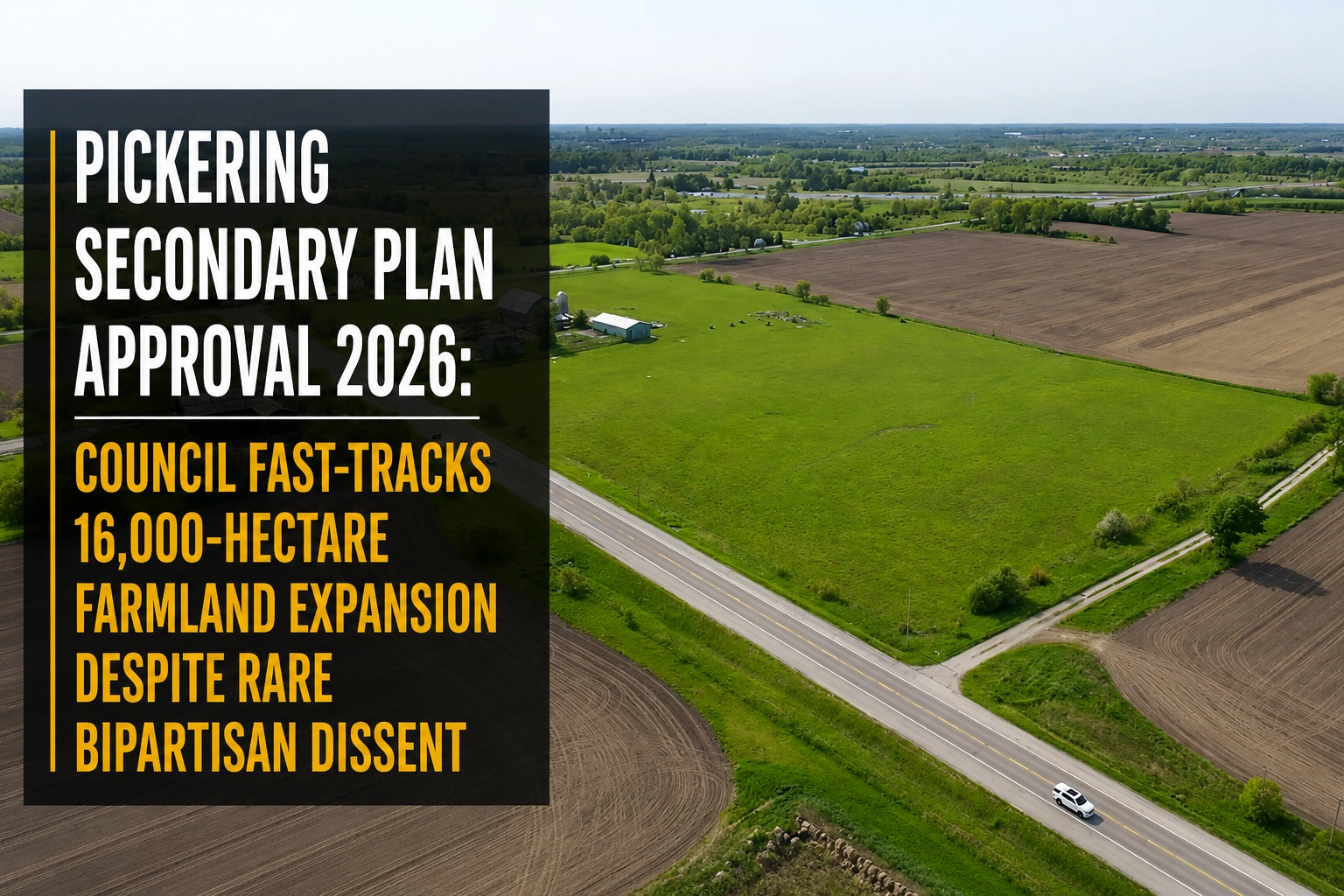
Defying intense pushback from agricultural advocates, local environmental coalitions, and regional First Nations, Pickering City Council has officially greenlit the highly controversial Northeast Pickering Secondary Plan. In a tense, late-night session, lawmakers voted 5–2 to adopt the sweeping urban expansion master plan, permanently designating 16,000 hectares of pristine Class 1 farmland for future subdivision and commercial zoning. The decision represents a monumental and irreversible victory for developer consortiums, effectively clearing the primary administrative hurdle required to transform the municipality’s northern agricultural reserve into a massive suburban network designed to absorb 72,000 new residents over the next quarter-century.
The successful vote has immediately fractured council chambers, drawing blistering condemnation from dissenting representatives who argue that fast-tracking structural zoning approvals prior to completing fundamental ecological and financial reviews amounts to an absolute failure of responsible urban planning.


“Backwards Planning” and Unfinished Growth Corridors
The opposition inside city chambers was anchored by a rare alliance between Councillors Lisa Robinson and Maurice Brenner—two political figures who routinely sit on opposite sides of municipal debates but united to vote against the secondary plan. Following the vote, Robinson openly challenged the absolute urgency driving the expansion, scathingly labeling the majority decision as “backwards planning.”


Robinson pointed out that the city is rushing into permanent urbanization decisions without a complete blueprint of the downstream consequences. Major statutory assessments required to evaluate the long-term impact of the master plan—including critical environmental, groundwater, hydrology, flood mitigation, transportation, servicing, and fiscal impact analyses—have either not been completed or have yet to be initiated.
Furthermore, Robinson rejected the dominant pro-development narrative that Pickering is facing a catastrophic land shortage requiring the immediate sacrifice of prime agricultural reserves. She argued that the municipality possesses an abundance of underutilized properties, commercial redevelopment opportunities, high-density intensification corridors, and massive, unfinished growth zones—most notably within the ongoing Seaton community development itself.
The Assembly Rejection and Speculative Land Expansion
The ideological divide on council was laid bare during procedural maneuvers preceding the final tally. Robinson attempted to introduce an emergency motion seeking a formal deferral of the secondary plan to allow for an extended window of public consultation and independent science reviews. However, the motion died instantly on the floor for lack of a seconder, signaling a unified wall among the remaining five council members to push the developer-led initiative across the finish line.
This rapid execution is particularly troubling to residents because many of the upcoming technical impact studies will ultimately be financed directly by the private development interests holding land titles within the targeted tract. Opponents argue that allowing the very parties who stand to reap hundreds of millions of dollars from the approvals to fund the scientific baselines used to justify the project completely erodes public trust.
Compounding the ethical friction, Robinson revealed she had personally participated in private conversations with landowners who openly discussed the astronomical capital tied to these municipal designations, focusing heavily on the staggering corporate profits connected to future land flipping and artificial land value inflation rather than sustainable community planning. “At one point, I was literally told, ‘I probably shouldn’t be telling you this,'” Robinson stated, noting that the encounter stripped away any illusion of careful civic design, revealing instead an aggressive environment of speculative real estate expansion.
With staff admitting that actual shovels will likely not break ground on the northeast agricultural sector for years, the rush to lock in irreversible zoning designations leaves a vast cross-section of Durham residents feeling entirely unheard. Local environmental watchdogs are already mapping out appeal strategies, warning that once these Class 1 topsoils and delicate groundwater recharge systems are paved over, no future municipal council can ever truly rebuild the destroyed ecosystems.