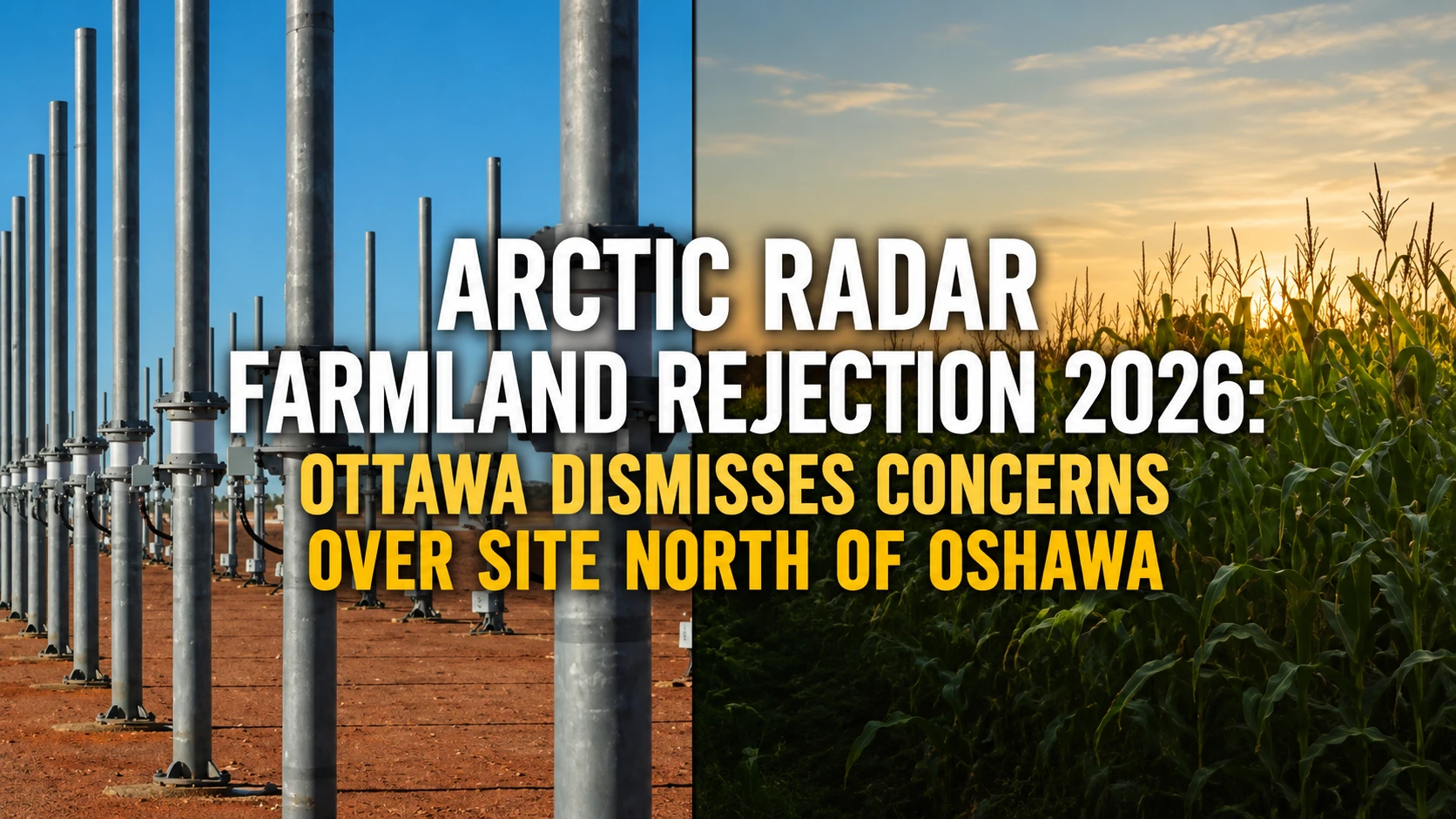
The federal government has officially rejected formal petitions from Ontario residents and municipal leaders who sought to protect high-quality agricultural land from a massive new military installation. The Arctic Radar Farmland Rejection 2026 confirms that National Defence will proceed with its $6 billion Over-the-Horizon Radar (OTHR) project, which includes a critical transmitter site located in Kawartha Lakes, approximately 70 km north of Oshawa. Despite protests regarding the loss of prime farmland and local ecological impacts, Defence Minister David McGuinty stated that the project’s technical requirements are “inflexible” and must proceed to meet a 2029 preliminary capability deadline.
The Arctic Radar Farmland Rejection 2026 marks a significant moment in Canada’s NORAD modernization efforts. The OTHR system is designed to detect threats in Arctic airspace with greater speed and accuracy than current technology. However, the system’s physics require that the antennas be located south of the 46th parallel—effectively south of the Trans-Canada Highway—to properly “bounce” signals off the ionosphere. Federal officials claim they assessed “hundreds” of sites before settling on the Clearview and Kawartha Lakes locations, ruling out military-owned lands like CFB Borden due to training interference.


The impact of the Arctic Radar Farmland Rejection 2026 is being felt acutely in the rural communities bordering North Durham. In addition to the 288-hectare receiver site near Barrie, the transmitter site north of Oshawa has raised concerns among local farmers about drainage and the potential disruption of the Minesing Wetlands. Clearview Township Mayor Doug Measures expressed frustration, noting that agriculture remains the region’s primary economic engine and that “farmland is disappearing” at an unsustainable rate. Measures also claimed that the federal government has been unresponsive to requests for meetings to discuss alternative sites.


Beyond economic concerns, the Arctic Radar Farmland Rejection 2026 highlights environmental anxieties. Local groups have raised alarms about the impact on nesting birds and the potential for electromagnetic interference with existing local technology. National Defence has acknowledged these concerns but maintains that the strategic necessity of the radar outweighs local land-use preferences. The project is being managed by the newly formed Defence Investment Agency and involves a partnership with Australia to adapt their “Jindalee” radar technology for the Canadian climate.
For residents in North Oshawa and the surrounding townships of Scugog and Brock, the Arctic Radar Farmland Rejection 2026 signals the beginning of a long-term military presence in the area. While the system is expected to be partially functional by 2029, it will not be fully operational until 2043. The government’s refusal to register the acquired land under an agricultural trust means that hundreds of hectares of formerly productive soil will be permanently converted to high-tech military use, a move that critics say sets a dangerous precedent for federal land acquisition.
As construction preparations begin, the Arctic Radar Farmland Rejection 2026 serves as a reminder of the friction between national security priorities and local conservation. With millions already spent on land acquisition, the federal government appears committed to the site, leaving local municipalities with little recourse but to monitor the environmental and economic fallout as the 2029 rollout approaches.