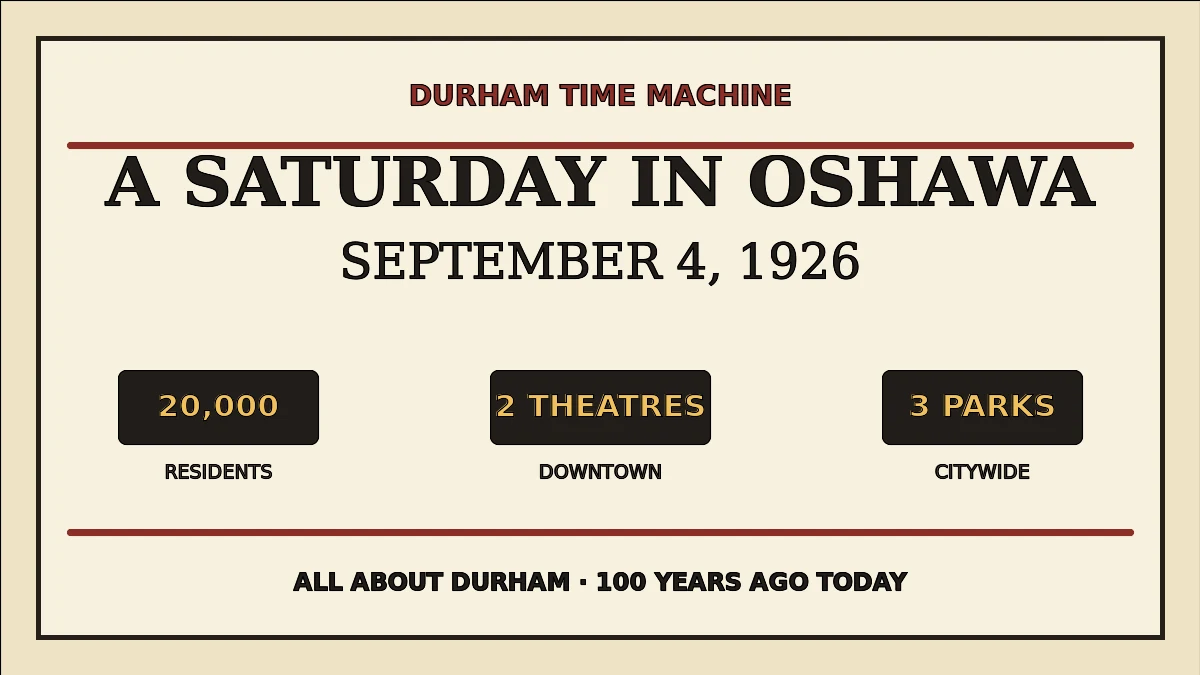
Durham Time Machine — September 4, 1926 ↔ September 4, 2026
What did Oshawa look like on Saturday, September 4, 1926?
The surviving local newspaper run is not currently accessible to our newsroom for this exact date, so this edition does not pretend to report that day’s headlines. Instead, it reconstructs the city a resident would have recognized using the 1926 City of Oshawa Directory, published May 1 of that year and preserved by Oshawa Public Libraries.
The result is a snapshot of a fast-growing industrial city: roughly 20,000 people, thousands of factory workers, electric streetcars, two downtown theatres, three major parks and a public library on Simcoe Street.
A city growing at remarkable speed
The directory described Oshawa as one of Canada’s leading industrial centres. It reported more than 5,000 industrial workers and an annual industrial payroll of $6.222 million.
Its population figures tell the larger story. Oshawa had about 4,000 residents in 1904 and 12,361 in the 1921 Dominion census. The directory said the 1925 assessor’s estimate had reached 19,941, with the surrounding urban population bringing the total to roughly 20,000.
Those figures came from a civic and commercial directory designed partly to promote the city, so they should be read as period claims rather than a modern statistical report. Even with that caution, the pace of growth is unmistakable.
Saturday travel meant rails, streetcars and busy sidewalks
The directory counted 22 miles of paved streets and 65 miles of permanent concrete sidewalks. Oshawa was connected to both the Canadian National and Canadian Pacific main lines between Toronto and Montreal.
Within the city, the electrically operated Oshawa Railway moved freight to private industrial sidings and also ran local streetcar service. The directory claimed an average of 200 freight cars moved in or out each day—evidence of how deeply manufacturing shaped daily life.
For residents heading downtown on that September Saturday, the intersection of King and Simcoe was already a commercial and transportation centre, not simply a crossroads.
Two downtown theatres offered an evening out
The directory listed two movie houses:
- the New Martin Theatre, at 19 King Street East;
- the Regent Theatre, at 48 King Street East.
We cannot confirm the September 4 programs without the daily newspaper’s entertainment listings, but the addresses establish that both theatres formed part of downtown Oshawa’s cultural life in 1926.
The Regent remains one of the city’s recognizable historic venues. Its survival provides a rare physical connection between a Saturday night in 1926 and downtown Oshawa today.
Parks, recreation and the lakefront
The directory promoted three major public spaces. Lakeview Park, described as 65 acres on the Lake Ontario shore, offered picnicking and recreation. Alexandra Park included a race track, sports grounds and a grandstand. The newer Central Memorial Park featured Oshawa’s war memorial, which the directory said cost more than $27,000 through voluntary community subscriptions.
These parks show that Oshawa’s growth was not measured only in factories. Civic leaders were also investing in public gathering places, sport and remembrance.
Schools, health and public services
The directory estimated 4,000 school-age children and listed seven public schools, one high school, a separate school and two colleges. It located Oshawa General Hospital near Alma Street and Simcoe Street North.
The public library stood at 44 Simcoe Street South, with Mrs. D. V. Oke listed as librarian, Harry Rowland as assistant librarian and Miss B. Millichamp as children’s librarian.
Other civic listings included the fire hall and police station at Richmond and Simcoe streets, a Tuesday afternoon baby clinic at the Albert Street United Church school, and the Children’s Aid Society office at City Hall.
Who led Oshawa in 1926?
The directory named Robert D. Preston as mayor and F. E. Hare as city clerk. It also documented the boards overseeing parks, health, water, housing, planning, the hospital and the library.
Those lists reveal a city becoming more administratively complex as its population and industrial base expanded.
Then and now
Oshawa’s scale has changed dramatically, but many themes in the 1926 directory remain familiar: growth, housing, transportation, schools, health care, recreation and the influence of the automobile industry.
The most striking difference may be how compact the city’s civic life appears on paper. A library, theatres, shops, churches, government offices and streetcar connections clustered around a walkable downtown, while rail lines tied local factories to the country.
Explore the source
- View the 1926 City of Oshawa Directory
- Browse Oshawa Public Libraries’ city-directory collection
- Explore Oshawa Public Libraries’ local-history resources
Share a Durham memory
Does your family remember the Regent, Lakeview Park, Alexandra Park or old downtown Oshawa? All About Durham welcomes documented memories, corrections and photographs for consideration. Please include your source and confirm that you have permission to share any submitted image.
Source note: This article is original editorial work based primarily on the public-domain 1926 City of Oshawa Directory, fourth edition, published by Henry Vernon & Son and digitized by Oshawa Public Libraries. The directory was published May 1, 1926; it provides period context for September 4 rather than a record of that day’s individual events. No archive scan, photograph, advertisement or protected newspaper text has been reproduced.