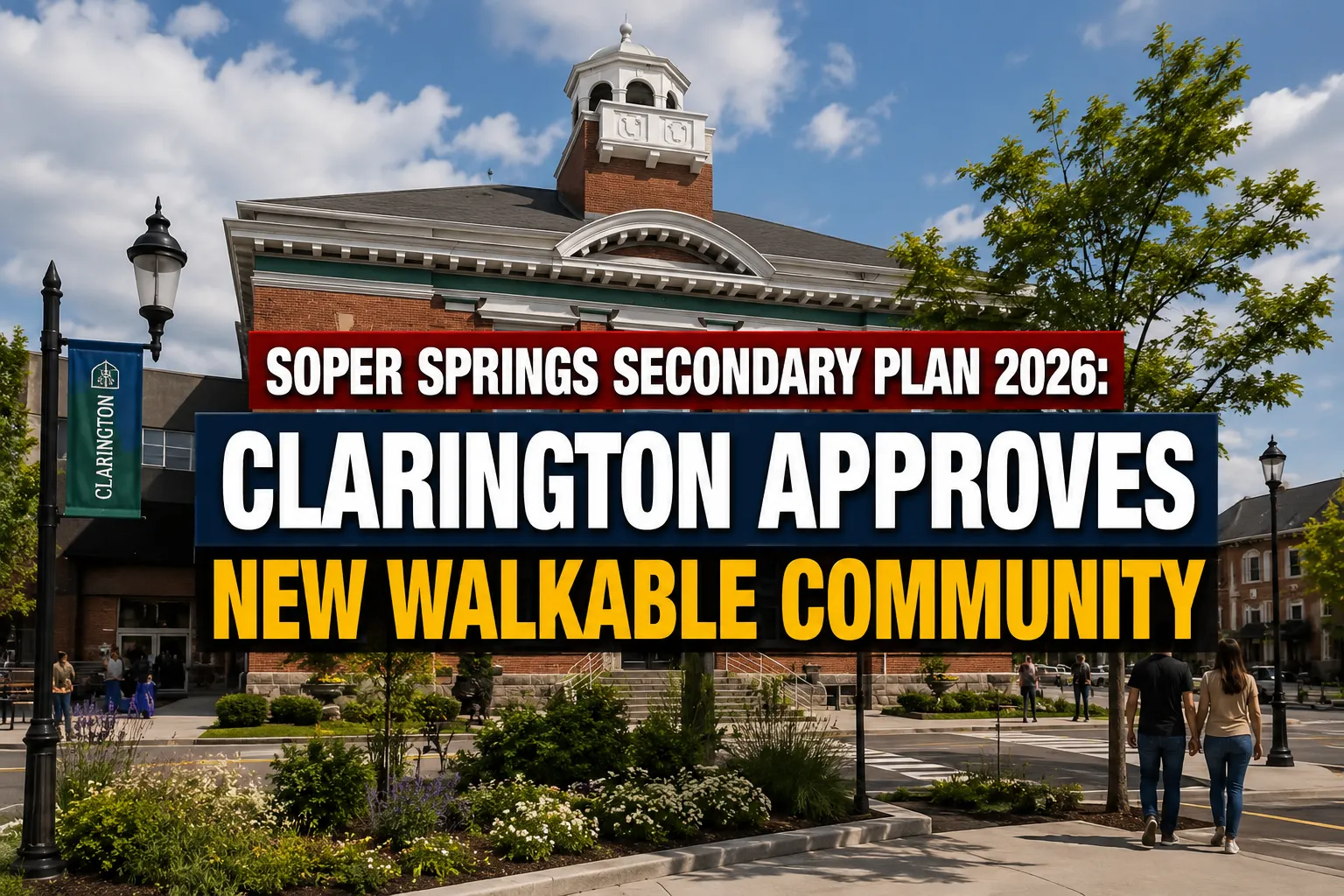
The Municipality of Clarington is charting a bold course for its future growth with the official approval of the Soper Springs Secondary Plan 2026. This long-term development framework aims to transform the North Bowmanville landscape into a “compact, complete, and walkable community” that prioritizes environmental integration and high-density urban living. Mayor Adrian Foster announced the plan as a proactive measure to manage the province’s rising population, ensuring that new neighborhoods are built with a cohesive vision rather than through piecemeal development.
A central pillar of the Soper Springs Secondary Plan 2026 is its focus on high-density, transit-supportive design. The municipality is targeting a density of at least 60 people and jobs per hectare, specifically along the Concession Road 3 and Liberty Street North corridors. To reduce car dependence, the area is slated to feature mixed-use buildings, allowing future residents to live, work, and shop within the same neighborhood. Residential structures will range from three to six storeys, with special provisions allowing for an additional two storeys if developers include affordable housing units—a critical incentive to address Durham’s housing crisis.


The Soper Springs Secondary Plan 2026 also places a heavy emphasis on “active transportation.” Instead of traditional suburban layouts that prioritize the automobile, this new community will be defined by an extensive network of multi-use paths, trails, and walkable streetscapes. These routes are designed to connect residential complexes directly to new parks and commercial hubs. Mayor Foster emphasized that while these changes won’t happen overnight, the plan ensures that as growth occurs, it aligns with Clarington’s long-term vision for a sustainable and connected urban environment.


Environmental preservation is another defining characteristic of the Soper Springs Secondary Plan 2026. The framework was developed alongside a municipal class environmental assessment to ensure the long-term health of the local ecology, particularly the lands associated with the Soper Creek tributaries. The plan seeks to protect the area’s natural heritage system while integrating it into the community through a robust tree canopy and strategically placed green spaces. Public art and enhanced streetscapes are also written into the policy to ensure the new neighborhoods have a distinct aesthetic and cultural identity.
As North Bowmanville continues to be one of the fastest-growing areas in the Durham Region, the Soper Springs Secondary Plan 2026 serves as a vital blueprint for responsible expansion. By mandating a mix of mid-rise apartments, townhouses, and ground-floor retail, Clarington is moving away from low-density sprawl in favor of a more urbanized, efficient model. This “complete community” approach is intended to foster a stronger sense of local belonging while providing the diverse housing options needed for young families and seniors alike.
Final ratification of the plan marks the culmination of years of technical studies and public engagement sessions. As development begins to advance in the coming years, the Soper Springs Secondary Plan 2026 will dictate the height of buildings, the location of businesses, and the layout of essential infrastructure. For current residents of Bowmanville, the plan promises a future where the natural beauty of the Soper Creek area is preserved even as the town evolves into a modern, high-density hub.