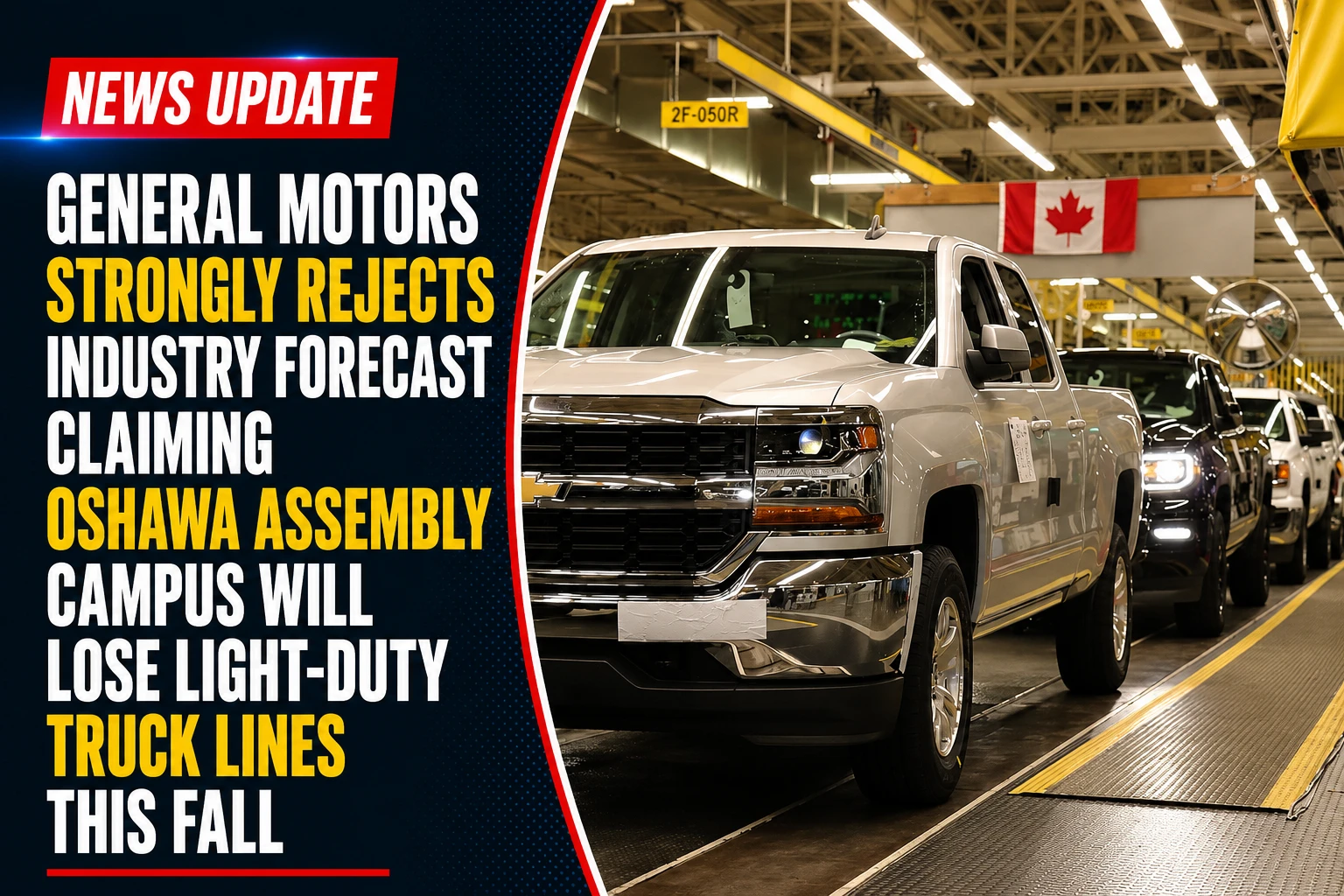
A major corporate dispute has emerged over the structural long-term manufacturing output of the Durham Region’s largest industrial employer, prompting an immediate public rebuttal from automotive executives. Tracked under regional economic monitoring files on June 22, 2026, General Motors Canada issued a definitive denial responding to a widely circulated independent business intelligence report. The controversial third-party forecast claimed that the automaker’s flagship assembly facility would completely lose its light-duty pickup production lines later this autumn, a development that auto sector analysts warned could force severe structural downscaling.
The contentious production forecast originated from AutoForecast Solutions, a prominent global automotive software and advisory firm based out of Pennsylvania. According to the firm’s published data tracking models, GM is allegedly planning to alter its North American manufacturing allocation as it transitions to its next-generation truck programs later this year.
The analysts suggested that GM would withdraw the light-duty Chevrolet Silverado 1500 model from the local facility, centralizing that specific high-volume production line exclusively within competing assembly complexes located in Indiana and Mexico. Under that projected scenario, the local site would find itself restricted strictly to assembling heavy-duty variants. Industry experts immediately warned that limiting the plant to low-volume heavy-duty trucks could slash total annual output to roughly 50,000 units, inevitably forcing operations to contract from two production shifts down to a bare-minimum single shift.
General Motors Canada moved swiftly to lock down the speculation and reassure its regional workforce. Jennifer Wright, Executive Director of Communications for GM Canada, flatly denied any planned reduction in manufacturing scope, emphasizing that the complex remains a cornerstone of the company’s full-size truck portfolio. While acknowledging that specific production assignments for future light-duty models have not been publicly disclosed, Wright highlighted that the firm’s massive, ongoing $343 million capital investment directly into the local campus serves as concrete evidence of a long-term commitment to maintaining strong Oshawa Assembly Production baselines.
Company officials stated that current shift configurations and employment levels are expected to remain stable as the transition to next-generation models proceeds on schedule. The corporate pushback arrives during an incredibly tense climate for the regional automotive labor market. The facility’s total output has experienced a steady decline over the last two fiscal cycles, dropping from 152,190 vehicles in 2024 down to 125,758 units in 2025. Furthermore, the local manufacturing ecosystem absorbed a severe economic blow on February 2, 2026, when escalating tariff friction driven by the U.S. administration forced GM to eliminate its third overnight shift.
That single shift elimination directly eliminated more than 500 unionized manufacturing positions inside the plant gates while triggering hundreds of secondary layoffs across regional parts suppliers. The current production debate is unfolding against the critical backdrop of the 2026 Detroit Three auto contract negotiations, which officially commence this week. Unifor national leadership confirmed they are prioritizing a pattern-setting agreement with Ford Motor Company before turning their attention to finalizing comprehensive labor and job security pacts with General Motors.