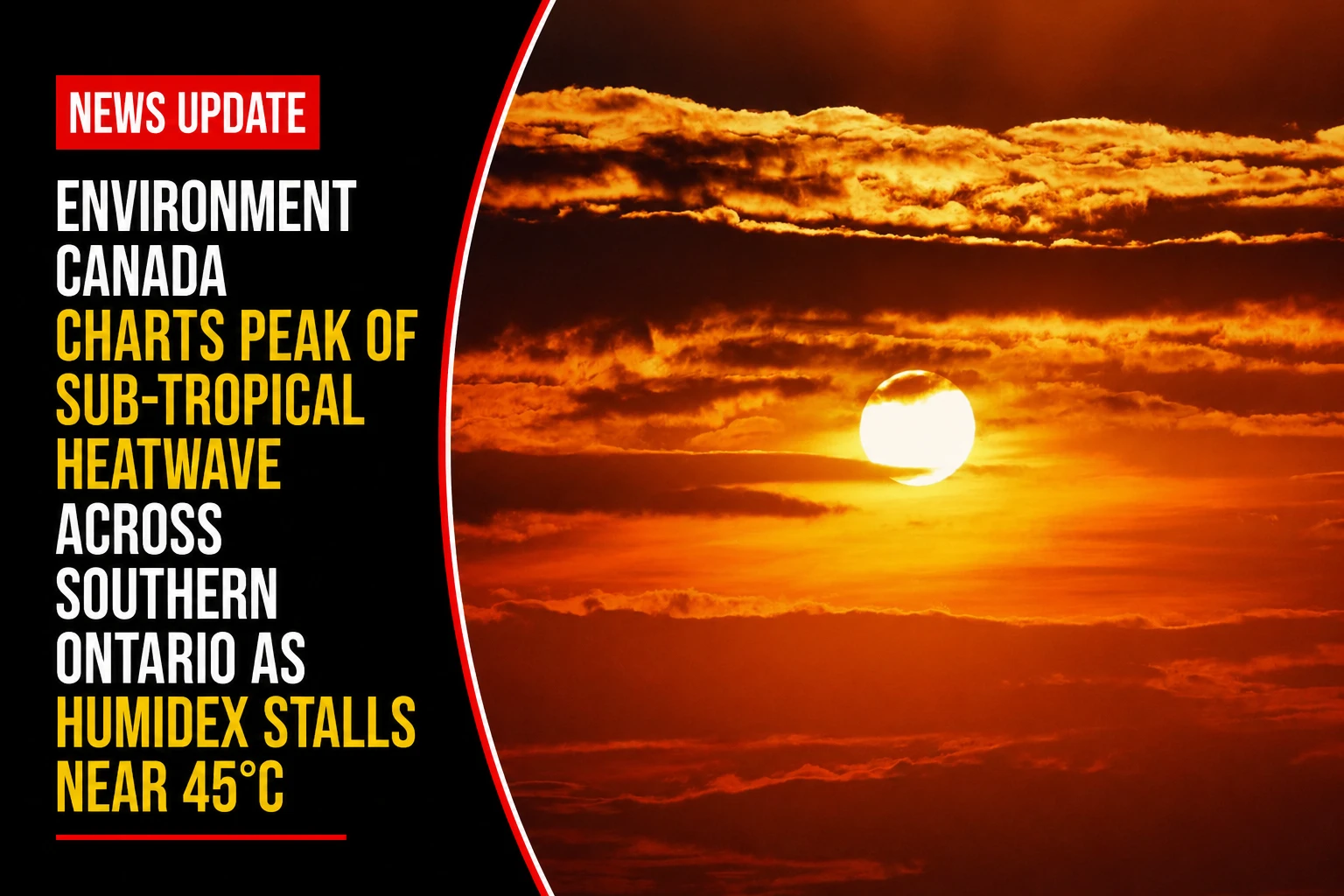
The municipal disaster management networks, emergency medical commands, and community safety bureaus within the Durham Region are operating under a high-tier weather response framework. Tracked under provincial climatology and public health portfolios on Tuesday, July 14, 2026, emergency operations planners finalized the regional macro data log Toronto and Ontario hit with dangerous humidex near 45 C. Data compiled by Environment and Climate Change Canada indicates that the ongoing severe heat dome is hitting its maximum developmental intensity today, driving ambient valley temperatures into the high 30s while excessive dewpoints spike humidity factors near emergency limits.
Public safety officials are reinforcing strict health warnings as the prolonged thermal pressure shifts urban and rural environments into high-risk heat-illness zones.


The Multi-Regional Meteorological Comparison and System Baselines
The current weather system displays unique structural differences between the severe convective alert zones across the province.


-
The Northern Corridor Orange Grid: Much of northern Ontario—including the Kenora, Thunder Bay, Fort Hope, and Timmins operational nodes—spent the start of the week locked under severe orange weather warnings, logging sustained ambient highs of 36°C and humidex factors peaking at 42°C.
-
The Southern Corridor Yellow Grid: While classified under a yellow warning tier, southern Ontario zones spanning Windsor, the Greater Toronto Area (including the Durham Region), North Bay, Ottawa, and Cornwall are enduring higher overall moisture retention, pushing the localized humidex index near 45°C.
-
The Regional Relief Deficit: Unlike neighboring southern Manitoba, where high-pressure cells are breaking up to allow temperatures to drop back to normal late-week ranges, the Ontario sub-tropical system will remain trapped over the lower Great Lakes until a late-week convective frontal system moves in.
Analyzing the Heat-Strain Symptom Registry and Public Mitigation Directives
Public health units have deployed standardized diagnostic checklists to help frontline emergency services quickly identify and treat heat-induced metabolic shock.
| Vulnerable Population Cohorts | Primary Biological Stress Indicators | Mandatory Preventive Measures | Active Municipal Emergency Support Systems |
|
• Isolated Older Adults • Infants & Young Children • Pregnant Individuals • Outdoor Commercial Laborers |
• Persistent, throbbing headaches • Acute dizziness or lightheadedness • Sudden nausea or cyclical vomiting • Unusual fatigue and sudden mental confusion |
Continuous Hydration Intake: Drink cold fluids constantly, completely bypassing the biological thirst response window. | Extended Facility Operations: Designated community centers, public libraries, and outdoor pools opened for extended cooling periods. |
Environment and Climate Change Canada, the Ontario Medical Association, and the Durham Region Emergency Measures Desk handle ongoing atmospheric diagnostics, air quality tracking, and regional cooling station scheduling.
Durham families, industrial job site supervisors, and neighborhood watch groups looking to locate active municipal cooling stations, view real-time regional radar updates, or download accessible heat-safety checklist sheets can find the networks online through the central Environment Canada alert platform, review health advisories via the Durham Region Public Health portal, or track localized safety alerts via the provincial emergency response hub.