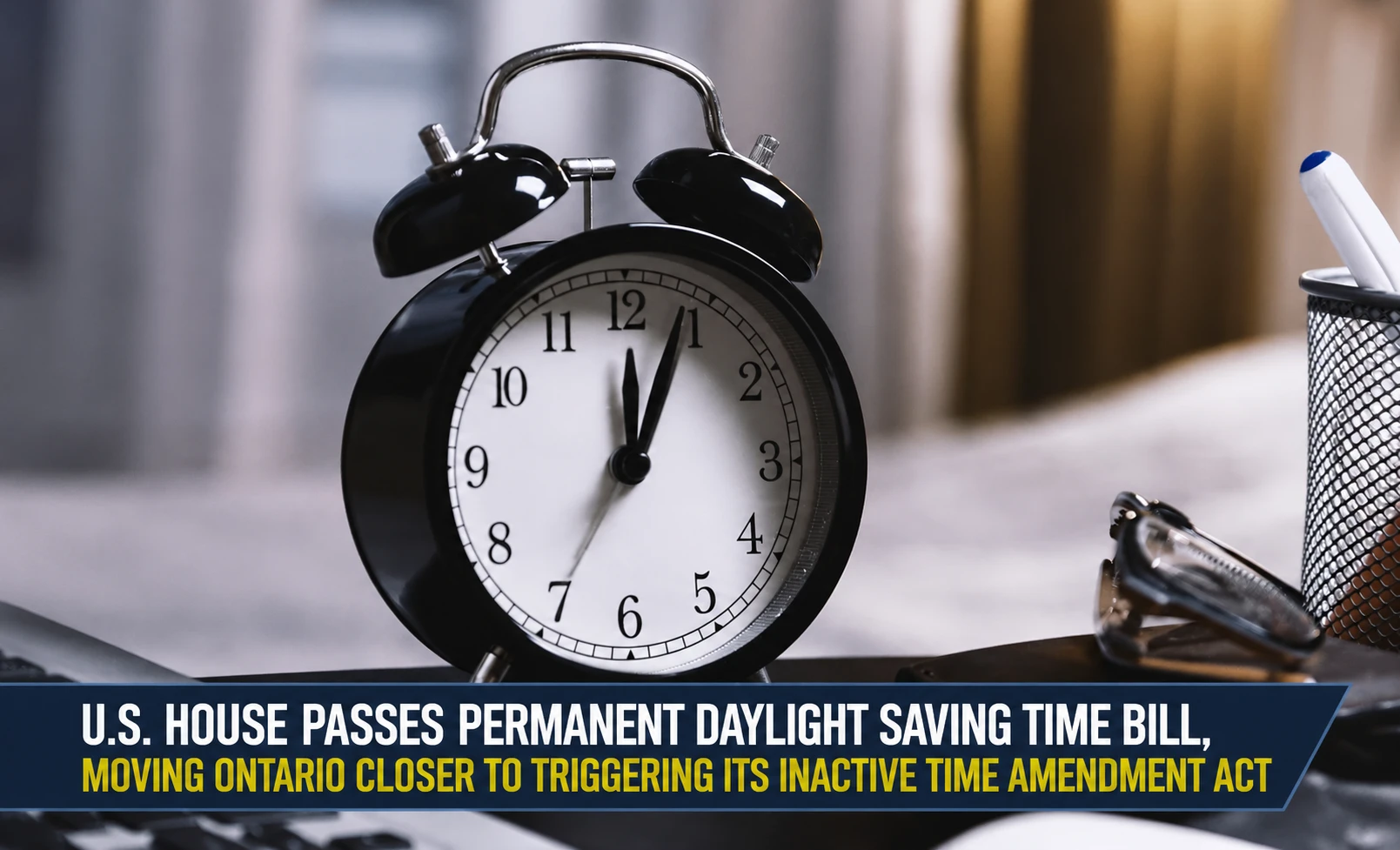
The public administration bureaus, cross-border logistics agencies, and financial operations desks within the Durham Region are closely tracking international legislative chambers. Tracked under provincial statutory triggers, inter-jurisdictional trade alignments, and municipal operational planning portfolios on Friday, July 17, 2026, legislative analysts finalized the policy overview Daylight saving time could be a step closer to changing in Ontario. In a significant institutional shift, the United States House of Representatives passed a federal bill aimed at making daylight saving time permanent year-round across the United States.
Because Ontario’s pre-existing, inactive time-change legislation is explicitly tied to the statutory movements of neighboring global trade partners, this congressional advancement brings the province the closest it has been in six years to entirely discarding the biannual clock change.
The 2020 Legislative Stalemate and Cross-Border Coordination Rules
The modern time-zone framework relies on strict geographic synchronizations to insulate regional economic systems against localized operational friction:
-
The Inactive Provincial Statute: Way back in 2020, the Government of Ontario formally debated and passed the Time Amendment Act. The legislation grants the province the legal authority to permanently freeze the clocks on daylight saving time, ending the traditional spring-forward and fall-back cycles.
-
The Triple-Jurisdiction Lock: To prevent catastrophic logistical decoupling, the Ontario government embedded a strict conditional execution clause into the Act. Queen’s Park will only activate the law if both the Province of Quebec and New York State simultaneously adopt permanent daylight saving time.
-
The Synchronized Commerce Mandate: The three economic hubs share high-density, multi-billion-dollar transportation corridors, synchronized television broadcast networks, cross-border commuter loops, and highly sensitive financial markets. Moving independently would instantly disrupt morning trading desks and international flight manifests.
-
The Present Calendar Baseline: Until the U.S. Senate and President Donald Trump fully ratify the new congressional bill—subsequently triggering New York State compliance—the legacy time rules remain active. The next mandatory seasonal time change is locked for Sunday, November 1, 2026, when Durham residents must shift clocks back one hour.
Analyzing the Time Synchronization Impact Grid and Sector Vulnerabilities
Eliminating the seasonal clock change requires multi-tier municipal coordination to re-align local public services with shifting morning daylight baselines.
| Impacted Regional Sector | Legacy Biannual Time Configuration | Proposed Permanent Year-Round Daylight Model | Key Operational Dependencies & Inversions | Primary Cross-Border Risks of Misalignment |
| Financial & Capital Markets | Shifts matching Toronto, Montreal, and New York equities desks. | Fixed matching permanent eastern daylight values. | Real-time algorithmic trading loops and international settlement clearing. | High Liability: A one-hour zone gap would throw multi-million dollar transaction windows into severe disarray. |
| Supply Chain & Logistics | Shifting freight delivery schedules twice a year. | Fixed, predictable transit lanes year-round. | Long-haul trucking manifests departing from Durham industrial sectors. | Missed delivery slots and border clearing bottlenecks at international crossings. |
| Public Transit & Rail Systems | Scheduled adjustment shifts on GO Transit and local DRT lines. | Uniform timetables maintained across all seasons. | Coordination with VIA Rail corridors running through Oshawa and Pickering. | Scheduled connection errors and altered crew resting parameters. |
| Education & Student Safety | Adjusting morning school walk times to ambient winter light. | Darker winter mornings offset by extended late-afternoon daylight. | School bus route tracking handled by local Durham school boards. | Increased student exposure to early-morning dark roads during winter segments. |
The Government Relations and Commercial Operations Directives
“The Ontario government has said it will only move ahead with permanent daylight saving time if both Quebec and New York State adopt the same approach,” insauga staff noted within their legislative analysis, underscoring that the policy remains completely contingent on international legal harmony. Regional administrative leads point out that while a permanent time freeze eliminates the documented spikes in workplace injuries and cardiovascular stress linked to the sudden spring time loss, it will permanently shift winter sunrise times past 8:00 a.m. in southern Ontario. Local businesses, international shipping companies, and municipal emergency planners are being urged to keep their scheduling systems flexible as diplomatic and legislative teams monitor Washington’s next moves moving into the autumn legislative session.
The Ontario Ministry of the Attorney General, the Parliament of Canada Intergovernmental Affairs Secretariat, the Durham Region Clerk’s Department, and individual corporate trade compliance panels handle ongoing legislative monitoring, inter-provincial policy coordination, and logistical risk mapping.
Durham residents, international trade managers, and corporate compliance officers looking to read the complete text of Ontario’s Time Amendment Act, track the live progress of the permanent time bill through the U.S. Senate, or review public safety guidelines for the upcoming November time transition can find the platforms online through the central Ontario Legislative Assembly database at www.ola.org, track international bills via the U.S. Congress legislative portal, or monitor regional policy alignments through the Durham Region administrative newsroom.