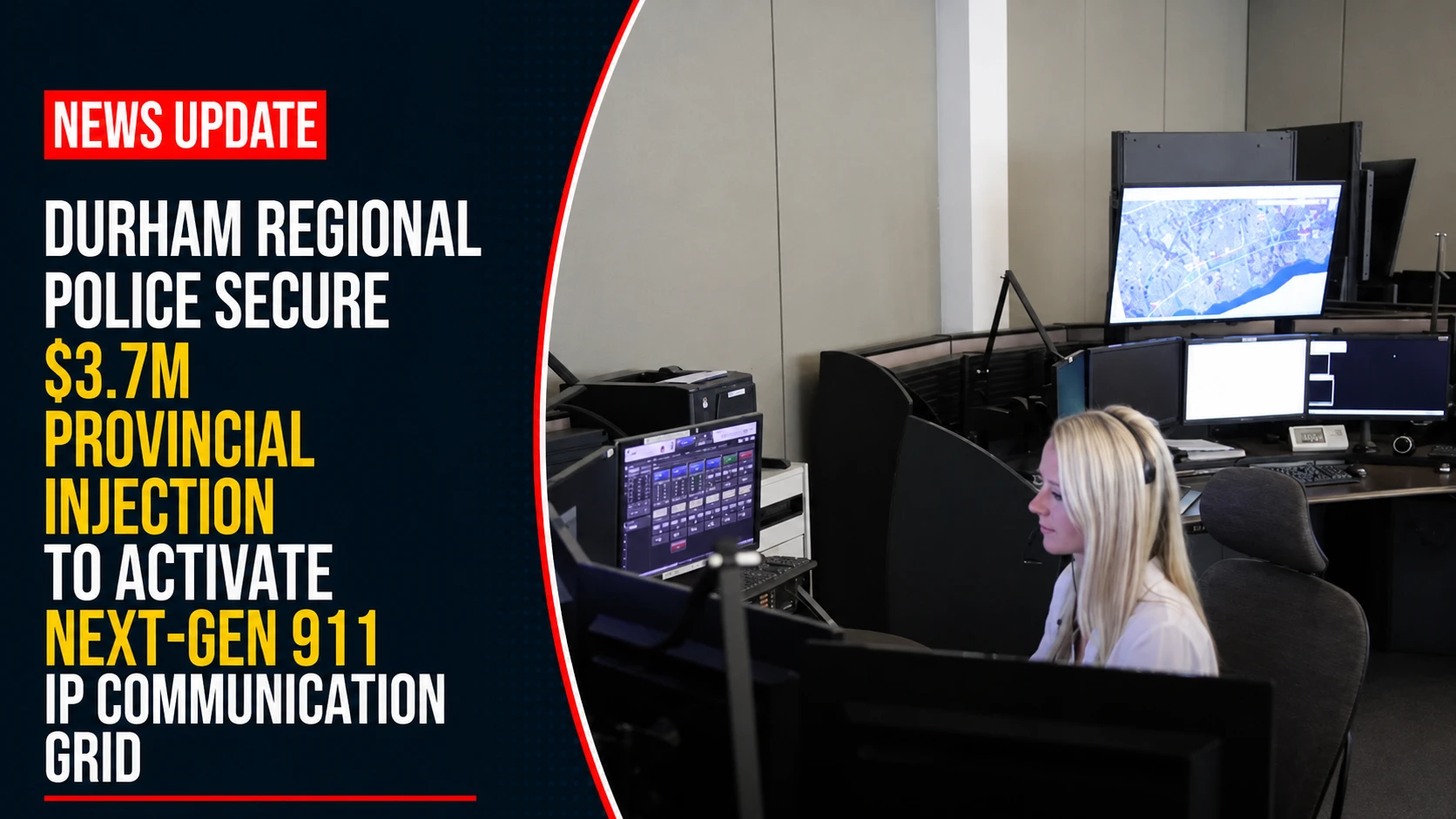
The public safety communication branches, regional telecom directorates, and emergency response command centers across Ontario are advancing a massive infrastructure transition. Tracked under provincial emergency service registries on Thursday, July 2, 2026, technology deployment teams finalized the network profiles for the report DRPS gets Ontario funding to upgrade 911 system. Backed by more than $3.7 million in cumulative funding from the Ontario government since 2022, the Durham Regional Police Service (DRPS) has successfully activated its Next Generation 9-1-1 (NG9-1-1) framework, fundamentally modernizing how emergency communications function across the region.
The multi-year tech shift moves Durham’s primary communications center away from decades-old legacy analog phone architectures, replacing them with a highly secure, internet protocol (IP)-based digital ecosystem.


The CRTC Mandate and Core Network Enhancements
The digital overhaul is part of a strict nationwide public safety directive designed to keep emergency centers synchronized with modern smartphone capabilities.


-
The Federal Deadline: This transition is driven by a strict mandate from the Canadian Radio-television and Telecommunications Commission (CRTC), which legally requires all public safety answering points (PSAPs) across Canada to completely sunset their legacy analog systems and fully adopt digital NG9-1-1 networks by March 31, 2027.
-
The Immediate Impact: The newly activated IP backbone immediately improves system reliability and network resiliency, protecting against service drops while allowing call-takers to process simultaneous emergency inputs with zero data lag.
-
The Public Calling Rule: Emergency officials emphasized that there is absolutely no change to how the public contacts 9-1-1. Standard voice calling remains the sole operational method to reach first responders during an active emergency.
-
Future Phase Features: While not yet active on local operator dashboards, the IP architecture lays the mandatory groundwork to eventually roll out high-precision geographic routing, real-time text (RTT) data streams, and the direct transmission of on-scene photos or video clips from smartphones to dispatch centers.
Analyzing the NG9-1-1 Corporate Engineering Consortia
To successfully overhaul the region’s communications core without interrupting active emergency lines, DRPS partnered with a specialized team of global and domestic telecom providers.
| Technology Integration Partner | Primary Infrastructure Delivery Role | Core Technical Component Deployed |
| Bell Canada | Primary ESInet Network Architect | Establishes the secure, high-capacity IP fiber transport network |
| Avaya | Communications Framework Engine | Unifies the physical call-taker desktop applications and digital audio paths |
| Netagen | Systems Integration Specialist | Manages on-site system installation, cyber-security firewalls, and data testing |
| Komutel | Specialized 911 Call Handling | Deploys browser-based bilingual call-routing software (Komand911) |
Solicitor General’s Directive: Ontario Solicitor General Michael Kerzner called the rollout a complete game-changer for public safety, noting that the NG9-1-1 system feeds first responders with real-time, life-saving geolocation data. This significantly shrinks response times during multi-vehicle collisions or remote trail rescues where callers cannot easily provide an intersection or address.
DRPS Chief Peter Moreira praised the transition, noting that the new system ensures local emergency teams can keep pace with rapidly changing consumer technology. The communications branch will run continuous quality assurance testing on the new lines throughout the summer as part of the provincial compliance framework.
The Durham Regional Police Communications Unit manages the centralized emergency dispatch registry.
Durham Region residents, commercial network engineers, and safety advocates looking to review the CRTC regulatory timeline decisions, learn about the upcoming text-with-911 accessibility programs, or view active emergency response safety guides can access the digital documentation portals online at drps.ca, crtc.gc.ca, or ontario.ca/solicitorgeneral.