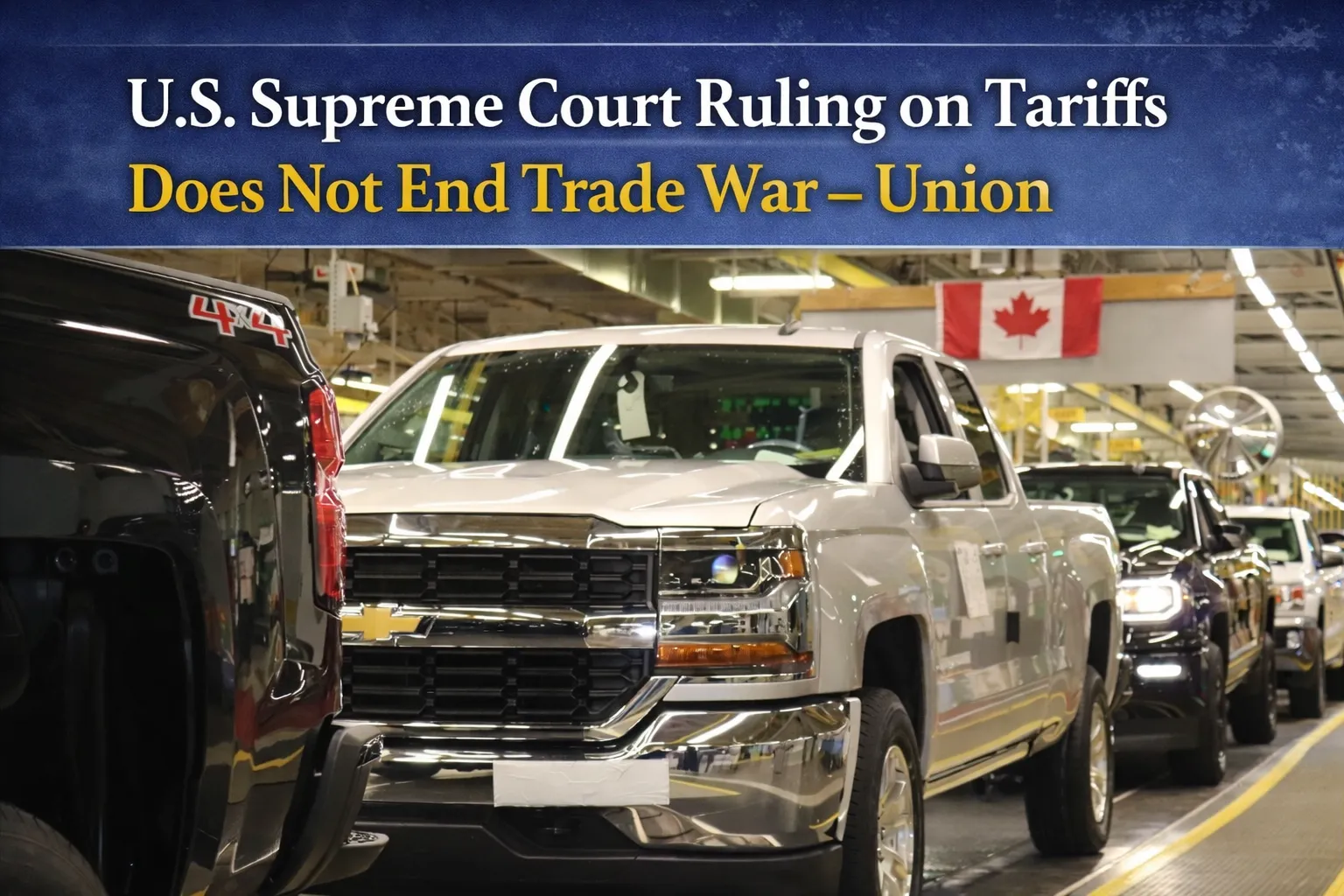
The U.S. Supreme Court’s recent ruling striking down tariffs imposed by U.S. President Donald Trump under the International Emergency Economic Powers Act (IEEPA) has been hailed as a legal rebuke of presidential overreach. However, according to Lana Payne, Unifor’s National President, this decision does little to resolve the ongoing trade crisis that continues to jeopardize Canadian jobs and key industrial sectors.
Payne stressed that while the ruling exposed how legally flawed the IEEPA tariffs were, the risk to Canadian workers remains high, particularly in industries like automotive manufacturing. “Canadian workers should not mistake this for a victory,” Payne said, adding that tariffs targeting the Canadian auto industry, among others, remain in effect and could increase as Trump looks for alternative ways to impose economic measures against Canada.


The Supreme Court ruling confirmed that Trump did not have the legal authority to impose sweeping tariffs under the IEEPA, which is intended for national emergencies. However, it did not end the trade war between the U.S. and Canada, as national security tariffs under Section 232 continue to target critical sectors like auto, steel, aluminum, and wood products. These tariffs remain fully in force and could be expanded at any time, said Payne.


The auto sector in Ontario has been hit particularly hard by these tariffs. General Motors in Oshawa, for example, made significant production cuts due to the tariffs, including the shutdown of a shift that resulted in at least 500 job losses. The company also moved much of its production south of the border. GM Oshawa is just one example of how the tariffs are hurting the Canadian workforce. Ingersoll’s EV factory has also been shut down, and Jeep production was moved out of Brampton by Stellantis.
According to Payne, the most damaging tariffs were never the IEEPA tariffs but rather the “national security” tariffs under Section 232. These tariffs have had a particularly devastating impact on the Canadian auto sector, with GM Oshawa being one of the hardest-hit facilities. The ongoing trade war continues to raise concerns about job losses and the future of Canadian automotive manufacturing.
Unifor has long advocated for stronger actions to protect Canadian jobs and promote a more resilient economy. The union has urged the Canadian government to take a more strategic approach to defending Canadian sovereignty and industrial policy. “Protecting workers means developing and implementing strategic industrial policy and investments,” said Payne. The union has provided Ottawa with a list of asks, including penalizing any companies that move jobs or operations from Canada due to the U.S. tariff policies.
While the U.S. Supreme Court ruling marks a legal victory for Canada, Unifor warns that the broader trade war and the impact of tariffs on Canadian workers, particularly in Ontario’s auto sector, remains unresolved and could have long-lasting consequences.