Ontario’s night skies are set to brighten in early February as the Snow Moon Ontario reaches full illumination, accompanied later in the month by a rare planetary alignment.
According to The Old Farmer’s Almanac, the Full Snow Moon will reach its peak at 5:09 p.m. EST on Sunday, February 1, 2026. While the exact peak occurs near sunset, skywatchers will be able to see the full moon rising in the eastern sky shortly after dusk.

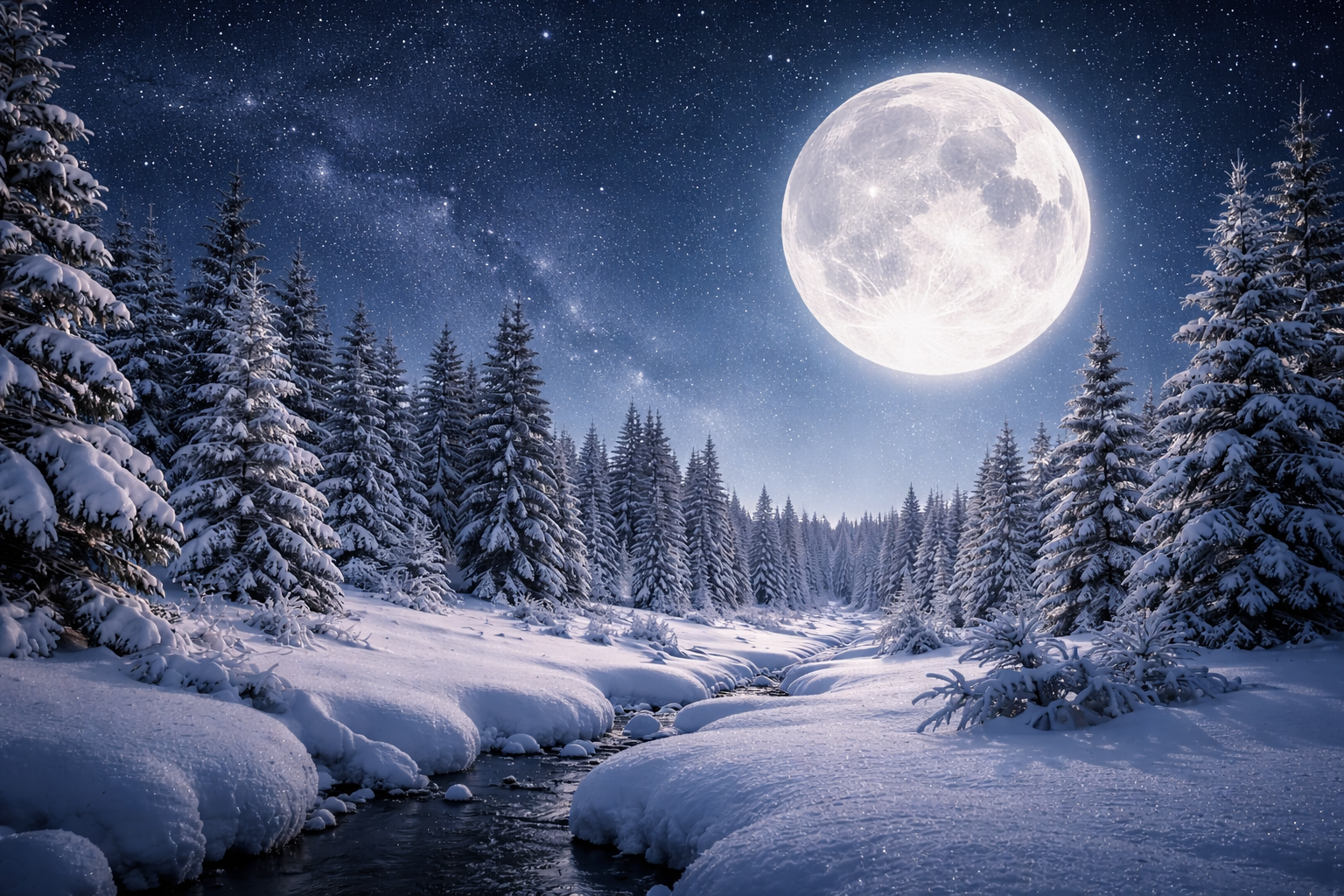
The Snow Moon follows January’s Wolf Moon and takes its name from the heavy snowfall historically associated with February. Lunar naming traditions were developed by Indigenous peoples, early settlers, and European sources, reflecting seasonal patterns and survival cycles.


Several Indigenous cultures use alternative names for February’s moon. The Cree referred to it as the Eagle Moon, while the Ojibwe called it the Bear Moon, marking the time when bear cubs are born. The Dakota used the name Raccoon Moon, some Algonquin peoples called it the Groundhog Moon, and Cherokee traditions referred to it as the Hungry Moon, reflecting late-winter food scarcity.
February’s 2026 lunar phases, according to The Old Farmer’s Almanac (EST), are as follows:
-
Full Moon (Snow Moon): Feb. 1 at 5:09 p.m.
-
Last Quarter: Feb. 9 at 7:43 a.m.
-
New Moon: Feb. 17 at 7:01 a.m.
-
First Quarter: Feb. 24 at 7:27 a.m.
Late February will also feature a rare planetary parade. NASA reports that on February 28, six planets — Mercury, Venus, Jupiter, Saturn, Uranus, and Neptune — will appear in the evening sky. Venus, Jupiter, and Saturn will be visible to the naked eye, while Uranus and Neptune will require binoculars or a telescope. Mercury may be harder to spot due to its low position near the horizon.