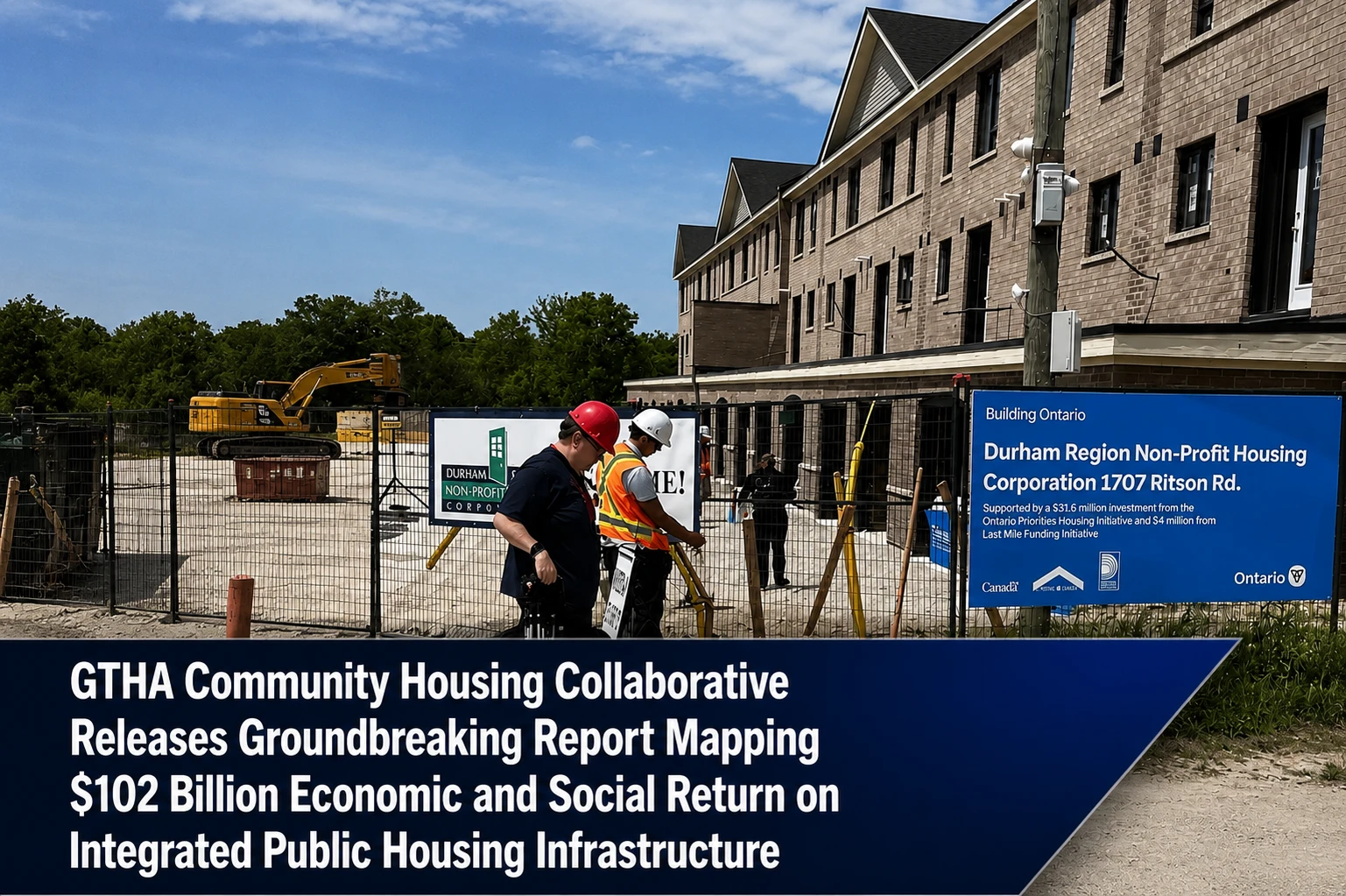
The municipal housing corporations, regional development boards, and public finance agencies within the Durham Region are parsing a landmark econometric framework. Tracked under provincial housing infrastructure, regional economic modeling, and municipal social services portfolios on Wednesday, July 15, 2026, corporate policy analysts finalized the inter-municipal research brief Report declares public housing benefits both people and the Greater Toronto economy. Commissioned by the GTHA Community Housing Collaborative—a massive coalition uniting the region’s six largest housing providers across Toronto, Peel, York, Durham, Halton, and Hamilton—and mathematically prepared by the Canadian Centre for Economic Analysis (CANCEA), the freshly unveiled Public Housing Dividend Report marks the most detailed, data-driven return-on-investment (ROI) analysis ever conducted within the Canadian housing sector.
Macroeconomic researchers stress that the findings decisively shift the public narrative surrounding social housing, proving that affordable units operate as productive economic infrastructure—similar to mass transit networks, electrical grids, and hospital complexes—rather than static public expense drains.
The Five-Tier Funding Simulation and the Balanced Investment Strategy
The core methodology of the study utilized comprehensive Canadian data modeling to stress-test five separate fiscal pathways running through the year 2050 to evaluate long-term outcomes on regional GDP, employment, healthcare budgets, and building conditions:
-
Expected Funding (Status Quo): Maintaining the existing baseline funding trajectories exactly as they are currently allocated.
-
Reduced Funding (Austerity Model): Systematically scaling back direct government capital injections into the social housing sector.
-
Renewal Only (Capital Maintenance): Directing all available liquid capital strictly toward retrofitting and repairing existing deteriorating structures, with no new unit growth.
-
New Construction Only (Expansion Focus): Prioritizing the construction of new affordable complexes while completely frozen out of repairing current aging building stock.
-
Renewal and Construction (The Integrated Approach): A balanced, simultaneous allocation that completely repairs inherited building portfolios while aggressively scaling up new localized builds.
The CANCEA modeling conclusively demonstrated that Renewal and Construction represents the ultimate optimal fiscal pathway, yielding compounding social dividends that far outweigh the initial capital deployment.
Analyzing the Macroeconomic Projections and Regional Social Value Matrix
By adopting the dual renewal and expansion pathway, the collaborative projects a sweeping transformation of regional labor, health, and fiscal metrics over the next quarter-century.
| Projected Economic Dividend | Documented System Capacity Deliverable | Associated Public Financial Return | Primary Social & Community Benefits | Collaborative Strategic Scope |
|
+$50 Billion GDP Boost
(Targeted by 2050) |
86,000+ Additional People Housed securely across the regional footprint. | $3.00 Generated for Every $1 Invested: High efficiency leverage index. | $48.3 Billion in Pure Social Value: Quantifies physical/mental health improvements and lower crime rates. | 40% of All Ontario Public Housing: Represents a combined portfolio of 81,500+ individual homes. |
|
~15,000 Sustained Annual Jobs
(Full-Time Equivalents) |
23,000 Total Units Added or Protected from catastrophic facility closure. | $12.6 Billion in Total Tax Revenue flowing back to federal and provincial coffers. | $1.8 Billion in Public System Savings: Drastically reduces emergency room, hospital bed, and justice system loads. | $20+ Billion Joint Asset Value: Serving a regional base of over 150,000 active tenants. |
The Municipal and Executive Operations Mandates
“Public housing is not just about support – it helps drive economic growth and healthier communities. By investing in both new and existing housing, we can build a stronger economy while making sure people have stable, affordable homes,” stated Erin Valant, Director of Housing Services for Durham Region and CEO of Housing Durham. Gary Muller, the region’s Director of Affordable Housing Development and Renewal, reinforced the technical validity of the data, noting that the metrics confirm expanding supply acts as the ultimate bedrock for inclusive community strength. Durham Region Chair John Henry formally endorsed the collaborative’s findings, highlighting that local tax dollars directed into housing services consistently yield massive dividends in local safety, family health stability, and commercial job creation across the regional landscape.
The GTHA Community Housing Collaborative Steering Committee, the Housing Durham Executive Board, the Regional Municipality of Durham Works Department, and the Ministry of Municipal Affairs and Housing handle ongoing funding distributions, asset renewal management, and local construction tendering.
Durham homeowners, public policy analysts, and housing advocates looking to download the complete technical text of the Public Housing Dividend Report, review localized affordable housing development master maps, or track regional council capital project agendas can access the records online through the central Durham Region municipal news portal at www.durham.ca, explore housing support frameworks via the Housing Durham network, or monitor long-term socioeconomic indicators through the GTHA Community Housing database.