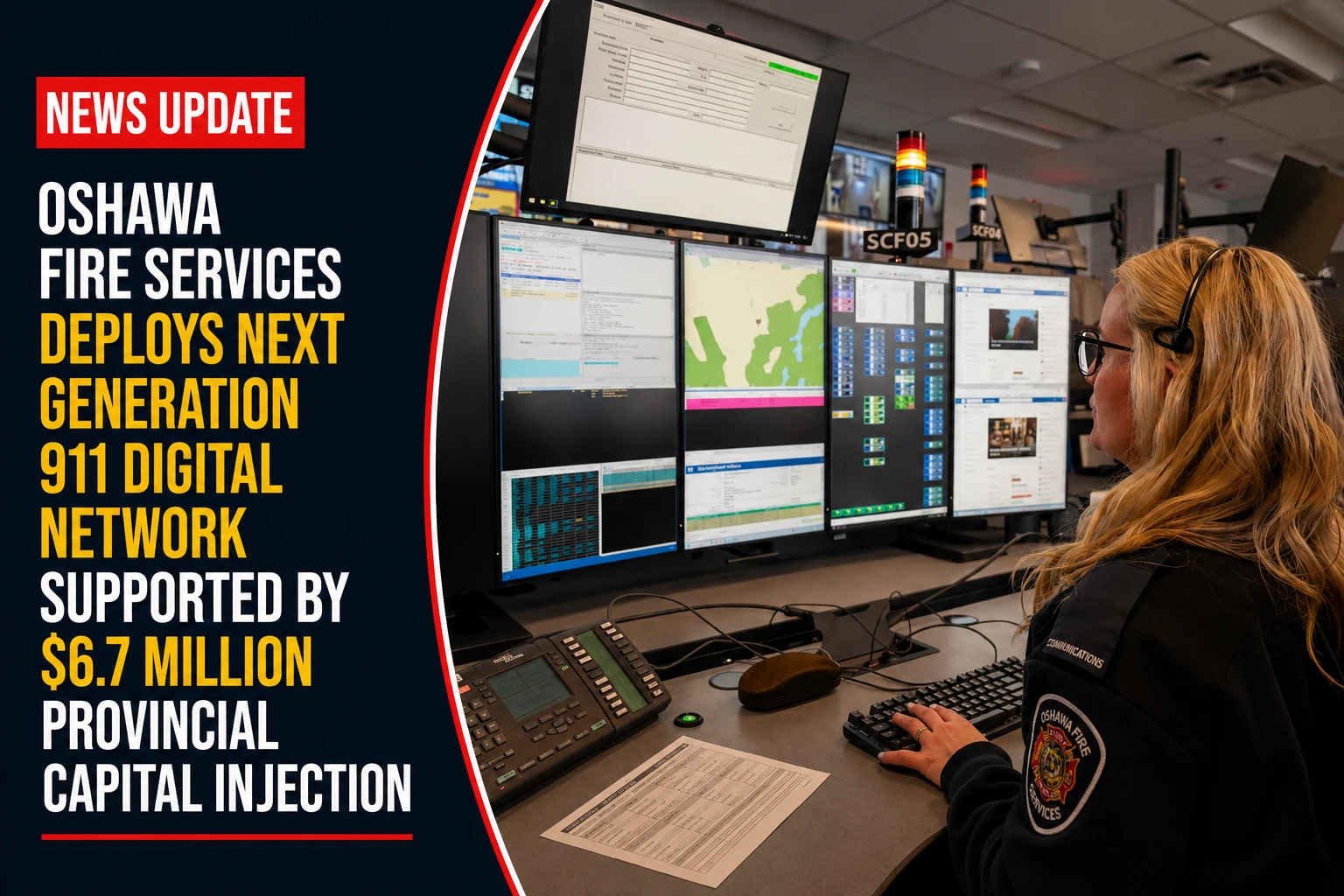
The municipal dispatch networks, public safety advisory boards, and emergency infrastructure desks within the Durham Region are launching a technological modernization. Tracked under provincial telecommunications, local public safety, and municipal technology portfolios on Tuesday, July 14, 2026, communications infrastructure planners finalized the emergency services baseline log Oshawa fire service transitions to upgraded 911 network. Formally executed on Sunday, July 12, Oshawa Fire Services (OFS) successfully migrated its primary emergency communications backbone to the advanced Next Generation 911 (NG911) framework, complying with federal public safety directives well ahead of mandatory national operational target timelines.
Emergency service controllers stress that while the baseline consumer process for initiating a crisis call remains entirely unchanged for the public, the digital transition completely overhauls how data packets move from cellular towers straight into first responder dispatch rooms.


The CRTC Telecom Mandate and Provincial Funding Integration
The rapid structural transition is driven by national telecom regulatory orders paired with heavy multi-year provincial capitalization programs.


-
The Federal Deadline: The nationwide transition from legacy analog telephone routing networks to end-to-end IP-based digital infrastructure is mandated by the Canadian Radio-television and Telecommunications Commission (CRTC), carrying a hard national completion deadline of March 2027.
-
The Financial Backing: To ensure local tax layers were not heavily burdened by the advanced hardware requirements, the province has systematically funneled $6.7 million in targeted grants since 2022 directly into the Oshawa Fire Service transition fund.
-
Immediate Network Enhancements: The initial phase deployment delivers instantly accelerated digital processing connection speeds, significantly increased system data bandwidth capacities to mitigate dropouts during high-demand mass emergency events, and optimized cross-agency communications tools.
Analyzing the NG911 Data Matrix and Phased Infrastructure Roadmap
The modernized system lays down an advanced technological foundation, dividing deployment capabilities between immediate data handling upgrades and future rich-media emergency messaging features.
| System Deployment Phase | Active Network Capabilities | Geospatial & Technical Routing Tools | Primary Public Safety Deliverables | Regulatory & Financial Governance |
|
Phase 1: Core Digital Migration (Active as of July 12, 2026) |
• Ultra-low latency data link speeds. • Enhanced routing stability. • Secure IP-backbone failovers. |
Traditional tower-based cell sector identification paired with instantaneous digital line transfers. | Drastically drops dropped-call volumes during major localized regional storm or accident spikes. | Funded by $6.7M Provincial Pool: Administered locally by Oshawa Fire Chief Stephen Barkwell. |
|
Phase 2: Advanced Media Arrays (Future Target Map) |
• Real-time emergency text messaging (RTT). • Smart automated call routing protocols. |
Geospatial routing loops that match incoming cellular packets against live GIS map databases. | Allows callers to communicate silently via text when voice calls are unsafe or restricted. | Monitored by the National Emergency Number Association (NENA) standards index. |
|
Phase 3: Deep Location Mapping (Future Target Map) |
• Rich media telemetry files. • Advanced caller ID profiles. |
Z-Axis location precision data (Pinpoints the exact floor level height inside a multi-story building). | Drops dispatch response times down to the second by completely removing caller location guesswork. | Tracked through the CRTC national regulatory enforcement baseline. |
The City of Oshawa Information Technology Department, the Oshawa Fire Services Communications Division, and the Canadian Radio-television and Telecommunications Commission handle ongoing network monitoring, digital route testing, and future RTT phase provisioning.
Oshawa homeowners, telecom industry analysts, and public safety advocates looking to review the official city transition briefs, track nationwide NG911 compliance data grids, or review emergency contact protocols can access the networks online through the central City of Oshawa portal at www.oshawa.ca, explore national rollout documentation via the CRTC telecommunications platform, or monitor public safety investments through the Durham Region administrative network.