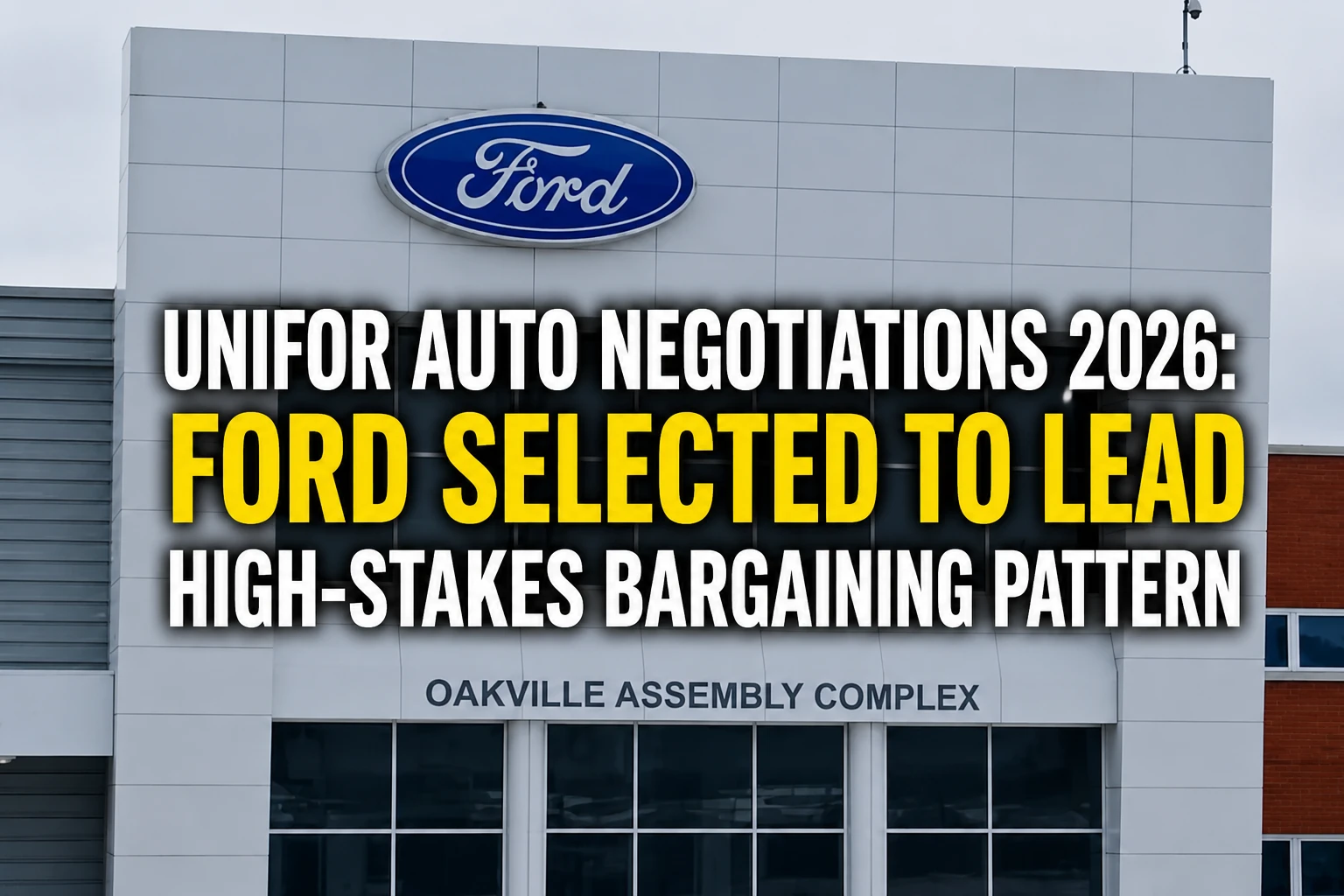
The future of Canada’s automotive sector—and the job security of thousands of Durham Region families—is moving into sharp focus as Unifor officially selects Ford Motor Company to lead the 2026 Detroit Three Auto Negotiations. On Wednesday, May 13, Unifor National President Lana Payne announced that bargaining will commence on June 22. The decision to start with Ford, historically the union’s most productive negotiating partner, aims to establish a “pattern agreement” that will eventually dictate the wages, benefits, and investment commitments for workers at General Motors in Oshawa and Stellantis in Brampton.
Why Ford? The Strategy of the Pattern
In Canadian auto labour history, Unifor (and formerly the CAW) uses “pattern bargaining” to ensure parity across the Big Three. By selecting Ford first, the union hopes to secure a stable framework with a company that currently maintains a strong working relationship with Unifor Local 200 and Local 707. Once a deal is ratified with Ford’s 5,000 members, that contract serves as the non-negotiable template for General Motors and Stellantis. This strategy is critical this year, as the union seeks to navigate a volatile landscape of U.S. trade tariffs, federal EV policy shifts, and the looming renegotiation of the Canada-United States-Mexico Agreement (CUSMA).


The “Oshawa Factor” and Investment Uncertainty
The Unifor Auto Negotiations 2026 come at a precarious time for the Oshawa Assembly Plant. While GM has invested heavily in the facility’s return to truck production, recent shifts—including a move to a two-shift operation in early 2026 that led to roughly 500 layoffs—have created “investment uncertainty.” A key priority for the Oshawa bargaining committee will be securing long-term product mandates that protect the plant from being used as a “swing” facility during economic downturns or trade disputes with the United States.


Key Issues on the Table
The Unifor Auto Negotiations 2026 will center on several “unprecedented challenges” cited by the union:
-
EV Transition: Ensuring that workers at plants like CAMI in Ingersoll and the Oakville Electric Vehicle Complex are not left behind as the industry pivots away from internal combustion engines.
-
Tariff Protection: Navigating the impact of U.S. protectionist rhetoric, which has threatened the cross-border integrated supply chain that Durham’s parts manufacturers rely on.
-
Wage Integrity: Addressing the rising cost of living in southern Ontario, particularly for younger members in high-cost areas like Durham and Halton.
Timeline to the Deadline
Following the June 22 kickoff with Ford, negotiations are expected to intensify throughout the summer. The current collective agreements for most Detroit Three workers are set to expire on December 31, 2026. While the “pattern” is usually set by late summer or early fall, the complexity of the current geopolitical climate suggests these could be some of the most protracted talks in a decade.
For the residents of Oshawa, where the GM plant remains the city’s largest private employer, the Unifor Auto Negotiations 2026 represent a vital heartbeat of the local economy. A successful pattern at Ford could mean years of stability for the region, while a stalemate could signal a rocky road ahead for Ontario’s manufacturing heartland.