








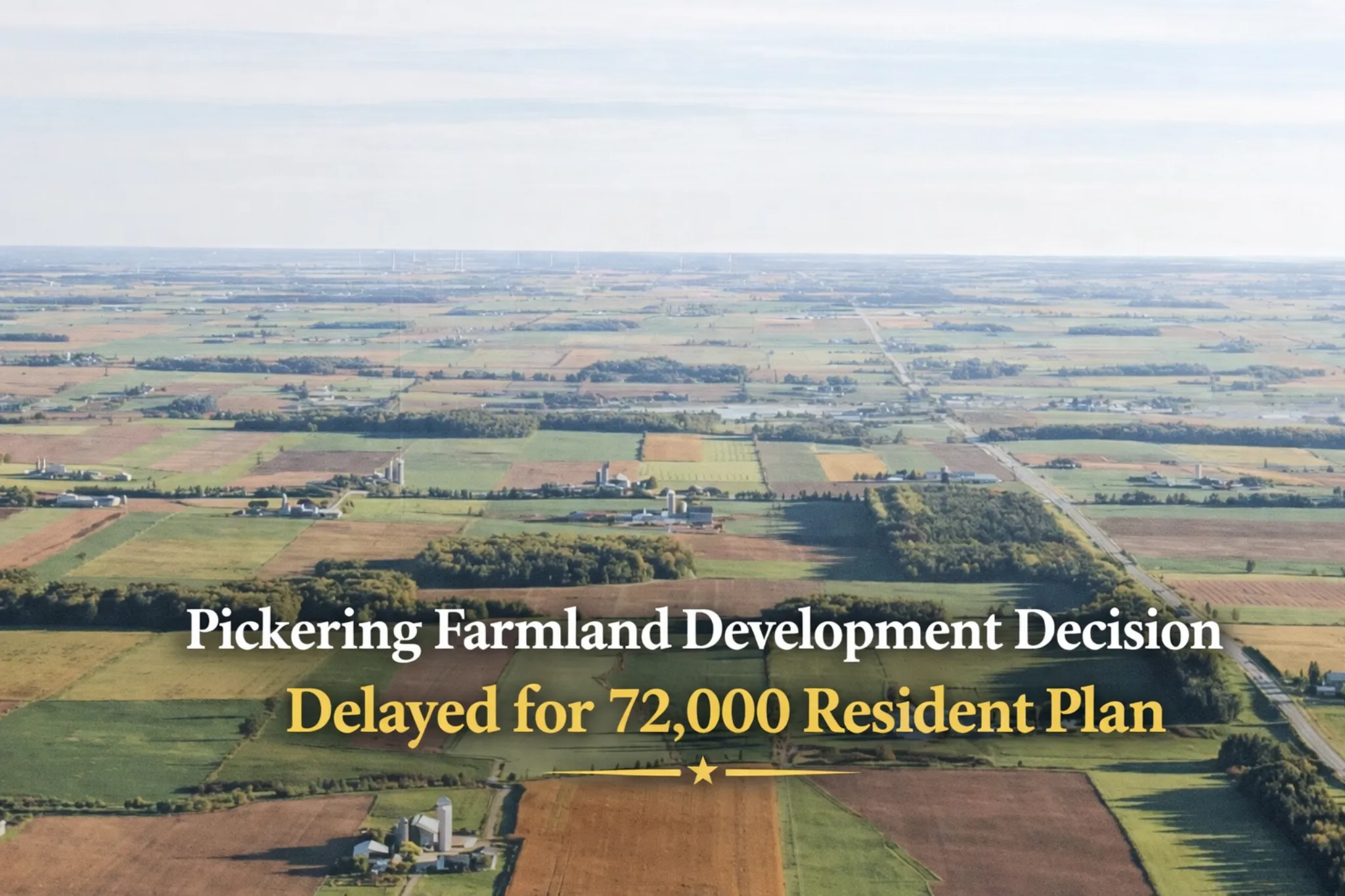
A major development proposal that could reshape the future of Pickering has been temporarily put on hold, as the Pickering farmland development decision delayed 72,000 residents plan moves back to council for further review next month.
The proposal, known as the Northeast Pickering Secondary Plan, aims to open up approximately 16,000 hectares of farmland for long-term development, potentially accommodating up to 72,000 residents over the next 25 years. However, during a recent council meeting, officials agreed to delay a final decision and request additional analysis before proceeding.


The Pickering farmland development decision delayed 72,000 residents plan comes after significant public concern and opposition from environmental advocates, community groups, and agricultural stakeholders. More than a dozen delegates addressed council, raising concerns about the environmental, financial, and social impacts of such a large-scale development.

Critics argue that the proposal could lead to urban sprawl, increased infrastructure costs, and the loss of valuable farmland. Activist Mike Borie described the plan as a “massive, uncalculated financial risk,” warning that expanding into rural areas would require substantial investment in roads, water systems, and emergency services.
He emphasized that low-density developments often fail to cover long-term infrastructure costs, potentially placing a financial burden on current taxpayers. According to Borie, focusing on existing urban areas—such as the still-developing Seaton community—would be a more sustainable and cost-effective approach.
Environmental concerns have also played a key role in the delay. The lands in question include prime agricultural soil and important watershed headwaters, which help manage flooding and support local ecosystems. Experts warn that replacing these natural areas with urban infrastructure could increase the risk of flooding in nearby communities, including parts of Ajax and southern Pickering.
Adding to the complexity, Scugog Island First Nation has expressed concerns over the lack of meaningful consultation. Chief Kelly LaRocca highlighted issues related to environmental studies and cultural heritage, stating that previous communication with the city has been insufficient.
Pickering Councillor Maurice Brenner noted that the delay will allow more time for dialogue with Indigenous leaders and for staff to complete additional studies. A revised report is expected to be presented at the next council meeting scheduled for April 27.
Despite the delay, officials acknowledged that the broader push for housing development in Ontario—driven in part by provincial policies—means that growth in northeast Pickering may be difficult to stop entirely. Brenner described the situation as a “speeding train,” suggesting that while the timeline can be adjusted, the overall direction may be unavoidable.
Still, he emphasized that the project is in its early stages and that it could take decades before any construction begins. Current estimates suggest that full build-out would not occur until around 2051, with multiple studies, approvals, and planning stages required before development proceeds.
The Pickering farmland development decision delayed 72,000 residents plan highlights the ongoing tension between growth and sustainability in Durham Region. As the debate continues, the outcome is expected to play a significant role in shaping local policy—and could become a defining issue in the next municipal election.