








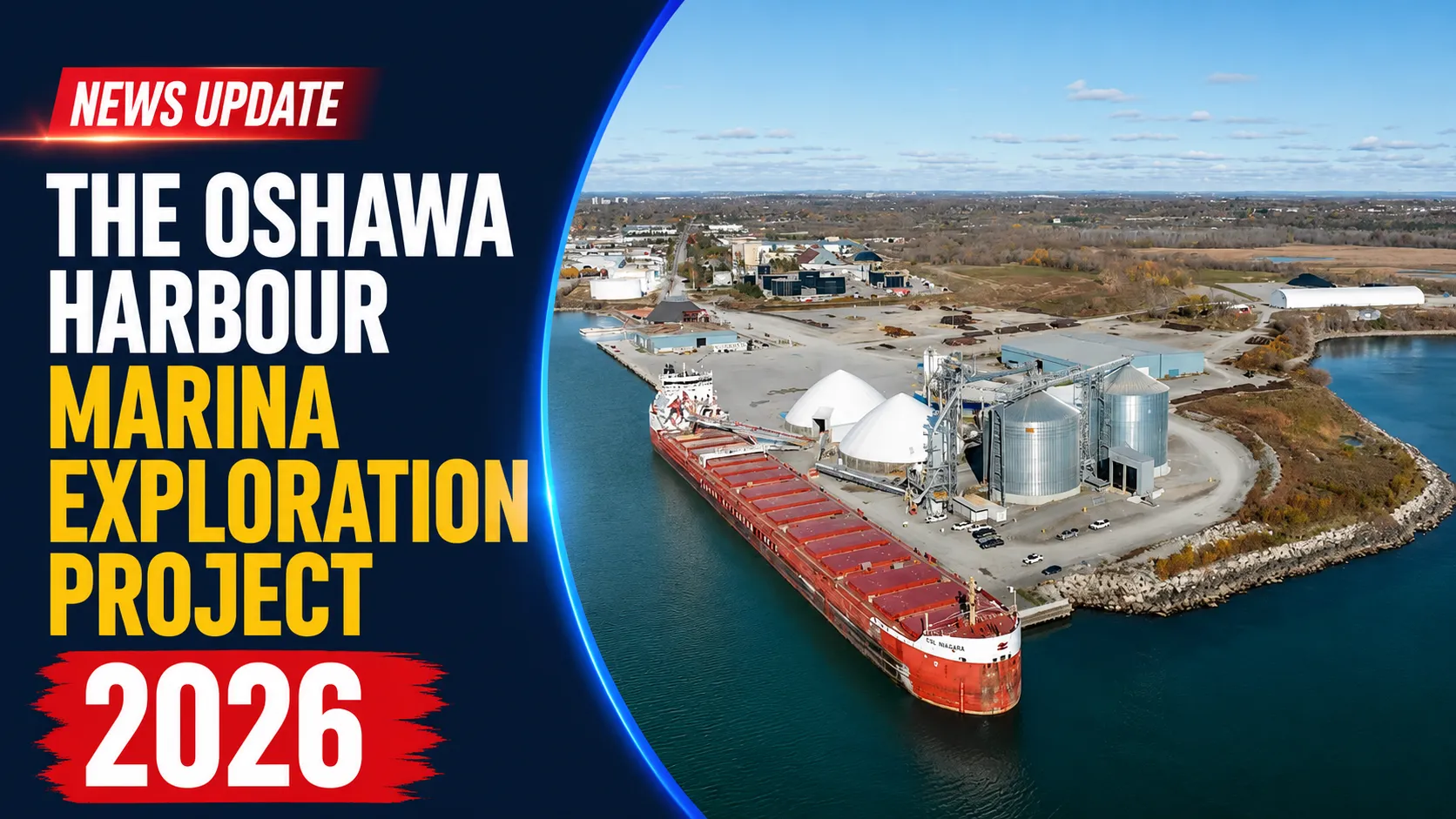
The Hamilton Oshawa Port Authority (HOPA) has stabilized public expectations surrounding the re-introduction of recreational boating infrastructure on the Oshawa waterfront, confirming that formal development plans remain unfinalized. Tracked under the multi-agency municipal file The Oshawa Harbour Marina Exploration Project 2026, federal port directors clarified their official planning stance on Thursday, June 4, 2026. The announcement addresses recent statements indicating that the crown corporation had triggered an active corporate investigation into constructing a new deep-water marina and public boat launch on industrial port lands.
The potential operational return of a municipal marina arrives nearly a quarter-century after the permanent closure of the former Oshawa Yacht Club facility in 2002.


Historical Dispersals and Shifting Inter-Governmental Relations
The current jurisdictional framework governing the waterfront is the direct byproduct of a highly complex, multi-year legal battle between the City of Oshawa and the federal government. The land dispute dates back to 2006—exactly forty years after the municipality originally transferred 61 acres of lakeside real estate to federal control to establish a deep-sea cargo port.


A binding compromise settlement reached in 2010 structurally divided the waterfront, allowing the City of Oshawa to reclaim 29 acres of land along with a 19-acre Crown parcel. This specific land recovery directly enabled the eventual construction of the Ed Broadbent Waterfront Park.
Oshawa Councillor Brian Nicholson noted that modern relations with HOPA have experienced a total turnaround compared to the previous, highly combative Oshawa Harbour Commission administration. However, Nicholson acknowledged that the raw economics of developing a standalone marina are deeply negative for the city or private capital alone—citing exceptionally high initial marine engineering costs paired with a low long-term income ceiling, meaning any eventual build must be integrated into a larger, multi-sector federal project.
Active Industrial Upgrades and Commercial Cargo Metrics
While HOPA Vice President of Corporate Affairs Larissa Fenn confirmed the agency is entirely willing to engage with municipal staff to explore how public boating access could safely coexist with heavy commercial shipping, the port’s primary focus remains locked on cargo capacity expansion.
| Active Port Infrastructure Vector | Capital Investment Scope | Current Operational Lifecycle Status |
| Grain Terminal Modernization | $35+ Million Injection | Completed / Added 20,000 MT of Storage Capacity |
| Farewell-Harbour Corridor Project | Joint Municipal-Federal Funding | Active Construction / Civil Grading Underway |
| Recreational Marina Feasibility | Exploratory Status Only | Open Dialogue Phase / No Design Budgets Assigned |
The port authority recently finalized a massive $35+ million modernization of the facility’s centralized grain elevator hub. The infrastructural overhaul successfully injected 20,000 metric tonnes of additional dry storage capacity into the terminal, effectively streamlining supply chain logistics for Durham Region’s agricultural sector and significantly slicing regional truck transit times.
Concurrently, heavy civil engineering crews are advancing work on the Farewell Street and Harbour Road Reconstruction Project. This capital works program is delivering upgraded stormwater management networks, heavy-vehicle roadway reinforcement, high-capacity electrical grids, and perimeter security barrier enhancements. HOPA emphasizes that ensuring these deep-sea shipping lanes remain uninhibited by personal watercraft traffic will serve as a primary hurdle in any future recreational feasibility modeling.