









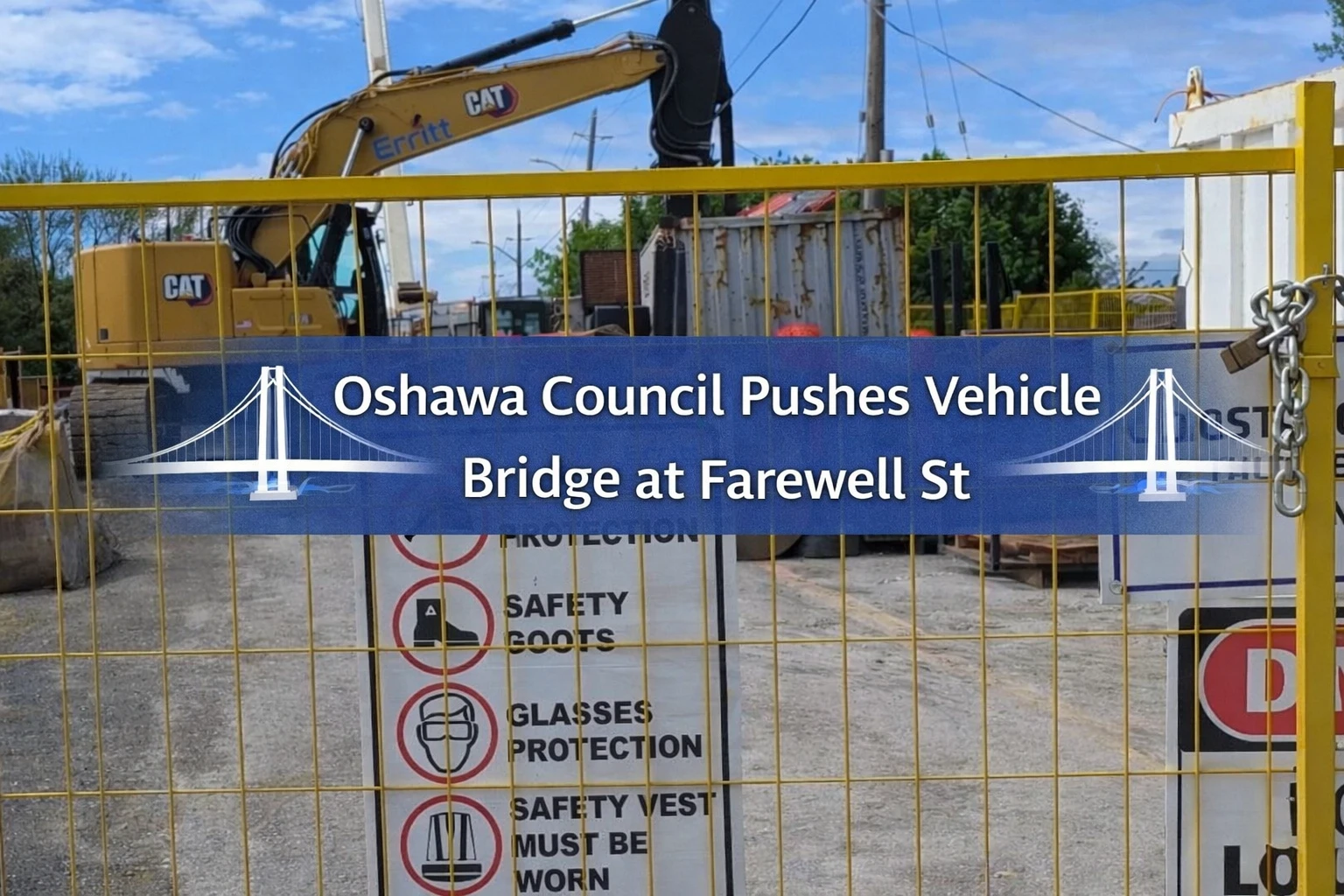
Two Oshawa city councillors are proposing a motion that would urge Metrolinx to replace a pedestrian Vehicle Bridge scheduled for demolition with a new bridge that allows both pedestrian and vehicle traffic in east Oshawa.
The proposal focuses on the Farewell Street Pedestrian Bridge, which crosses the CPKC rail tracks and is expected to be demolished as part of infrastructure upgrades connected to the GO train expansion project.


Ward 5 councillors Brian Nicholson and John Gray plan to introduce a motion asking Metrolinx to reconsider its current plan to rebuild the bridge as pedestrian-only access. Instead, they are advocating for a combined pedestrian and vehicular bridge that would improve traffic access and safety for residents in the surrounding neighbourhood.

Nicholson said several residents in the Farewell Street area have raised concerns about limited vehicle access to the community and suggested that replacing the bridge with a dual-purpose structure could help address those issues.
“A number of residents in the Farewell Street community have suggested that instead of rebuilding the existing pedestrian bridge, it may make more sense to build an accessible pedestrian and vehicular bridge over the CPKC rail tracks,” Nicholson said.
According to Nicholson, a bridge that allows vehicles could provide an additional access point for drivers entering and leaving the neighbourhood. This could help relieve pressure on nearby routes, particularly the Wilson Road and Harmony Road interchanges, which currently serve as the main access points to the area.
The councillor said the new bridge could also help reduce the risk of traffic accidents. He noted that there have been several collisions and near-miss incidents in recent months as drivers attempt to navigate the area’s limited road connections.
“With the growing needs of the community, access from Wilson Road and Harmony Road is already insufficient,” Nicholson said.
The proposal comes as Metrolinx continues a series of infrastructure upgrades along the rail corridor running through Oshawa, which are required to support the future expansion of GO train service in Durham Region.
Several bridges across the rail corridor are being rebuilt or replaced as part of the project, and construction has already caused significant traffic disruptions in parts of the city.
One of the most notable impacts has been the two-year closure of a section of Simcoe Street, which has created challenges for drivers travelling north and south through Oshawa.
The nearby Albert Street bridge, which might have helped ease traffic congestion, has also been closed for several years and is scheduled to be demolished.
With multiple infrastructure projects underway, Nicholson and Gray argue that building a new vehicle-accessible bridge at Farewell Street could help offset some of the transportation challenges residents are facing.
The councillors say the proposed bridge would be beneficial from both an accessibility and public safety perspective.
Demolition of the existing Farewell Street Pedestrian Bridge is expected to begin as early as March 16, and once construction begins, there will be no pedestrian access across the rail corridor at that location for approximately two years.
If approved, the council motion would ask Metrolinx to reconsider the design before rebuilding the bridge, potentially allowing the new structure to accommodate both pedestrians and vehicles.
City officials say the proposal will be discussed during an upcoming council meeting as part of ongoing conversations about transportation and infrastructure improvements in east Oshawa.