









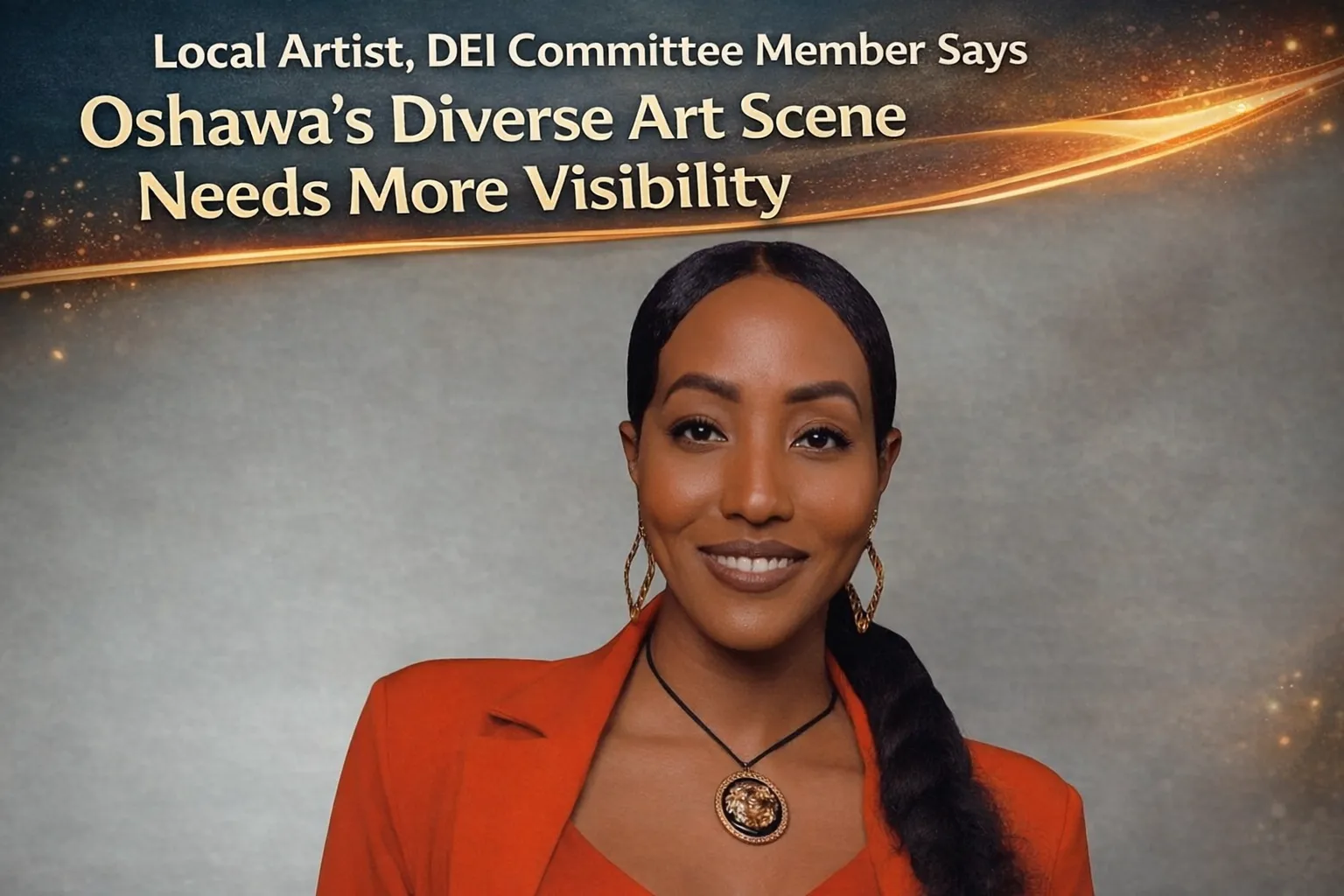
As Oshawa continues to grow more multicultural, local Oshawa artist Elle de Lyon believes there is an urgent need to increase visibility for the city’s diverse art scene. A spoken word music artist and the program director of R.I.S.E. Edutainment, de Lyon has long used her passion for storytelling and the arts to connect with her community, and she feels that now, more than ever, it’s essential to create spaces where different cultures can be explored, understood, and celebrated.
Reflecting on her childhood in Oshawa, de Lyon recalls how, as a young girl, she and her sister often counted the other people of colour they saw when they went out. “It was a low number for a long time,” said de Lyon. Despite growing up in a predominantly white community, de Lyon’s experiences in Scarborough, where she attended school, were more diverse. “At school, I was one of a few Black girls, but there was enough of everyone else that I didn’t feel like I was so other,” she explained.


However, at home, in Oshawa, de Lyon felt a different mindset. “Because of the colour of our skin, we were treated differently,” she said, acknowledging the subtle but impactful racial dynamics she faced growing up in a predominantly white neighborhood.

Fast forward to 2026, and de Lyon is seeing change in Oshawa. “I see that Oshawa is changing, and I’m happy to see the diversity,” she remarked. The city’s growing multiculturalism is creating new opportunities for the arts to flourish, and de Lyon believes more space needs to be created for these communities to showcase their stories and cultures.
In addition to her music career, de Lyon is the program director of R.I.S.E. Edutainment, a program that provides a platform for youth artists of colour. R.I.S.E. has been a key player in organizing cultural events such as the full-day celebration of hip-hop culture during the Convergence Music & Art Festival in September 2025. Despite the efforts of organizations like R.I.S.E., Oshawa and Durham Region are often not considered major hubs for Black or artistic communities, and de Lyon acknowledges that “the perception is not wrong.” She believes that as the city continues to diversify, more people are looking for ways to engage with and learn about various cultures. The challenge now, according to de Lyon, is giving these spaces and cultures the visibility they deserve.
In 2026, de Lyon’s focus is on expanding the impact of her work and advocacy. Having recently joined Oshawa’s Diversity, Equity, and Inclusion (DEI) Committee, de Lyon aims to influence policies that will benefit future generations. “Yes, things are changing — the landscape looks different — but the policies need to match,” she said, emphasizing the importance of integrating inclusivity and diversity into the city’s future.
De Lyon’s continued efforts to advocate for inclusive art spaces reflect her dedication to making Oshawa a place where diversity in the arts is visible and celebrated, ensuring that all communities have the opportunity to express their culture through creative outlets.